
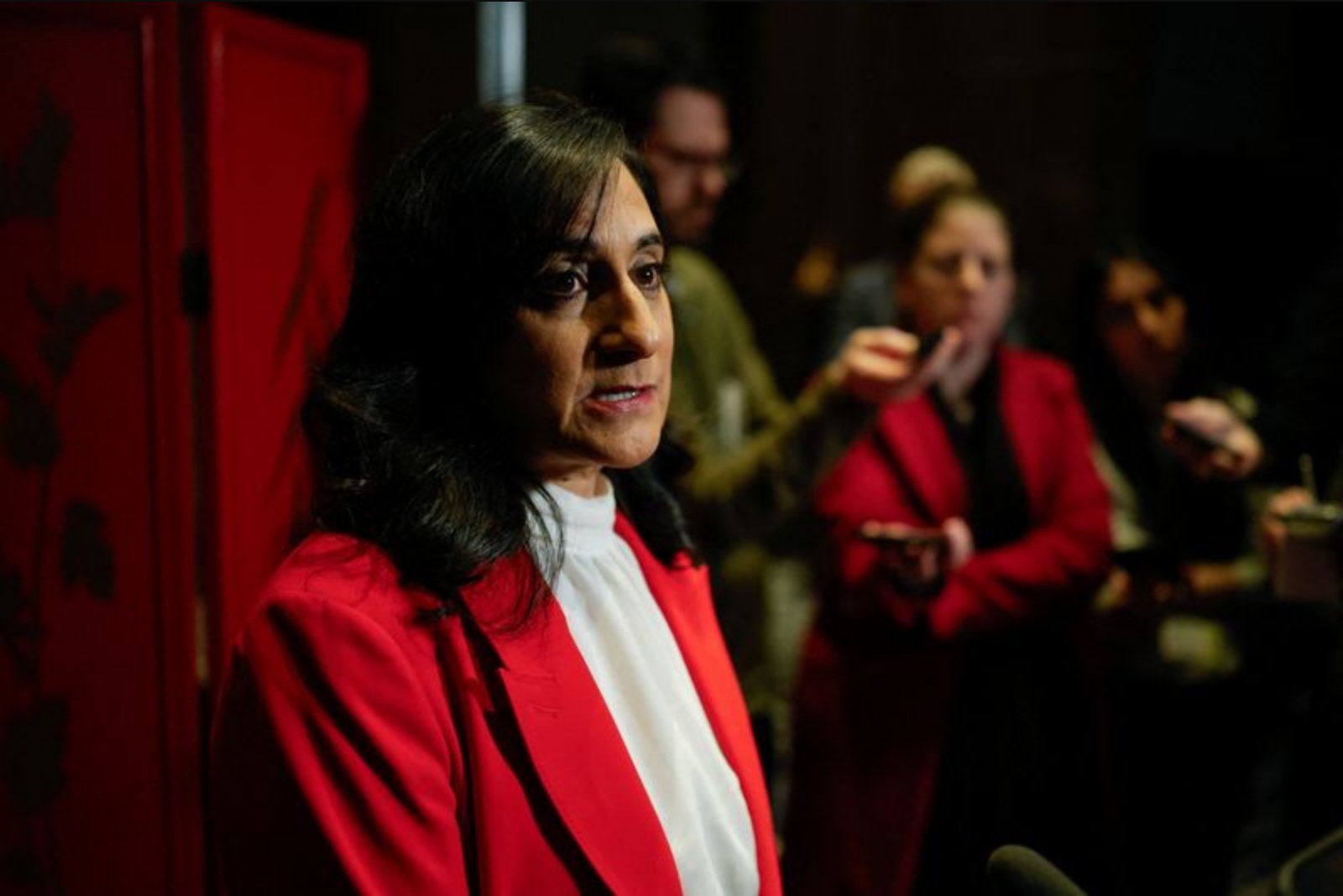
VAUX-DE-CERNAY, France, March 26 - Canada is taking a direct appeal to fellow G7 foreign ministers to participate in a proposed Defence and Resilience Bank (DSRB) meant to provide dedicated financing for smaller defence manufacturers that struggle to secure capital, Foreign Minister Anita Anand said on Thursday at the G7 foreign ministers' meeting.
The gathering of foreign ministers from leading Western democracies runs March 26-27 and takes place against the backdrop of active conflicts in Iran and Ukraine, broader economic uncertainty, and growing unease about an unpredictable U.S. foreign policy. Canada has steered recent work to develop the multilateral financial institution as part of what the country describes as Prime Minister Mark Carney's effort to strengthen co-operation among NATO members and allied partners.
For months Ottawa has convened meetings in Montreal to draft a charter for the DSRB and build the institutional framework. Anand said the amount of capital the bank could mobilize will depend directly on how many countries choose to join, and she is making a case at the G7 for broader participation.
"The capital available is going to depend on the number of countries that participate, and Canada is certainly advocating for more and more countries to come on board, and I will be presenting such an argument here at the G7 foreign ministers' (meeting)," Anand said at the session.
Montreal is a contender to host the bank's headquarters and has been actively lobbying for that role. However, Ottawa's proposal is only one of several initiatives now seeking to direct more private financing into national defence supply chains. Some major European capitals have not embraced the Canadian plan; Germany declined the idea of a new multilateral defence bank in December, Anand noted, while the United Kingdom announced earlier this week it intends to collaborate with the Netherlands and Finland on a separate effort to mobilize private finance for defence procurement.
Anand emphasized that many firms supplying defence equipment are small or medium-sized enterprises that do not currently possess the capital needed to respond to the recent surge in demand for weapons and military kit. That financing gap, she argued, has not been a central feature of other schemes, including the European Union's 150 billion euro SAFE loans programme.
"This bank is going to be a pooling mechanism for capital for these small and medium-sized enterprises in particular," she said, describing the institution's purpose as filling a market shortfall for mid-sized defence suppliers.
Work on the DSRB charter is ongoing. Anand said that once the charter is finalized, participating countries will determine both the scale of initial capital and the mechanisms by which funds would be allocated to qualified borrowers. Talks are expected to continue through the spring, and Anand encouraged additional countries to come forward and join discussions in Montreal, while declining to name which governments had already shown interest.
Officials framed the push for the bank as part of a set of lessons taken from the start of the war in Ukraine in 2022. Anand said the conflict demonstrated a need for both interoperability among allied systems and the capacity for rapid procurement and supply scaling of military equipment. She said the DSRB is intended to address those structural challenges.
Canada has committed substantial bilateral support to Ukraine, providing C$25.5 billion, equivalent in the article to $18.5 billion. Anand added that Ottawa plans further contributions drawn from both public and private sectors, citing, as one example, plans to source electricity generators in anticipation of needs ahead of the coming winter.
On broader G7 priorities, Anand urged continued collective pressure on Russia through sanctions while stressing the importance of ongoing military and economic assistance for Ukraine. When asked about the possibility of Kyiv being compelled into an unfavourable arrangement over its territory, she replied explicitly about sovereignty.
"The geographical boundaries of Ukraine and the decisions relating to its territory are Ukraine's alone to make, full stop," she said.
The discussions in Vaux-de-Cernay will feed into parallel efforts to identify financing vehicles and partnerships that can accelerate procurement and sustain arms production in allied countries. For the Canadian-led DSRB, the path ahead includes finalizing the charter, securing participating countries' commitments, and agreeing the size and distribution method for the bank's capital.
Financial specifics, including the precise commitments from prospective members and the timetable for capital deployment, remain to be set once the charter process advances. Officials say the talks will proceed through the spring, leaving opportunities for other countries to join conversations in Montreal as the DSRB concept is refined.
Currency conversion cited in the discussions noted that $1 equals 0.8657 euros.