
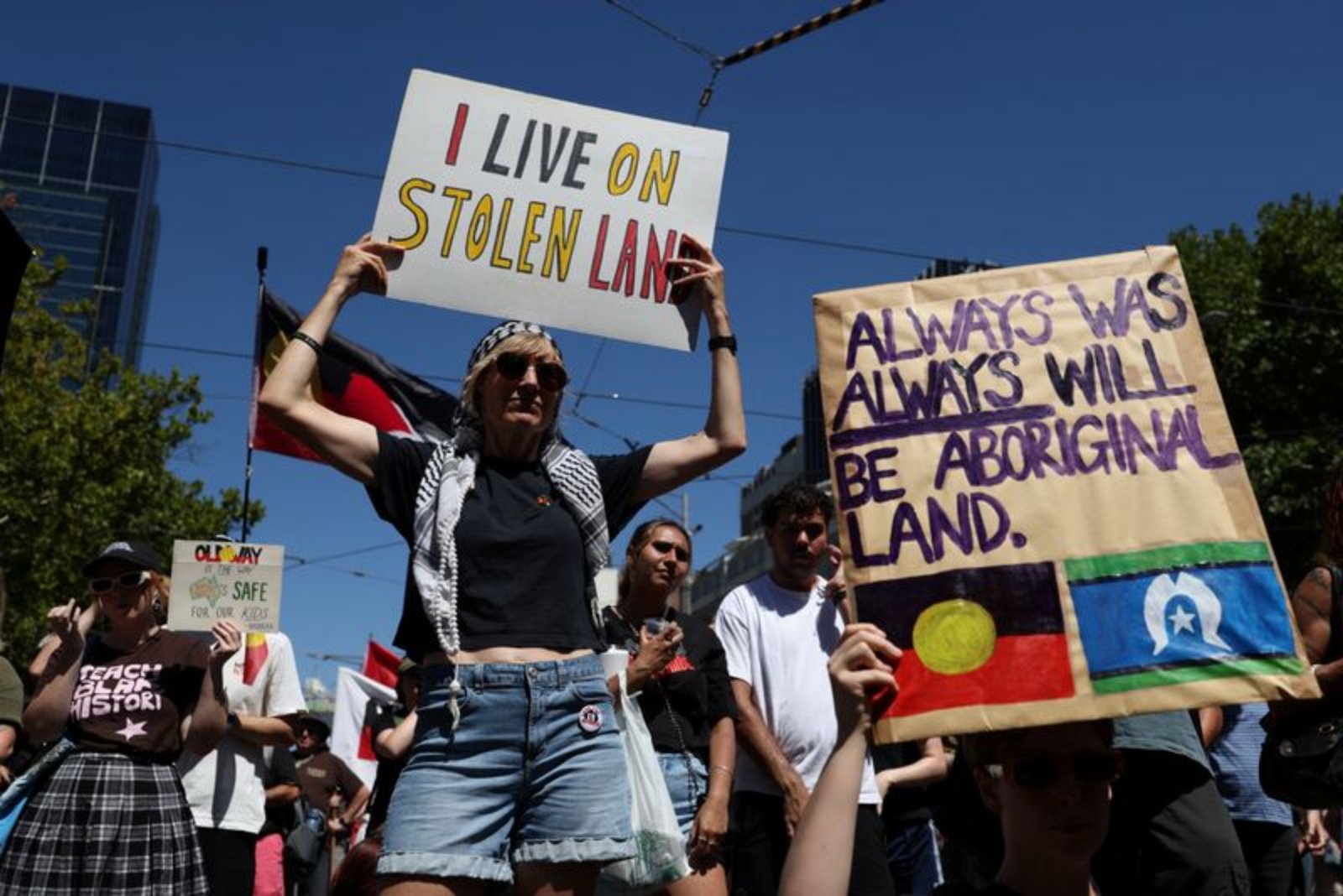
SYDNEY, Jan 26 - Thousands of people marked Australia’s national day by attending "Invasion Day" rallies that called for recognition of Indigenous experiences and a united response to social and political pressures, while separate anti-immigration demonstrations attracted a smaller but visible turnout.
Australia Day commemorates the establishment of the state of New South Wales as a British penal colony with the arrival of convict and colonist ships to Sydney. For many Indigenous Australians - who represent about 4% of the country’s population of roughly 27 million - the date is observed as "Invasion Day," a day that many say signifies the disruption and destruction of Aboriginal cultures by European settlers.
At Hyde Park in central Sydney, the annual "Invasion Day" rally began at 10 a.m. (2300 GMT) with a moment paying tribute to victims of a shooting carried out last week by a gunman in a rural town in New South Wales. Indigenous speakers took the platform to address a range of issues, including calls for land repatriation and concern over the high number of Aboriginal deaths in police custody.
Speakers at the rally also urged unity in the face of a changing political landscape, warning of growing nationalism. They referenced the fractured state of the mainstream right-wing opposition and noted that Pauline Hanson’s populist One Nation party has been rising in the polls, an element they said made cohesion among communities more important.
Demonstrators and speakers referenced wider social tensions in Australia, where immigration has increased in recent years. The country - where one in two people is either born overseas or has a parent born overseas - has experienced record-high immigration, a development that has stirred discontent among some voters amid sharp rises in the cost of living and a persistent housing shortage.
At the Hyde Park rally, Aboriginal woman Gwenda Stanley addressed the crowd and condemned Hanson directly, saying: "We need a coalition of all new Australians because if it wasn’t for immigrants, Australia would have perished. So don’t just stand with us today. Stand with us every day."
Each Jan. 26, protesters across the country gather to denounce the historical mistreatment of Indigenous people and to press the government to abandon the Australia Day celebrations or to change the date. Despite these annual calls for change, a survey published by the Sydney Morning Herald on Sunday found a record number of Australians prefer to keep the holiday on its current date.
Close to Hyde Park, an anti-immigration demonstration organized by a group called March for Australia began at noon. Local media estimated attendance in the hundreds, with participants carrying Australian flags mounted on poles. March for Australia has faced criticism for alleged links to neo-Nazi groups, according to reporting on the event; the organisation was the stated organiser of the demonstration.
Events similar to the Hyde Park rally and the March for Australia protest took place in other cities and towns across the country on the same day.
Earlier in the day, Prime Minister Anthony Albanese, while presiding over an Australia Day citizenship ceremony, called for unity rather than division in his remarks to new citizens and attendees.