
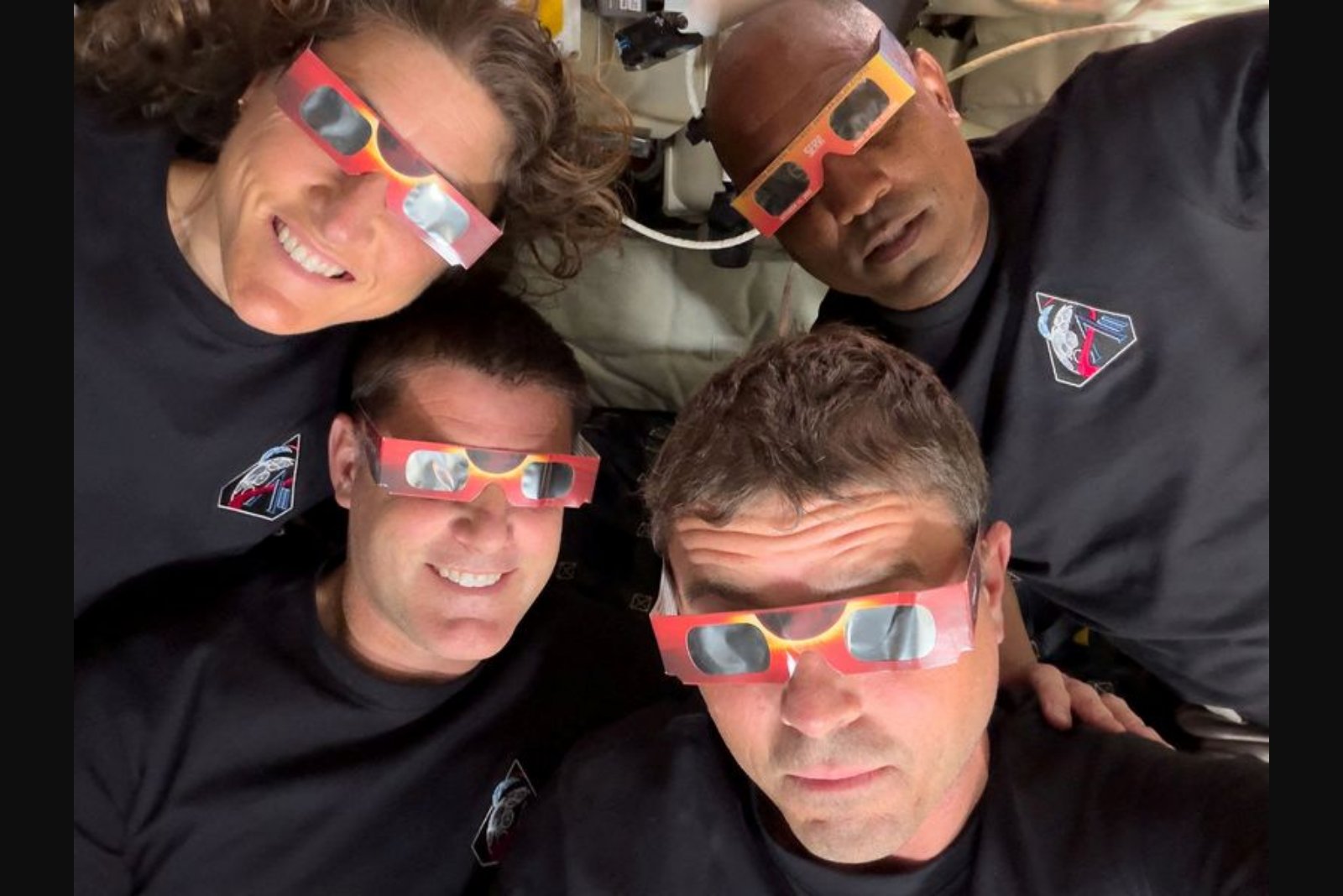
NASA's Artemis II mission will feature an unusual milestone on Wednesday when the four-person crew will address reporters from aboard their Orion spacecraft while returning toward Earth. The astronauts, who left Earth last week from Florida and have been aboard Orion since launch, reached and passed the moon earlier in the mission on a trajectory that took them over the shadowed lunar far side.
During the journey the crew became the farthest-flying humans in recorded history, and mission managers report that the spacecraft is functioning as expected. "Orion systems are operating nominally, remain healthy, and we are just trekking our way home from the moon," Orion deputy program manager Debbie Korth told reporters on Wednesday.
The four-member crew - NASA astronauts Reid Wiseman, Victor Glover and Christina Koch, together with Canadian astronaut Jeremy Hansen - represent the first operational team in a multibillion-dollar sequence of Artemis missions. The program aims to return humans to the lunar surface by 2028, ahead of China, and to establish a sustained U.S. presence on the moon over the next decade, including work toward a moon base that could support future missions to Mars.
Ground teams have been closely following the mission in Houston, where dozens of lunar scientists have gathered in rooms adjacent to NASA's Mission Control Center. Those scientists have been taking notes and discussing a steady stream of both live and recorded audio from the crew in Orion as the vehicle traversed deep space.
The astronauts are scheduled to splash down off the coast of San Diego, California, on Friday at about 8 p.m. ET (0000 GMT Saturday), concluding a mission that will span nearly 10 days. During re-entry, Orion and its crew are expected to reach peak velocities of up to 23,839 mph (38,365 kph) as they descend through Earth's atmosphere.
Earlier in the week, the spacecraft reached a maximum distance from Earth of approximately 252,000 miles, exceeding the long-standing record set by the Apollo 13 crew by roughly 4,000 miles. That milestone occurred amid a six-hour lunar flyby during which the crew conducted observations of the lunar surface from an altitude of about 4,000 miles.
Historically, progress in lunar science has relied heavily on data from lunar-orbiting satellites and telescopic observations from Earth. The Artemis II flyby provided a departure from that model by supplying real-time scientific collections and allowing immediate, two-way exchanges between the crew in deep space and researchers on the ground - communications taking place across the roughly 252,000-mile separation.
Scientists involved with the mission describe Artemis II as an important early move toward addressing fundamental questions about the formation of the solar system. Reflecting that perspective prior to liftoff last week, mission specialist Christina Koch called the moon a "witness plate" to the solar system's formation.
Summary
The Artemis II crew will hold a press conference from their Orion spacecraft as they return to Earth following a record-setting lunar far side flyby. The spacecraft is operating normally, ground teams continue scientific analysis of the crew's observations, and the mission will conclude with a planned splashdown off San Diego late Friday.
Key points
- The Artemis II crew became the farthest-flying humans in history, reaching about 252,000 miles from Earth and surpassing the Apollo 13 record by roughly 4,000 miles - relevant to aerospace and space exploration sectors.
- Orion systems are reported to be operating nominally, and the crew will hold the first press conference from deep space - important for mission operations and communications technology sectors.
- The mission provided a six-hour lunar flyby with direct human observations, offering scientists in Houston immediate data and interaction - relevant to scientific research and instrumentation sectors.
Risks and uncertainties
- Re-entry and splashdown carry the usual technical risks associated with high-speed atmospheric entry - this affects aerospace operations and contractors involved in re-entry systems.
- The mission's longer-term goals, including returning humans to the moon by 2028 and establishing a sustained presence over the next decade, face programmatic and execution uncertainties - this impacts government space programs and related industrial planning.