
Hook + Thesis
Yum! Brands is the kind of consumer name investors reach for when they want a low-friction, scalable exposure to global quick-service restaurants: franchise-heavy, recurring royalties, and local entrepreneurs running the P&L. The fundamentals look solid — positive free cash flow, a $44-45 billion market cap, and a position near the recent 52-week high give the stock tactical upside. That said, elevated valuation multiples, a negative book metric that signals aggressive capital allocation (and accounting quirks), and stiff competition in pizza and global markets make me reluctant to sit through a multi-quarter hold personally.
In short: I like YUM as a trade, not (today) as a core position. Below I lay out a defined long trade plan for a swing window, why the business matters, how valuation stacks up, catalysts to watch, and the risks that could derail the thesis.
What the Company Does and Why the Market Cares
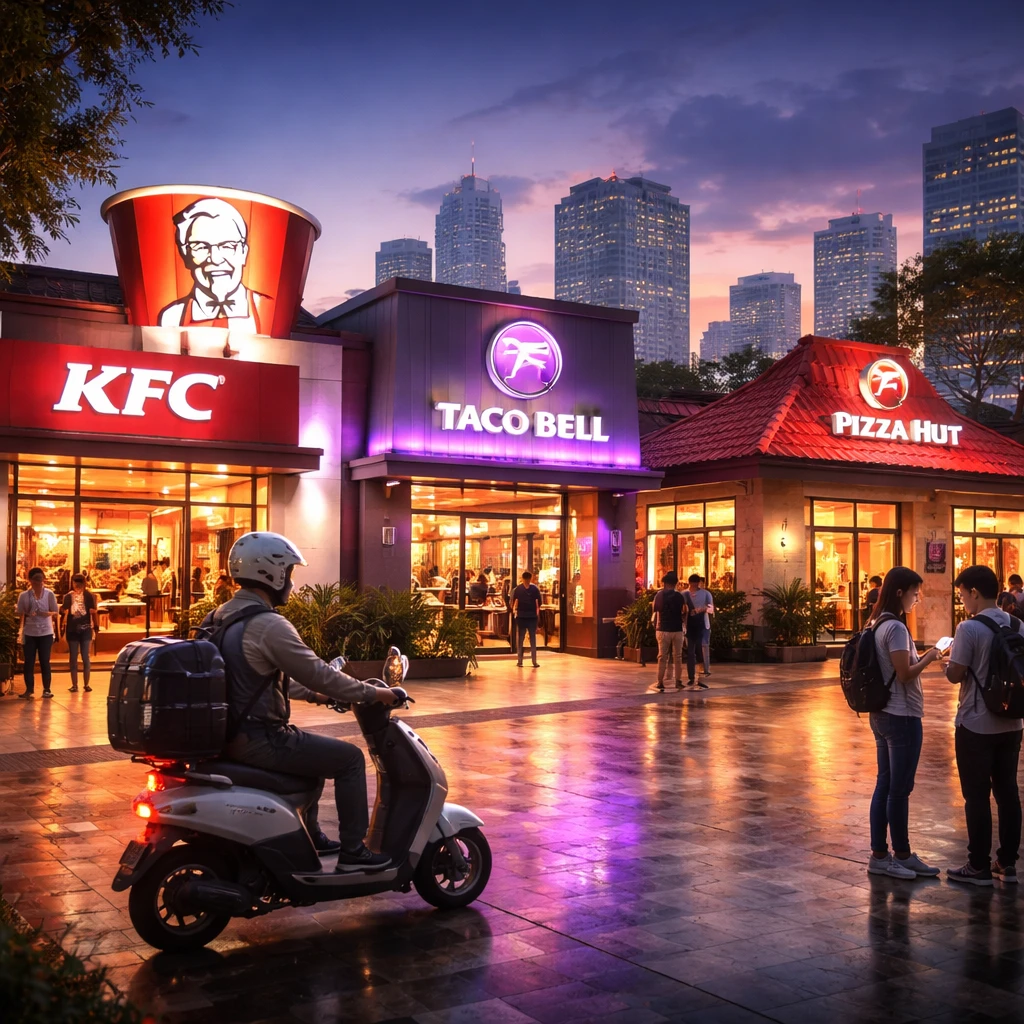
Yum! Brands operates an asset-light, predominantly franchised portfolio across KFC, Taco Bell, Pizza Hut and Habit Burger Grill. That model turns store-level economics into recurring royalties, marketing contributions and supply revenue while minimizing capital intensity for Yum itself. Investors care because this structure tends to produce predictable margins, strong free cash flow and the ability to return capital to shareholders even when unit growth asymptotes.
Key operational advantages:
- Portfolio diversification across chicken, Mexican-inspired fast food and pizza reduces single-concept risk.
- High return on assets — reported return on assets is ~19% — suggests unit economics are attractive where Yum operates well.
- Franchise leverage provides growth optionality without heavy capex; free cash flow in the dataset is $1.639 billion, which supports buybacks/dividends and reinvestment.
Support from the Numbers
Use the market's own price and ratios to frame the opportunity:
| Metric | Value |
|---|---|
| Current price (approx) | $161.64 |
| Market cap | $44.7B |
| Price / Earnings | ~29x |
| EV / EBITDA | ~20.9x |
| Price / Sales | ~5.51x |
| Free cash flow (reported) | $1.639B |
| Dividend yield | ~1.74% |
| 52-week range | $137.33 - $169.39 |
Those numbers tell a clear story: the business is profitable with decent FCF, but the market prices growth and durability at a premium. EV/EBITDA near 21x and P/E close to 29x suggests investors are paying for steady comp growth and margin resilience. That premium is not outlandish for large-cap consumer names, but it leaves less margin for execution misses.
Technical and Sentiment Context
Price action is constructive: the stock trades around its 10-, 20- and 50-day moving averages (SMA10 ~$160.02, SMA20 ~$162.04, SMA50 ~$159.05) and RSI near 52 suggests no overbought extremes. However, short interest is meaningful: in the latest settlement (02/27/2026) short interest was ~6.46 million shares with ~3.45 days to cover. Short-volume prints in March show heavy short participation on certain days, which creates both squeeze potential and volatility risk.
Valuation Framing
Valuation is a balancing act. The company’s market cap (~$44.7B) and enterprise value (~$56.45B) buy exposure to a diversified, franchise-heavy restaurant portfolio with decent returns and recurring cash flow. But metrics like P/S ~5.5 and P/FCF ~27.6x imply the market expects steady growth and margin stability. Another eyebrow-raising data point is price-to-book shown as negative (~-6.18x) and return on equity negative in the dataset; these indicate capital return/repurchase dynamics and accounting factors that complicate simple book-value comparisons. In short, you’re buying durable cash flow more than cheap accounting book value.
Catalysts to Drive the Trade
- Menu and digital innovation at Taco Bell (Fan Style menu rollout in late 11/2025) that lifts frequency and AUVs.
- International recovery and KFC unit expansion - large global footprint means outsized upside if China/international demand reaccelerates.
- Shareholder returns funded by FCF: continued buybacks/dividend support base valuation.
- Competitor weakness or execution missteps at Domino's/Pizza Hut that compresses industry multiples - positive for Yum if Pizza Hut regains share.
Trade Plan (Actionable)
Trade direction: Long.
Time horizon: swing (45 trading days) - I expect any re-rating or short-covering move to play out in the coming 3-9 weeks given current technicals and catalyst timing.
Entry - $162.00
Target - $169.00 (near the recent 52-week high of $169.39)
Stop loss - $156.00
Rationale: entry sits just above today's trade and around the 20-day average, giving room for intraday volatility. The target is logical: reclaiming the 52-week high would capture the near-term upside while respecting the premium valuation. Stop at $156 limits downside to a level below the 50-day SMA (~$158.88) and recent intra-day lows, keeping risk-to-reward approximating 1:1.25 on this setup.
Position sizing: treat this as a trade-sized allocation (not a core buy). If using a 1% account risk per trade, size accordingly so the dollar loss to stop aligns with that risk budget.
Risks and Counterarguments
- Valuation Fragility: Multiples are elevated (P/E ~29x, EV/EBITDA ~20.9x). Any pickup in inflationary pressure or margin pressure could compress the multiple quickly.
- Competitive Pressure in Pizza: Domino's expansion (noted increases in market share and store openings) is a real headwind for Pizza Hut. Domino’s price leadership and heavy U.S. expansion create near-term share risks.
- Geographic Execution Risk: Exposure to China and other international markets adds volatility; Yum China insider selling (02/13/2026) is a reminder management/insider actions can inject short-term volatility.
- Short Interest & Volatility: Meaningful short interest and recent high short-volume prints increase the odds of sharp swings against your position; that can be good for squeezes but bad if sentiment turns negative.
- Accounting/Capital Allocation Quirks: Negative price-to-book and negative ROE in the reported metrics point to aggressive buybacks or other balance sheet dynamics that can make accounting-based valuation comparisons misleading and potentially elevated risk if cash returns are reduced.
Counterargument: A sensible counterargument is that Yum's franchise model and consistent FCF justify the premium multiple. If the company continues to report steady comps and maintain FCF (the dataset shows $1.639B), multiple contraction is less likely. Add in potential for share buybacks and modest dividend, and the stock could grind higher even absent big upside in unit growth.
Conclusion - My Stance and What Would Change My Mind
Yum! Brands is an attractive 'me-me-me' consumer play in a portfolio sense: durable brand portfolio, asset-light model, and steady FCF. For traders, there's a well-defined long swing setup with reasonable upside toward the $169 area and a disciplined stop at $156. For me personally, however, I remain on the sidelines as a long-term holder right now because valuation leaves limited margin for error and competition—especially Domino's in pizza—poses a material execution risk.
What would change my mind and convert this from a trade to a core buy:
- Consistent beat-and-raise quarterly results with clear acceleration in global comps and unit economics, especially in Pizza Hut recovery;
- Evidence management is using FCF to sustainably buy back shares at accretive levels without destabilizing the balance sheet;
- Compression in EV/EBITDA toward historical trading ranges below 18x while revenue/EBITDA growth remains intact.
Absent one or more of those developments, I prefer to trade the setup as outlined rather than increase a strategic allocation.
Key Watch Items After Entry
- Quarterly comp guidance and any country-specific commentary on China recovery or U.S. traffic trends.
- Short-interest updates and heavy short-volume days that could trigger volatility.
- Share repurchase cadence and dividend announcements that could change the net return profile.
- Competitive moves from Domino’s and McDonald’s that could alter market share dynamics.
Trade it with a plan and tight risk control. This isn’t a deeply discounted buy; it’s a premium for predictability. If you want exposure to the sector on a long-term basis, wait for either a valuation reset or clear evidence of durable acceleration. For a disciplined swing trade, the entry/stop/target above gives a defined edge.
Instrument: Yum! Brands — Instrument Details