
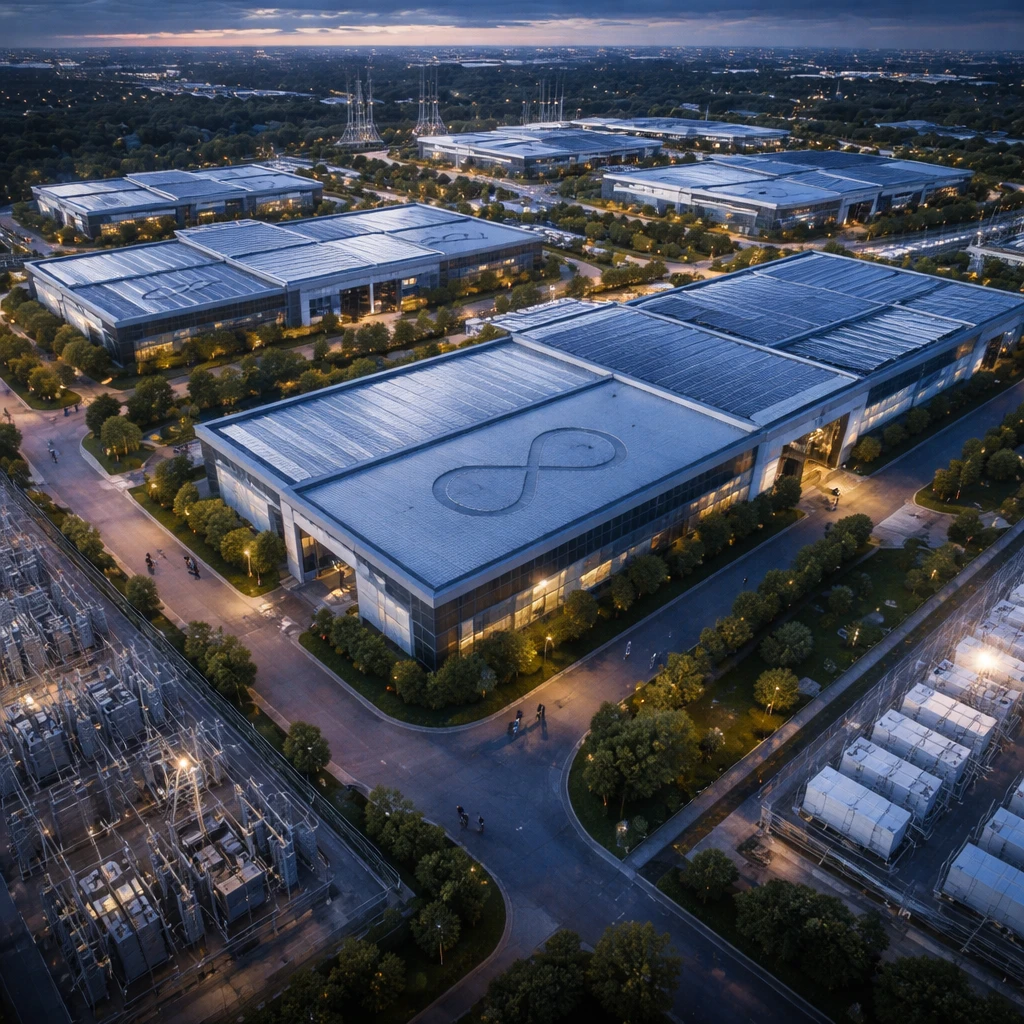
Hook and thesis
Meta is not the flashiest name in the AI conversation, but in my view it is the best-positioned hyperscaler for 2026. The company combines a massive ad-anchored cash flow engine with rapid, focused investment in custom infrastructure, long-term power deals, and a balance sheet that can underwrite aggressive scale without diluting returns. The market's recent pullback has opened a clean entry point.
My thesis is simple: Meta can build and operate AI infrastructure at scale more cheaply and with fewer execution risks than most cloud peers because it controls both demand (its own models and services across Facebook, Instagram, WhatsApp, Messenger) and an expanding set of supply-side advantages - including power and data-center scale. That combination should drive at least a modest re-rating and continued earnings/cash-flow growth into 2026. I present a concrete trade: entry $620.00, stop $560.00, target $760.00 for a long-term (180 trading days) position.
What Meta does and why the market should care
Meta Platforms operates two main businesses: Family of Apps (Facebook, Instagram, Messenger, WhatsApp) and Reality Labs. The Family of Apps remains the primary cash generator, funding large capex and R&D investments into AI, datacenter footprint, and new consumer hardware. Reality Labs is the optionality bucket for XR hardware/software and long-term platform plays.
Why investors care: hyperscale economics are winner-take-most once a firm achieves meaningful scale on both the demand and supply sides of AI workloads. Meta uniquely combines:
- Large, predictable revenue and free cash flow (advertising + services) to fund infrastructure.
- Rapid internal demand for model training and inference across its apps, which reduces the risk of underutilized capacity.
- Strategic energy and power partnerships that lower long-term operating costs for data centers.
Numbers that support the bull case
Start with the balance sheet and cash generation: market capitalization stands around $1.55 trillion and the company produced $46.1 billion of free cash flow in the period reported. That implies a free cash flow yield roughly in the 3.0% range on the current market cap, which is not trivial for a business still investing heavily in growth-capex but already delivering strong returns on equity (ROE ~27.8%) and return on assets (ROA ~16.5%).
Profitability multiples are reasonable relative to the cash generation profile: trailing P/E sits around 26x and EV/EBITDA is ~15.5x. Meta's current price of $627.60 is about 21% below its 52-week high of $796.25, a landscape that creates room for multiple expansion if growth and AI monetization accelerate.
Operationally, the company shows conservative leverage (debt-to-equity ~0.27) and healthy liquidity (current ratio ~2.6, quick ratio ~2.6, cash ratio ~0.86). Those figures matter because hyperscale builds are capital-intensive and Meta's financing flexibility reduces execution risk.
Technical and sentiment backdrop
Short-term technicals are constructive for a buy-the-dip approach. The stock pulled back sharply from recent highs and is trading below its short- and medium-term moving averages (10/20/50-day SMAs). RSI sits around 36, signaling near-oversold conditions but not extreme panic. Trading volume today (~18.96M) is above the two-week average (~12.2M), indicating the move lower is accompanied by meaningful liquidity.
Valuation framing
On an absolute basis Meta's valuation reflects growth expectations embedded in its multiple: P/S ~7.7 and EV/sales ~7.84 suggest the market is pricing a combination of continued ad-growth and successful monetization of AI-driven services. Relative to its free cash flow, a ~3% yield implies investors expect reinvestment to accelerate future cash returns or for margins to expand as Reality Labs scales or AI products monetize.
Put another way: Meta is not cheap in a vacuum, but it trades visibly below its 2025 highs while maintaining robust profitability metrics (ROE ~27.8%). If the company converts a fraction of its AI R&D and infrastructure into higher-margin services or ad-matching efficiency, the multiple could re-rate meaningfully.
Catalysts (what can drive the re-rate)
- Scale wins on AI infrastructure: continued deployment of custom accelerators or partnerships that lower cost-per-inference and increase throughput for internal workloads and potential external services.
- Power and data center partnerships: confirmation of long-term, low-cost energy deals (e.g., large-scale campuses and nuclear/renewable partnerships) that reduce operating expenses on a $/kWh basis.
- Improved monetization of AI features across Instagram and Reels leading to stabilizing ad growth and higher ARPU.
- Upside from Reality Labs licensing or a meaningful step-up in hardware margins, which would expand consolidated margins beyond the current level.
- Macro: a stable ad market and easing fears around consumer ad softness would lift consensus revenue estimates and multiples.
Trade plan and horizon
Actionable trade: Open a long position in Meta at an entry price of $620.00. Place a protective stop loss at $560.00. Primary target for full/near-full exit is $760.00.
Horizon: long term (180 trading days). Rationale: building and monetizing AI infrastructure is a mid-to-long-cycle process that requires time for capital deployment, efficiency gains, and product integration into advertising and services. A 180 trading day horizon gives the company time to report at least one material quarter of improved trend or for clear infrastructure-related cost benefits to appear in results.
Execution notes:
- Consider scaling in: initial allocation at $620, add on sustained weakness below $600 with volume support.
- Partial profit-taking can be set at $720 (midpoint) to lock profits if the market re-rates quickly.
- If the position approaches the stop, re-evaluate on volume and fundamental updates; a decisive breakdown under $560 on massive volume would invalidate the core thesis.
Key metrics at a glance
| Metric | Value |
|---|---|
| Current price | $627.60 |
| Market cap | $1.55T |
| Free cash flow | $46.1B |
| P/E (trailing) | ~26x |
| EV/EBITDA | ~15.5x |
| ROE | ~27.8% |
Risks and counterarguments
Below are primary risks that could derail the trade. I list them with practical triggers to watch.
- Ad market weakness - If macro or advertiser budgets deteriorate, revenue growth and FCF can compress quickly. Trigger: two consecutive quarters of negative YoY ad revenue growth or material cuts to guidance.
- Execution risk on AI infrastructure - Building custom hardware and data centers at scale is costly and can suffer delays or underperformance versus competitors. Trigger: public disclosures of cost overruns, lower utilization rates, or delayed accelerator rollouts.
- Reality Labs disappointment - High ongoing R&D and capex for XR with limited near-term revenue can compress margins if adoption stalls. Trigger: rising losses in the segment without a credible path to meaningful revenue.
- Regulatory or privacy shocks - New regulations or fines that restrict ad targeting or international operating models could hit revenue. Trigger: major regulatory actions that materially reduce ad targeting precision or access to markets.
- Valuation risk - Although the stock is off highs, multiples are still elevated; if the market de-rates growth tech indiscriminately, META could fall sharply. Trigger: market-wide multiple compression driven by rising rates or recession fears.
Counterargument: Investors will point to Microsoft/Azure and AWS as the safer hyperscaler plays because they sell cloud to a broader enterprise base and already monetize third-party customers. Those firms also have entrenched enterprise relationships and diversified cloud revenues.
Why I'm not persuaded that the counterargument is fatal: Meta's core advantage is internal demand and a growing set of external cost advantages (power, custom silicon). That means Meta can achieve lower cost-per-inference for its massive internal workloads and selectively offer differentiated services where it has a margin edge. Meta is not a full-service public cloud vendor, but it does not need to be to capture the value of hyperscale AI - it only needs to be the least-cost, highest-utilization operator for the workloads that matter to its business and potential partners.
What would change my mind
I would reduce or flip my view if any of the following occur:
- Two straight quarters of material ad revenue declines or downward revisions to guidance that imply structural demand loss.
- Evidence that Meta's infrastructure investments are chronically underutilized (low utilization rates, large write-downs, or significant capex-to-revenue deterioration).
- Severe regulatory outcomes that materially impair ad targeting or force the company to spin off major assets.
Conclusion
Meta is my preferred hyperscaler trade for 2026 because it combines strong cash flow, industry-leading returns on capital, and an operational approach to AI scale that includes energy and infrastructure advantages. The pullback to ~$627 creates an attractive asymmetric opportunity: the downside is protected by a strong balance sheet and diversified cash flows, while the upside includes both re-rating and structural improvements from AI monetization. Entry at $620 with a $560 stop and a $760 target over 180 trading days gives a clear risk-reward framework aligned with the company’s capital deployment timeline and the cadence of quarterly reporting.
If Meta shows continued execution on infrastructure cost curves and early evidence of higher-margin AI products, that will validate this trade. Conversely, persistent ad weakness or execution missteps would force me to exit or materially cut exposure.