
Hook & thesis
Western Midstream (WES) is offering a near 9% yield today on a unit price of $41.60, with annualized distributions of $3.64 per unit and free cash flow that appears to cover the payout. That combination makes WES one of the most attractive income plays inside midstream right now: you get a high nominal yield plus a material floor provided by cash generation. For income-focused accounts that can tolerate sector cyclicality, this looks like an asymmetric trade where downside is limited by attractive cash flow and upside comes from either multiple expansion or modest volume/revenue growth.
My trade idea: initiate a long position at $41.60, place a protective stop at $36.00, and target $48.00 within a long-term horizon of 180 trading days. This is a yield-first position with a secondary capital gain objective if distribution coverage stays intact and market sentiment toward midstream normalizes.
What Western Midstream does and why it matters
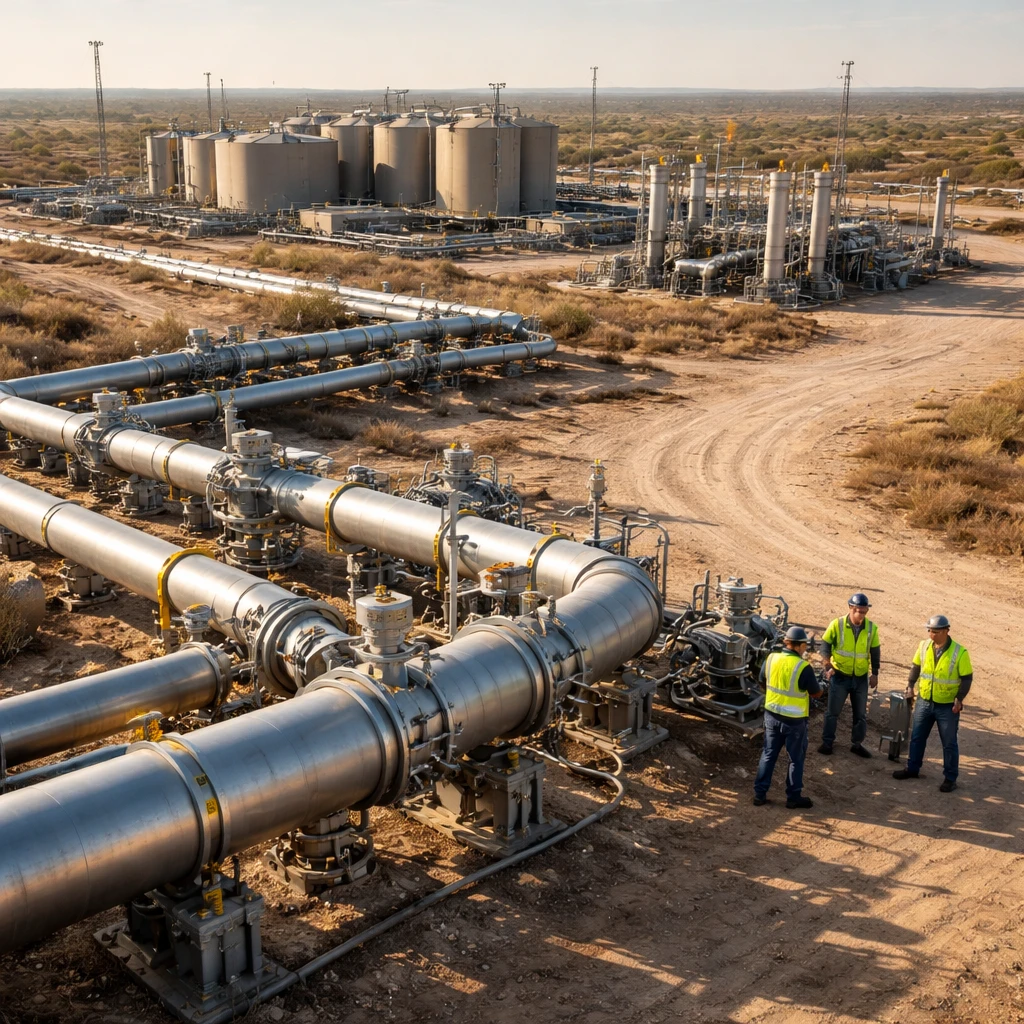
Western Midstream Partners, LP owns and operates midstream energy infrastructure - gathering, processing, compressing, treating and transporting natural gas, condensate, natural gas liquids and crude oil. The business is asset-heavy and fee-oriented: stable volumes from shale producers and customer contracts translate into predictable cash flow when commodity prices are not extreme.
The market should care because WES combines a very high current yield with a free cash flow profile that suggests the distributions are not purely financed by leverage or one-off gains. The partnership has been expanding into areas like produced water disposal and positioning to capture incremental demand tied to energy infrastructure buildouts (including incremental power demand for data centers referenced in sector commentary). Those initiatives can provide modest organic growth without dramatically increasing risk to the distribution.
Numbers that matter
| Metric | Value |
|---|---|
| Price | $41.60 |
| Market cap | $16.38B |
| Enterprise value (EV) | $24.20B |
| Free cash flow (FY) | $1.494B |
| Annualized distribution | $3.64 per unit ($0.91 quarterly) |
| Dividend yield (current) | ~8.8% |
| P/E | ~14 |
| EV / EBITDA | ~10.8x |
| Debt / Equity | ~2.15x |
| 52-week range | $33.60 - $44.74 |
Two quick arithmetic points that support the 'yield is real' claim: free cash flow of roughly $1.494B divided by the 393.7M shares outstanding implies free cash flow per share near $3.80. With an annualized distribution of $3.64, coverage on a simple FCF-per-share basis is just above 1.0x. Put another way, FCF yield versus market cap is in the neighborhood of 9%, which roughly aligns with the distribution yield - not a screaming mismatch that would suggest an unbacked payout.
Valuation framing
At a market capitalization of roughly $16.4B and EV around $24.2B, WES is trading at an EV/EBITDA of about 10.8x and a P/E near 14x. In midstream terms, those are reasonable — not a steep premium, but not a distressed multiple either. The story here is yield plus coverage rather than a deep value multiple waiting to unwind. If the sector rerates even modestly (e.g., 12x EV/EBITDA instead of 10.8x), that alone would support a meaningful increase in unit price. The technicals show price trading near short- and medium-term moving averages, so the market isn't currently pricing in a large near-term deterioration in fundamentals.
Catalysts (what will push the price higher)
- Distribution stability: Management has maintained quarterly cash distribution at $0.91 and the reported annualized $3.64 gives investors a visible yield anchor. Continued distribution maintenance or modest raises would re-rate the multiple.
- Improving coverage from produced water and fee-based projects: incremental fee-based cash flow from produced water disposal and other growth projects would improve FCF and reduce perceived payout risk.
- Sector sentiment normalization: midstream names often move together. A rotation back into high-yield energy infrastructure would disproportionately help WES because of its elevated yield.
- Buybacks or simplification: any move by management to repurchase units or simplify structure would be viewed positively by yield-seeking holders and could tighten the unit count / lift per-unit FCF.
Trade plan (actionable)
Trade direction: Long WES.
- Entry price: $41.60 (current price).
- Stop loss: $36.00 — a level inside the lower part of the trading band and well above the 52-week low of $33.60. This stop limits downside if distribution coverage weakens or if a broader midstream selloff resumes.
- Target price: $48.00 — a target reached either via multiple expansion toward peer-average EV/EBITDA or modest positive operating developments. This is roughly a 15% upside from the entry and aligns with a re-rating scenario plus baseline cash flow growth.
- Horizon: long term (180 trading days). Rationale: distributions and ROTE improvements take multiple quarters to show up in the unit price. Give management time to translate produced-water wins and fee-growth into visible cash flow improvement; 180 trading days lets the market reassess coverage and yield risk.
Risks and counterarguments
- Commodity and volume risk: A sharp decline in drilling activity or natural gas / NGL volumes would reduce throughput and squeeze revenues, pressuring coverage. Midstream cash flows are more stable than commodity producers, but they are not immune to sustained declines in basin activity.
- High leverage: Debt/equity around 2.15x and an EV near $24.2B mean interest costs and refinancing risk matter. If rates rise materially or credit spreads widen, the cost of capital could increase and compress distributable cash flow per unit.
- Distribution cut sensitivity: If free cash flow per share falls below the $3.64 distribution for several quarters, management may have to reduce the payout. The flat quarterly distribution is encouraging today, but it is not guaranteed.
- Regulatory / tax and MLP structure risks: Policy changes or unfavorable tax/regulatory developments impacting MLPs and midstream businesses could reduce investor appetite and force valuation resets.
- Macro & interest-rate environment: High-yield assets are sensitive to changes in the risk-free rate. A sustained move higher in rates could push investors away from high-yield equities toward fixed income.
Counterargument: The high yield could be a value trap. If the business requires higher-than-expected maintenance capex, or commodity/volume weakness persists, FCF could erode and force a distribution cut — turning the attractive yield into a principal loss. That scenario is credible and explains why many income investors demand a yield premium for midstream names.
Why I still like the trade despite the counterargument
Coverage on current numbers is tight but positive: free cash flow roughly covers the annualized payout. Management has kept the distribution steady and the partnership is investing in fee-like businesses (produced water, power for data centers) that should improve resiliency. The market is pricing WES at a reasonable multiple; a modest improvement in coverage or a shift in sentiment can produce double-digit price appreciation while preserving the income stream.
What would change my mind
- If quarterly free cash flow falls materially and coverage drops to well below 1.0x for multiple quarters, I would exit the position because payout risk would be real.
- New, large-scale capital commitments that are equity-funded or that substantially increase leverage without clear return paths would make me reduce exposure.
- Conversely, a distribution hike, a repurchase program, or clear, consistent growth in produced-water revenue would make me add to the position and raise the target.
Conclusion
WES is a pragmatic trade for investors seeking high income combined with reasonable downside protection through cash flow. The numbers today point to a covered distribution, which supports a buy at $41.60 for a long-term trade over 180 trading days, a stop at $36.00 and a target of $48.00. This is not a no-risk play: midstream cycles, leverage and rate sensitivity matter. But for investors who need yield and can tolerate sector volatility, WES provides an attractive yield backed by real cash generation.