
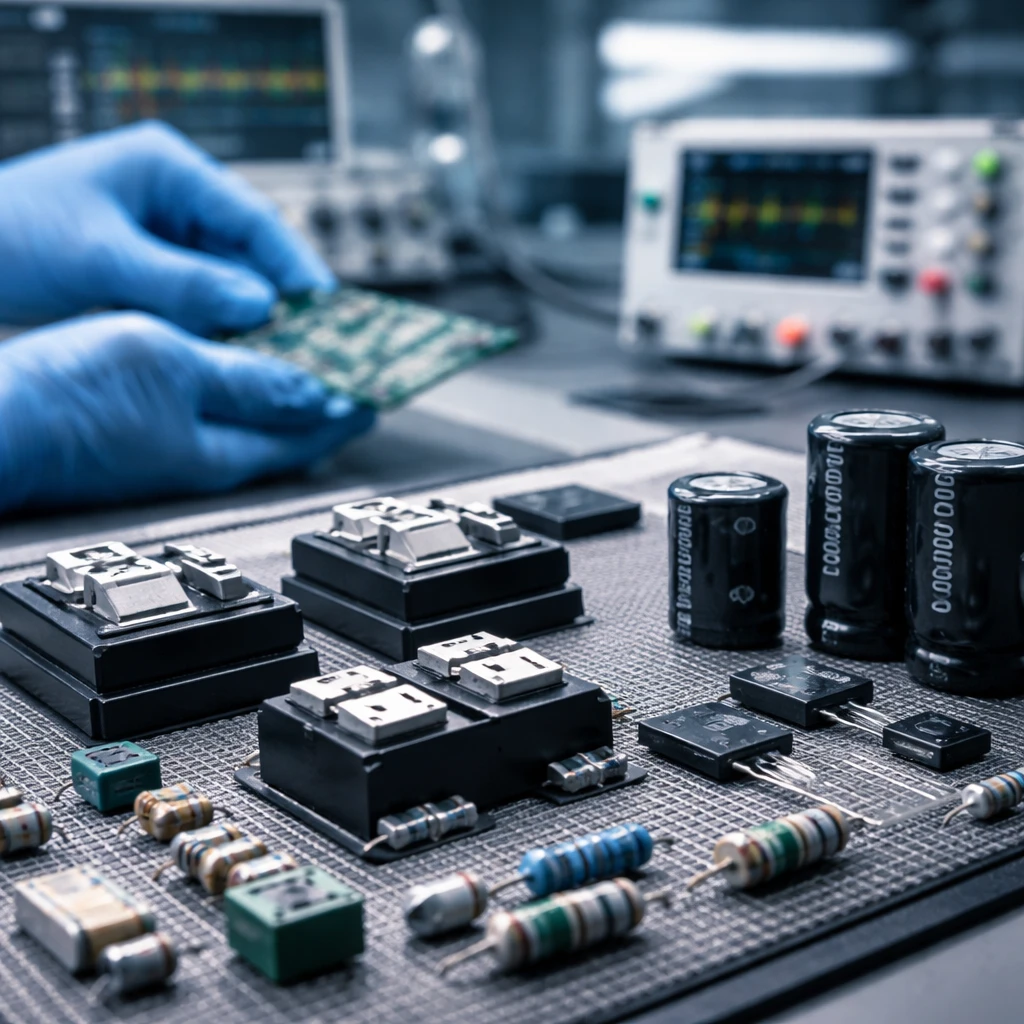
Vishay Intertechnology is not the kind of stock that trends on social media. It is the kind that quietly shows up in the bill of materials for the unsexy but essential parts of electrification: rectifiers, MOSFETs, capacitors, resistors, inductors, sensors. When the cycle turns, those “boring” components can become surprisingly good leverage.
Right now, VSH is giving a pretty clean setup: a sharp pullback to $18.45 after recently printing a 52-week high of $19.81, with the broader trend still pointed up (the stock is above its 10-, 20-, and 50-day moving averages). Add a defined catalyst on 02/04/2026 (Q4 and full-year 2025 results), and you have a tradeable window where sentiment can shift quickly.
Thesis: VSH is a pick-and-shovel cyclical exposure. You are not betting on one end market winning. You are betting that power conversion, industrial electronics, and electrification keep demanding the kind of discrete semiconductors and passives Vishay sells. With the stock off the highs but technically intact, this looks like a buyable dip into a known event.
My stance for this trade idea: tactically bullish, with risk defined below the near-term trend and upside aimed at a retest of the highs.
What Vishay does (and why the market should care)
Vishay manufactures and distributes a broad lineup of discrete semiconductors and passive components across multiple segments: MOSFETs, Diodes, Optoelectronic Components, plus Resistors, Inductors, and Capacitors. This is the kind of portfolio that matters when electronics content rises across industrial systems and vehicles, because power management and protection needs do not disappear when end-market demand shifts. They just get redesigned, re-qualified, and shipped in different mixes.
The market tends to reward “platform” component suppliers when customers are redesigning for efficiency and higher voltage operation. Vishay has been visibly active on the product cadence recently. For example, it introduced 100 V Gen 2 TMBS rectifier modules with forward voltage drop down to 0.83 V in an SOT-227 package, aimed at industrial applications like welding, industrial SMPS, 48 V battery-powered vehicles, and telecom equipment. It also extended its 193 PUR-SI snap-in power aluminum capacitors with 550 V and 600 V ratings, calling out up to 30% higher ripple current than standard solutions, targeting EV/HEV systems, industrial drives, solar inverters, and medical equipment.
Those details matter because they map to a simple driver: customers keep demanding higher efficiency, higher power density, and fewer components per design. If Vishay can win sockets because it offers better electrical performance or reduces BOM complexity, it can participate in the next demand leg even if the overall macro tape stays choppy.
Where the numbers sit today
At the current price around $18.45, Vishay’s market cap is about $2.50B. The stock is not priced like a high-growth compounder, and it does not need to be for this trade to work. The valuation reads more like a cyclical component supplier that investors don’t fully trust yet:
| Metric | Value |
|---|---|
| Market cap | $2.50B |
| Price | $18.45 |
| 52-week range | $10.35 - $19.81 |
| Price-to-sales | 0.84x |
| EV/Sales | 1.0x |
| EV/EBITDA | 10.86x |
| Price-to-book | ~1.20x |
| Dividend yield | ~2.27% |
| Debt/Equity | 0.44 |
| Current ratio | 2.67 |
| Quick ratio | 1.60 |
Two important flags: the company is currently showing negative EPS (-$0.56) and negative free cash flow (-$220.8M). That is exactly why I’m framing this as a trade rather than a forever-hold pitch. Cyclicals can rip when the market sniffs a turn, but they can also punish you if the fundamentals don’t confirm.
Balance-sheet liquidity looks reasonable on the surface (current ratio 2.67, quick ratio 1.60), and leverage is not extreme (debt-to-equity 0.44). That combination is typically what you want when you’re taking a cyclical swing: a company that can fund itself through softer demand and still show up with product investment when customers re-accelerate.
Technical setup: trend intact, dip is the opportunity
VSH just had a rough day, down about -3.20% to $18.45 with an intraday low of $18.27 on volume of roughly 2.51M shares (above the 30-day average volume of about 1.59M). That matters because high-volume down days can either be distribution or just a shakeout before a move higher. I lean toward “shakeout” here because the broader trend metrics are still constructive:
- 10-day SMA: $17.59
- 20-day SMA: $16.48
- 50-day SMA: $15.10
- RSI: 67.86 (strong, not yet screaming euphoric)
- MACD state: bullish_momentum (histogram positive)
So yes, it’s extended versus the 50-day, but that is what momentum looks like in cyclicals when the market starts re-rating them. The “tell” for me is whether the stock can hold above the mid-$17s on any further weakness.
Short interest is also non-trivial. As of 12/31/2025, short interest stood at about 10.71M shares, or roughly 9.66 days to cover based on average daily volume. Days-to-cover near 10 can add fuel if the stock catches a bid on earnings commentary or guidance tone. It’s not a squeeze thesis, but it is a supportive mechanic.
Trade plan (actionable)
This is a mid term (45 trading days) trade. The reason is simple: you have a defined catalyst on 02/04/2026 (earnings), and then you typically get a 2-6 week window where the market digests the read-through for industrial/power demand. That’s enough time for either a retest of the highs or a break of trend support that tells you the setup is wrong.
- Direction: Long
- Entry: $18.45
- Stop loss: $17.39
- Target: $19.70
How I’m thinking about levels: The stop at $17.39 sits below the 10-day SMA (~$17.59) and gives the trade room to breathe while still cutting the position if the recent momentum regime breaks. The $19.70 target aims for a near-retest of the $19.81 52-week high without requiring a clean breakout day. If the stock reclaims the highs and holds, that’s when you reassess for a second leg rather than forcing a bigger first target.
If VSH closes multiple sessions below the high-$17s after earnings, the “buy-the-dip in an uptrend” thesis is likely broken, and I’d rather step aside than argue with price.
Catalysts (what can move the stock)
- 02/04/2026 earnings event: Q4 and FY2025 results can reset expectations quickly for a cyclical name, especially if management commentary suggests stabilization or early recovery.
- Product cycle cadence: Recent launches in rectifier modules (down to 0.83 V forward drop) and high-voltage capacitors (550 V and 600 V, up to 30% higher ripple current) reinforce the narrative that Vishay is competing on performance and design simplification.
- Positioning/short interest: With about 9.66 days to cover, even a modestly positive surprise can create mechanical buying pressure.
- Dividend support: A yield around 2.27% is not the reason to own it, but it can soften selloffs when the tape is indecisive.
Valuation framing (why this can work even without “hero” growth)
At roughly 0.84x sales and 1.0x EV/Sales, VSH is not priced as a high-multiple semiconductor story. It trades more like a company the market is waiting to believe again. That’s exactly the kind of setup that can produce solid percentage moves when the narrative shifts from “downcycle” to “stabilization.”
The pushback is obvious: valuation alone does not protect you when earnings power is depressed, and the company currently shows negative EPS and negative free cash flow. That’s why the chart and the catalyst matter here. This is not “cheap equals buy.” This is “cheap-ish plus improving price action plus a near-term reset point” equals a tradeable bet.
Counterargument to the thesis
The cleanest counter is that the recent rally has already priced in a cyclical rebound, and the latest dip is the start of a longer digestion. With an RSI near 67.9 and the stock well above the 50-day SMA (~$15.10), VSH could simply be extended. If earnings commentary doesn’t validate improving conditions, buyers may not defend the trend, and the stock can mean-revert quickly.
Risks (what can go wrong)
- Earnings disappointment on 02/04/2026: A miss or cautious tone could break the uptrend and turn this into a failed momentum trade.
- Cash flow risk: Free cash flow is currently -$220.8M. If cash burn persists, the market may demand a lower multiple regardless of product cadence.
- Cyclical demand whiplash: Vishay’s end markets (industrial power, automotive-related systems, telecom equipment) can shift quickly. A delayed recovery can keep margins and utilization under pressure.
- Short interest can cut both ways: High days-to-cover can amplify upside, but it can also reflect informed skepticism. If the report is weak, shorts can press, and liquidity can vanish on down days.
- Event-driven volatility: Even if the longer-term direction is right, the stock can gap through stops around earnings, creating worse-than-expected execution.
Conclusion: buy the dip, but don’t marry it
I like VSH here as a pick-and-shovel way to express cyclical exposure without needing to predict the single “winning” OEM or platform. The stock is in an uptrend, momentum is bullish, and the pullback to $18.45 offers a defined entry ahead of an earnings catalyst on 02/04/2026.
Stance: Long, mid term (45 trading days). Entry $18.45, stop $17.39, target $19.70.
What would change my mind: A post-earnings break of the high-$17s that persists, or any price action that drags VSH back below its near-term trend (especially if volume expands on down days). If that happens, the market is telling you the cycle narrative is not ready, and the right move is to step away and wait for a cleaner base.