
Hook & thesis
Toast has been one of the better stories in restaurant technology: mission-critical point-of-sale and payments, expanding software ARR, and growing footprint inside independent and regional chains. The stock is sitting near $27.64 after a sector-wide bid that punished many SaaS names. That weakness looks disproportionate to the company's actual operating momentum. With $608M of free cash flow and ARR guidance near $2.3B in 2026, Toast can justify a materially higher price than today's market offers — but only if execution continues.
My actionable view: take a controlled long position at $27.50 with a stop at $24.35 and a primary target of $36.00 over a mid-term horizon (45 trading days). This trade captures a ~31% upside while limiting downside to the 52-week low. The risk-reward is attractive given improving fundamentals, activist attention, and a valuation that has compressed with the rest of the software sector.
Why the market should care
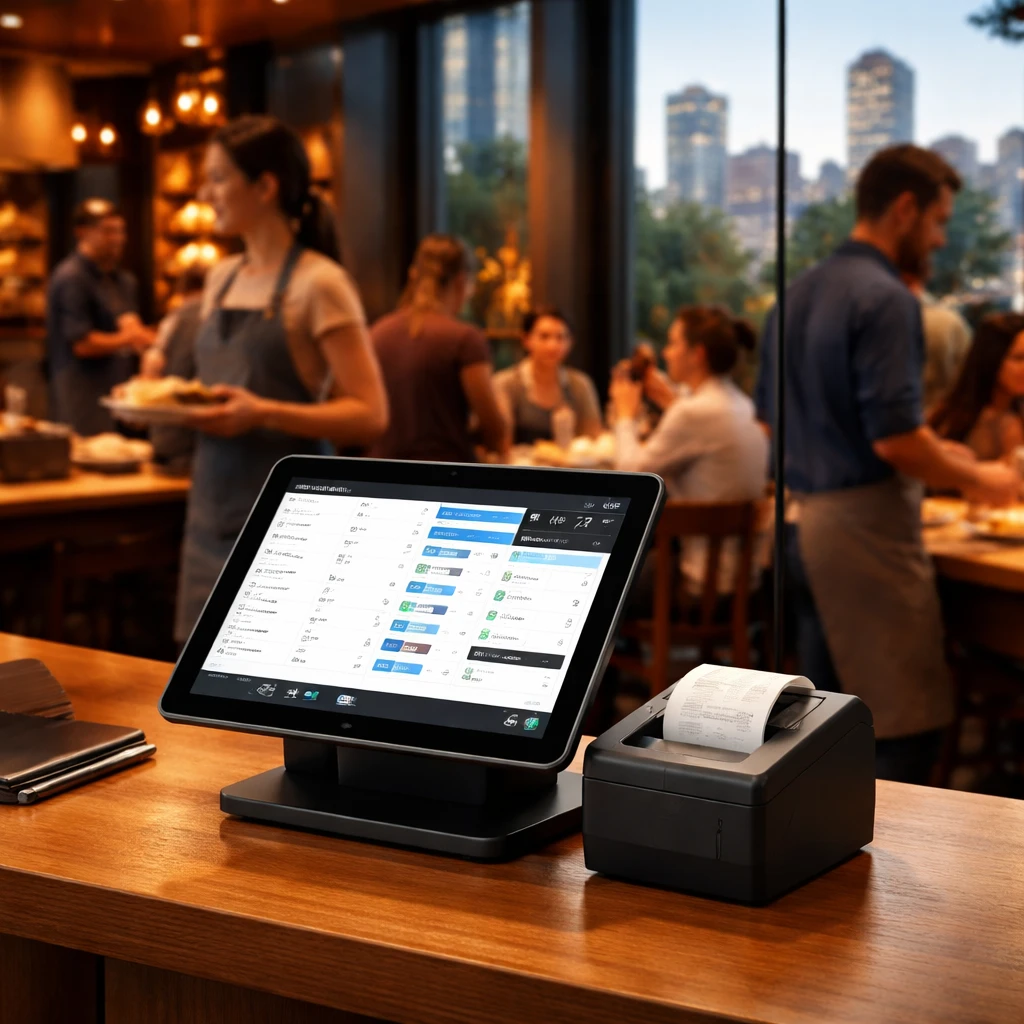
Toast builds payments and point-of-sale systems for restaurants and sells mission-critical software: terminals, guest-facing devices, online ordering, kitchen displays, analytics and more. That makes the product sticky: once a restaurant is live on Toast, switching cost and operational disruption are substantial. The company served roughly 164,000 restaurants and added 8,000 net new locations in Q4, demonstrating continued adoption at a time when the sector is under pressure.
Signs of a stronger business (numbers matter)
- ARR scale and growth: public reporting and coverage point to 2026 ARR guidance around $2.3B, which underpins a large, recurring revenue base.
- Free cash flow: Toast generated $608M in free cash flow, a meaningful positive figure that supports reinvestment in product and potential margin expansion or share repurchases.
- Balance sheet: cash is about $1.4B and current/quick ratios are healthy (current ~2.75, quick ~2.64), which gives the company flexibility through industry cycles.
- Profitability metrics: return on equity is reported at ~16.1% and return on assets ~10.87%, showing the business is producing decent returns on capital.
Valuation framing
Toast's market cap sits roughly in the $16.1-16.3B range and enterprise value is about $14.8B. That implies an EV/sales near 2.4x and a price-to-sales around 2.62. Based on commentary in the market, an EV-to-ARR multiple near 6x is being cited using 2026 guidance — a reasonable shorthand for a high-quality, mission-critical SaaS operator in a large market.
Put differently: the company produces substantial recurring revenue and meaningful free cash flow. With $608M FCF and a market cap near $16.2B, the implied free cash flow yield is only in the mid-single digits (~3.7-3.8%), which looks modest given the growth profile. The compression in multiples lately is more about sector sentiment than a sudden deterioration in Toast's business.
Technicals & investor positioning
- Share price range: 52-week high $49.66 (08/05/2025) and low $24.35 (02/24/2026). Current price around $27.64 is closer to the low end, leaving room to mean-revert if sentiment improves.
- Momentum indicators: short-term RSI is ~44 — not oversold but not stretched — and MACD shows bullish histogram momentum, suggesting a base may be forming.
- Short interest has generally trended down from peaks and days-to-cover sits in the low single digits, which limits a big short-squeeze risk while indicating reduced bearish positioning.
Catalysts (what could re-rate the stock)
- Activist/strategic investor moves: ValueAct more than doubled its stake in late February (02/25/2026), which adds credibility and increases the odds of management prioritizing shareholder-friendly moves or accelerating margin expansion.
- Continued net new locations and ARR growth: adding thousands of locations each quarter and pushing ARR toward $2.3B supports higher multiples if growth remains consistent.
- Sector stabilization: a broader recovery in software valuations after the AI-driven volatility would benefit Toast due to its mission-critical position and consistent recurring revenue.
- Product wins/partnerships: more high-value chain signings or partnerships (payment, delivery, voice AI integrations) can drive both revenue and stickiness.
Trade plan (actionable)
Entry: Buy at $27.50.
Stop loss: $24.35 (the 52-week low). If price trades below $24.35, it suggests the current base has failed and risk management requires exit.
Primary target: $36.00 over a mid term (45 trading days). This target assumes a re-rating toward historical multiple ranges and some catch-up to peers as execution proves out.
Alternate/longer target: $45.00 over a long term (180 trading days) if ARR beats and FCF conversion accelerates — a scenario that would validate a multi-quarter multiple expansion.
This is a mid-term trade: mid term (45 trading days) is the primary horizon because tangible catalysts (earnings cadence, activist involvement, and sector sentiment normalization) typically play out over several weeks to a couple of months. If Toast reports strong results or shows sustained location adds and margin progression, hold toward the long-term target and tighten risk management.
Why the math favors the upside
A move from $27.50 to $36.00 is ~31% upside; that re-rate would still leave Toast below its 52-week high and only modestly above an EV/ARR multiple in line with smaller, faster-growing SaaS peers. Given the business' growing ARR ($2.3B guidance), positive free cash flow ($608M), and a healthy balance sheet, a >30% move is within the realm of possibility on improved sentiment and continued execution.
Risks and counterarguments
- Macro and sector risk: a renewed sell-off in software or a sharp economic slowdown could compress multiples further and pressure restaurant spending and technology upgrades.
- Competition and product risk: payments and POS are contested markets. If larger incumbents or platform providers accelerate product offerings, Toast may have to spend more to defend share, pressuring margins.
- Execution risk: sustained net-new-location growth and ARR expansion must continue. If growth stalls or churn increases, multiple compression could persist.
- Valuation sensitivity: Toast still trades at elevated earnings multiples (P/E near 47-49) so any miss on profitability or guidance could trigger outsized downside in the stock.
- Counterargument - AI/sector narrative: critics argue AI consolidations (new multi-function tools) will displace single-purpose SaaS. That is plausible market fear and explains recent weakness. My view: mission-critical, deeply integrated systems like Toast have higher switching costs and are less vulnerable short-term to generic AI tools, but longer-term risks exist if competitive dynamics shift significantly.
What would change my mind
I would abandon the bullish stance if Toast reports consecutive quarters of slowing net new locations, materially higher churn, or a sudden decline in free cash flow. Similarly, if the company's payments or software revenue growth decelerates below mid-teens after accounting for lapping comparisons, that would indicate a deeper product or market share problem and would require revisiting the thesis.
Conclusion
Toast offers a pragmatic risk-reward right now. The fundamentals and cash generation are solid, and activist interest increases optionality for improved capital allocation and execution focus. The sector-wide sell-off has created an entry point near the lower boundary of the year's trading range. For disciplined traders and investors prepared to use a hard stop, buying $27.50 with $24.35 protection and a $36.00 mid-term target is a logical way to express a constructive view on the business while keeping risk controlled.
Trade plan recap: Buy $27.50, stop $24.35, target $36.00 (primary, mid term - 45 trading days); secondary target $45.00 (long term - 180 trading days).
| Metric | Value |
|---|---|
| Current price | $27.64 |
| Market cap | $16.2B (approx) |
| Enterprise value | $14.8B |
| Free cash flow | $608M |
| 2026 ARR guidance (market commentary) | $2.3B |
| 52-week range | $24.35 - $49.66 |
Key takeaway: The business is stronger than the current price implies. Use a disciplined entry at $27.50, protect capital at $24.35, and target $36.00 over the next 45 trading days while watching for execution or macro signals that would change the view.