
Hook & thesis
Toast is sitting in the eye of a software sell-off but the underlying business argues for ownership: a mission-critical POS stack for restaurants, a reported guidance path to roughly $2.3 billion in ARR for 2026, and meaningful free cash flow generation. The stock trades around $27.40 with an enterprise value near $15.05 billion - a multiple that looks reasonably priced if Toast sustains ARR growth and pushes EBITDA margins higher.
My trade thesis is straightforward: buy into the recovery in SaaS multiples for mission-critical platforms while leaning on improving profitability metrics. Entry at $27.40, a stop at $24.00 to limit downside, and a target at $38 capture upside from growth plus multiple expansion over a long term (180 trading days) horizon.
What Toast does and why it matters
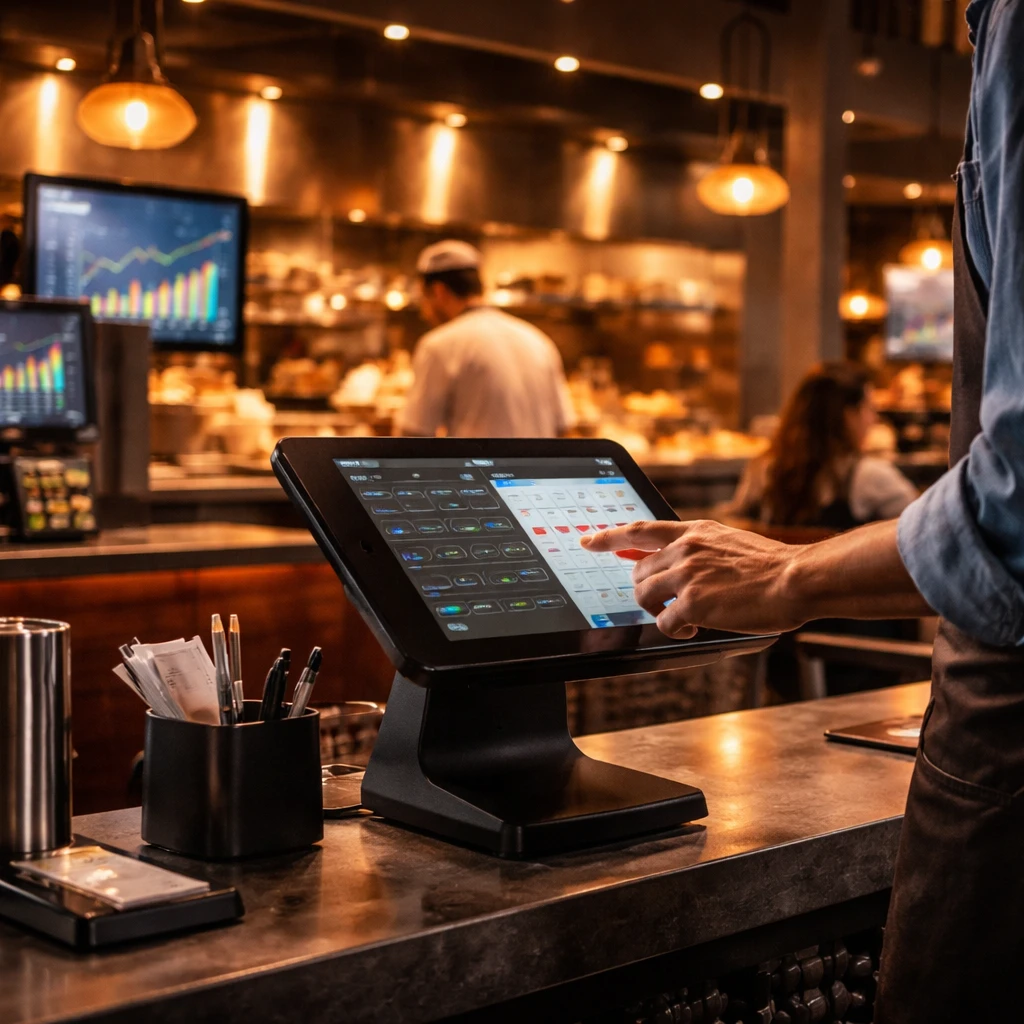
Toast provides a vertically integrated point-of-sale (POS) and payments platform for restaurants - hardware terminals, guest-facing displays, online ordering, kitchen displays, analytics, and payment processing. That integration makes Toast more than a one-off application: it becomes a central operating system for restaurants. For owners, that reduces switching costs and increases the stickiness of subscription and payment revenue.
The market cares because restaurants are still largely under-digitized in the U.S. The company reported adding roughly 8,000 net new locations in Q4 and serves about 164,000 restaurants, suggesting clear room to grow against an addressable base measured in hundreds of thousands of legacy premises. When a platform can monetize both software subscriptions (ARR) and payments, the revenue profile deepens and free cash flow can scale quickly once variable costs normalize.
What the numbers tell us
Key balance sheet and valuation facts to anchor the argument:
- Market cap is roughly $16.1 billion and enterprise value about $15.05 billion.
- Reported free cash flow is $608 million and cash on the balance sheet about $1.4 billion.
- Guidance commentary suggests roughly $2.3 billion in ARR for 2026, putting EV/ARR near the mid-single digits (around 6x by published estimates).
- Profitability metrics are improving: trailing earnings per share around $0.58 and return on equity about 16.1% with return on assets near 10.9%.
- Traditional multiples are mixed: price-to-earnings near 48-50x and EV/EBITDA roughly 32x today, reflecting growth expectations retained in the stock.
That mix tells a clear story: the market is willing to pay for growth, but it is also demanding a path to better margins and cash returns. Toast’s $608 million in free cash flow provides an important runway to either reinvest in adoption or improve margin through operating leverage.
Valuation framing
At an enterprise value of about $15.05 billion and a guidance-like ARR figure of $2.3 billion, the headline EV/ARR multiple sits in the 6x range. For a vertically integrated, sticky POS operator with diversified revenue streams (software subscriptions, payments, hardware), that multiple is attractive compared with historical SaaS highs and generous relative to single-function SaaS names that have been hit harder by AI fears.
However, trailing EV/EBITDA north of 30x implies the market still prices significant growth and margin expansion into the share price. The trade here is clearly contingent on Toast proving both - consistent net new locations and EBITDA expansion that justify a move toward mid-teens EV/EBITDA or a higher EV/ARR multiple driven by scale benefits.
Catalysts that could drive the re-rate
- Execution on new locations: Continued net adds similar to the reported 8,000 net new locations in Q4 would extend ARR momentum and validate the long-term penetration thesis.
- Margin expansion: As subscription mix and payment margins improve, incremental revenue should drop to the EBIT line faster, turning FCF into a tailwind.
- Institutional support: The decision by ValueAct to more than double its stake as reported on 02/25/2026 signals a vote of confidence from an active investor and could attract additional long-term holders.
- Macro tailwinds for dine-in and digital ordering: positive comps in restaurant spending would lift payment volumes and attach rates.
Trade plan (actionable)
Entry price: $27.40
Target price: $38.00
Stop loss: $24.00
Horizon: long term (180 trading days) - give the story time to play out through at least one major results cycle and additional location add disclosures. Toast’s business cadence and the need for margin improvement argue for a multi-quarter timeline rather than a short-term pop play.
Rationale: The entry is at the current market level, where downside is capped by a modest cash buffer and an achievable operational reset. The $38 target assumes continued ARR growth plus a multiple re-rate as EBITDA and FCF become more visible and durable. The stop at $24 limits capital at risk below the company’s recent 52-week low area, acknowledging that a meaningful deterioration in ARR or churn would require cutting the position.
Technical and sentiment context
Technically, the stock is trading below its 10-, 20- and 50-day simple moving averages ($28.43, $28.03, $30.05 respectively) with an RSI around 42.6, suggesting a consolidation phase rather than an oversold panic. Short interest sits in the high tens of millions of shares (recent prints around 27-28M), which creates potential for volatility on either positive or negative news flow. Volume patterns show active trading; be prepared for sharper intraday moves around quarterly releases.
Risks and counterarguments
- AI and competitive compression: Recent sector sell-offs tied to new AI offerings (for example, tools that bundle multiple software functions) highlight a real risk: single-purpose vendors and aggregators can pressure pricing or reduce add-on opportunities for platforms like Toast.
- Restaurant spend sensitivity: Toast’s growth is linked to restaurant health. A durable slowdown in dining or tighter capex budgets for small businesses would slow location adds and ARR growth.
- Execution on margin expansion: If hardware costs, payment provider fees, or go-to-market spend remain elevated longer than management expects, EBITDA expansion may be delayed and the re-rate will not occur.
- Valuation re-rating risk: With EV/EBITDA above 30x, any guidance miss or lower-than-expected net adds could trigger a multiple contraction, amplifying downside.
- Concentration and integration risk: The integrated hardware-software model creates operational complexity. Supply chain, returns, or large-scale hardware refresh delays would pressure margins.
Counterargument: Skeptics will point to the AI-driven sell-off and argue that new multi-tool AI suites will hollow out single-use software vendors. That is a valid concern, but Toast’s differentiation is tight integration into restaurant operations and payments. Mission-critical suites that sit in the stack tend to be stickier and harder to replace than simple point solutions. For the counterargument to fully win, we would need to see evidence of material customer churn or a large portion of revenue becoming commoditized.
What would change my mind
I would turn cautious or reduce sizing if any of the following occur: a) guidance revision meaningfully below the implied $2.3B ARR path; b) clear signs of rising churn among mid-market customers; c) margin guidance slipping meaningfully such that free cash flow turns negative or drops substantially from the reported $608M; or d) a sustained decline in gross payment volumes that signals a durable drop in restaurant spending.
Conclusion
Toast presents a pragmatic risk-reward trade: it is priced like a growth company that still needs margin proof. The company has the structural advantages of an integrated platform, a sizeable addressable market, and real cash flow today. Buying at $27.40 with a $24 stop and a $38 target over 180 trading days balances patience for execution against a defined downside guardrail. If management continues to deliver net new locations and EBITDA gains, the multiple should follow - making this a tactical long for investors comfortable with mid-cap SaaS volatility.
Key dates & monitoring plan
- Monitor quarterly results and commentary on location adds and ARR progression closely. Expect the next major update in the company’s public results cycle.
- Watch free cash flow trends and any commentary on margin drivers: payments margin, subscription gross margin, and hardware cost dynamics will be decisive.
- Track institutional activity - additional buying from value-oriented funds could be a positive signal for further multiple expansion.
Trade summary
- Buy: 1x position at $27.40
- Target: $38.00 (long term - 180 trading days)
- Stop: $24.00
- Risk level: medium