
Hook / thesis
Target Hospitality (TH) looks like a classic recovery trade: a $900M-market-cap operator of workforce lodging with exposure to Texas oilfield demand and government contracts, trading near $9.05 after a year of contract noise and profitability swings. The company reported Q2 2025 revenue of $61.6 million, beat expectations, and raised full-year guidance despite headwinds from terminated government contracts. That combination - revenue resilience plus demonstrated free cash flow generation - makes a disciplined long worth considering for traders who can take a mid-term view.
My thesis is simple: if utilization in the HFS South footprint stabilizes and government contract losses stop being a headline drag, TH should re-test and clear its 52-week high of $9.90 and push toward $11 as multiple expansion and better margin visibility return. The trade is actionable with clear entry, stop and target, but it is conditional on continued operational improvement and no unexpected contract terminations.
What the company does and why the market should care
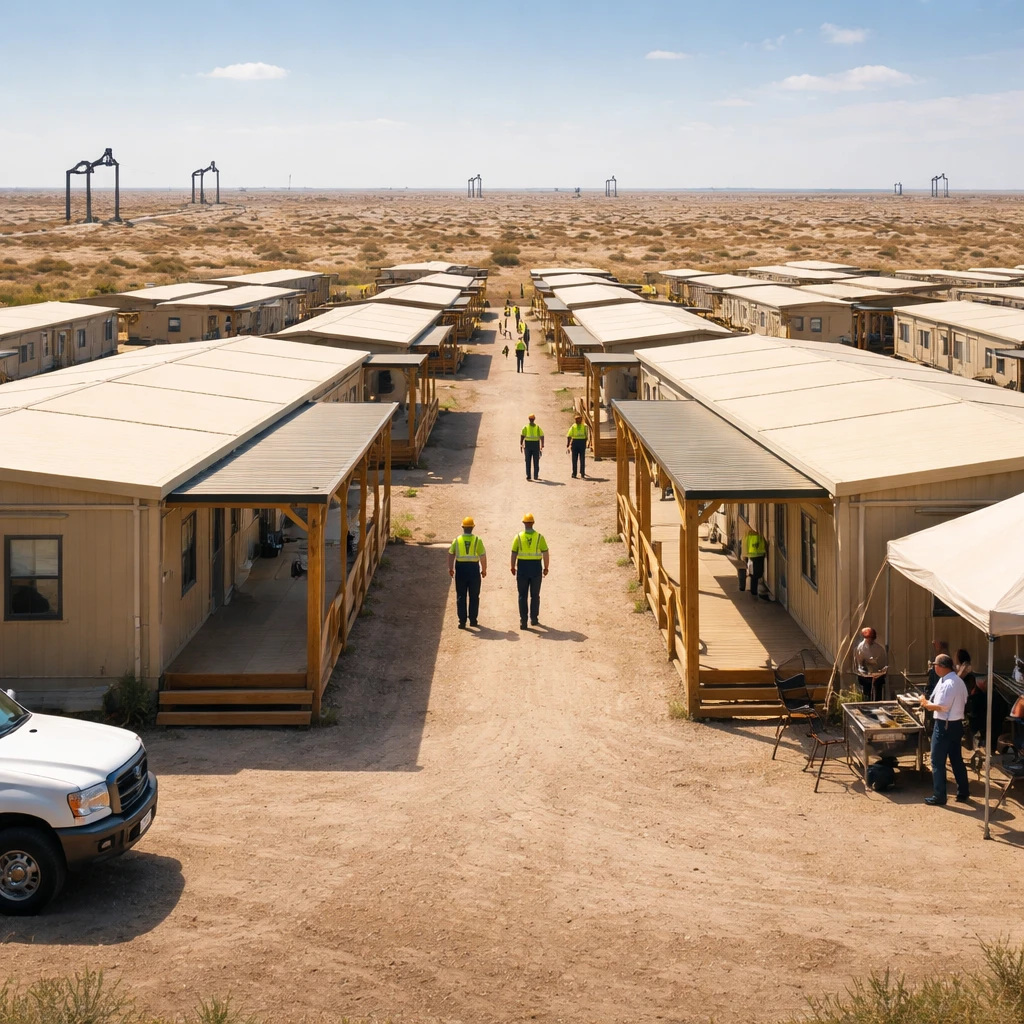
Target Hospitality provides rental accommodation with catering and hospitality services through three segments: HFS South (primarily natural resources and development customers in Texas and New Mexico), Government (rental and hospitality under government contracts in Texas), and All Other (natural resource customers outside HFS South). The business model is asset-light to asset-moderate depending on camp ownership and contract structure, and revenue is driven by utilization of lodging units and contract length.
Investors care because this is a cash-generative services business tied to cyclical industries. When energy activity or government demand rises, utilization and contract rates lift revenue quickly. Conversely, contract churn - especially in the Government segment - can quickly depress margins. The key for the equity is predictable utilization and longer-term contract cadence.
Support for the thesis - the numbers that matter
- Market capitalization stands around $906 million and enterprise value is roughly $906.8 million - the market is valuing the equity nearly in line with enterprise value, highlighting modest net debt or negligible cash/debt separation at current prices.
- Q2 2025 revenue was $61.6 million and the company raised full-year guidance after the quarter, indicating management expects tougher spots to be behind them and a return to growth or at least stabilization in contracted revenue.
- Free cash flow registered at $73.34 million in the latest ratio set - a material positive for a sub-$1B market cap company and a sign that operations can generate meaningful cash even amid margin noise.
- Profitability metrics are mixed: trailing EPS is negative at -$0.37, and the reported price-to-earnings ratio is not meaningful on a negative EPS. Valuation multiples that are useful include price-to-sales at 2.84 and enterprise-value-to-sales at ~2.83. EV/EBITDA is high at ~32.68, reflecting depressed EBITDA in recent quarters and the market's uncertainty on margins.
- Technicals show improving momentum. The 10-day SMA is $8.98, the 20-day SMA $8.23, and the 50-day SMA $7.71 - the stock has climbed through shorter-term averages and the 9-day EMA ($8.94) is above the 21-day EMA ($8.43). Relative Strength Index sits at 62.7, signaling bullish but not overbought conditions.
- Short interest is non-trivial: recent short interest counts imply around 7 days-to-cover on average. That creates both downside pressure if sentiment flips and upside gamma if positive catalysts materialize.
Valuation framing
At a market cap near $906 million and trading at $9.05, Target Hospitality is priced for recovery, not excellence. Price-to-sales of 2.84 is reasonable for a lodging services operator if revenue growth and margins return to pre-disruption levels. The balance sheet indicators suggest low leverage - debt-to-equity is effectively minimal - so the company has flexibility to compete for contracts and invest in operations.
EV/EBITDA ~32.7 looks rich, but that is more a reflection of depressed EBITDA rather than an inherently frothy equity valuation. The proper framing: pay attention to EBITDA recovery and contract visibility. If management can convert recent revenue beats into sustained margin improvement, multiple compression should reverse and the stock can rerate into a lower EV/EBITDA band that reflects normalized earnings.
Catalysts (what could drive the trade higher)
- New long-term contract awards in the HFS South or Government segment that boost booked revenue and utilization.
- Sequential improvement in utilization and per-diem rates reported on the next quarterly results, turning free cash flow into a predictable stream rather than a one-off.
- Management commentary reducing the chance of future government contract terminations and outlining diversification efforts into longer-duration commercial contracts.
- Short-covering if visible operational improvement accelerates, given days-to-cover sits near 7 and recent short volume spikes have been real.
Trade plan - rules, horizon and sizing
Actionable plan (mid-term tactical long):
- Entry price: buy at $9.05. This is the current reference price and a reasonable level to initiate a small base position.
- Target price: $11.00. This would represent roughly a 21.5% upside from the entry and a clear break above the recent 52-week high ($9.90 on 03/12/2026) into a higher-multiple zone if achieved.
- Stop loss: $8.00. A break below $8.00 implies resumed downside momentum and potential deterioration in utilization or a fresh contract loss; exit to preserve capital.
- Horizon: mid term (45 trading days). Expect the bulk of the move to play out within the next 11-45 trading days as contract news or quarterly results re-rate the name. If the catalyst set is slower, re-evaluate at 45 trading days and either trim or convert to a longer position if fundamentals continue to improve.
- Position sizing: keep this as a tactical sleeve - no more than 2-4% of portfolio risk capital. This is a recovery trade, not a broad-market core holding.
Risks and counterarguments
All of these are real and justify a cautious position size:
- Contract concentration and terminations: The Government segment has been a source of volatility; previous terminated contracts hurt profitability and can do so again. This is the single largest operational risk.
- Profitability remains fragile: Negative EPS (-$0.37) and a high EV/EBITDA multiple mean the stock needs margin recovery to justify higher prices. If margins stay depressed, the equity is vulnerable.
- Short interest pressure: With roughly 7 days-to-cover and elevated short volume on several recent days, the stock can swing violently in either direction. That increases trading risk and stop-hit probability.
- Macroeconomic / energy demand risk: HFS South and All Other segments are tied to natural resources activity. A downturn in oilfield activity or capital spending would reduce utilization and revenue.
- Regulatory / legal overhang: Past attention from a law firm investigating securities claims introduces reputational and distraction risk; while not a current headline, it remains a lingering overhang that can affect sentiment.
Counterargument to the thesis: The market may be right to price in persistent contract instability. Q2 2025 showed a revenue beat but also material profitability challenges from terminated government contracts. If government contract churn continues or new contracts come with lower margins (more pass-through costs, shorter duration), free cash flow may not be as repeatable as the headline $73.34 million suggests. In that scenario, even a lower share price could be justified.
Conclusion - stance and what would change my mind
I am constructive on a tactical long in Target Hospitality at $9.05 with a $11 target and $8 stop over a mid-term window (45 trading days). The case hinges on utilization stabilizing in core Texas markets, management converting recent revenue beats into sustained margin improvement, and the absence of new disruptive contract terminations. The company's free cash flow generation and modest leverage give it runway to pursue contract wins and survive temporary churn.
What would make me change my mind? I would reduce conviction or flip to neutral/short if any of the following occur: a) a new government contract termination or a large customer default; b) a negative guidance revision with visible margin erosion; c) cash flow weakness across two consecutive quarters despite revenue growth. Conversely, I would add to the position if management announces multiple long-term contract awards, shows sustained utilization above seasonal norms, and reports improving EBITDA converting into recurring free cash flow.
Key technical and sentiment checkpoints to monitor
- Weekly utilization and contract award updates from management or investor presentation materials.
- Next quarterly report for revenue, margin, and guidance comments.
- Technical: maintain $8.00 stop, watch for close above $9.90 to signal a higher-confidence breakout.
Trade idea summary: Initiate a small tactical long at $9.05, target $11.00, stop $8.00, horizon mid term (45 trading days). Keep sizing modest given contract and short-interest risks.