
Hook and thesis
Sprouts Farmers Market is a healthy-grocery operator that has been punished by slowing comp-store performance and a legal overhang tied to guidance cuts in late 2025. The selloff pushed shares into the mid-$60s to mid-$70s range, creating a rare entry point on an otherwise cash-generative business. I view SFM as a long-term compounder on sale: buy weakness now with a plan to hold through execution on store economics and margin stabilization.
Why buy here? At a market cap near $7.0 billion and trading around $74.29, SFM changes hands at roughly 13x reported earnings (EPS $5.38) and about 0.84x sales. The company generates meaningful free cash flow ($467.7M) and posts high returns on equity (37%). Those numbers argue for more upside if comparable-store trends recover and the company executes its expansion plan under a low-debt capital structure.
What Sprouts does and why the market should care
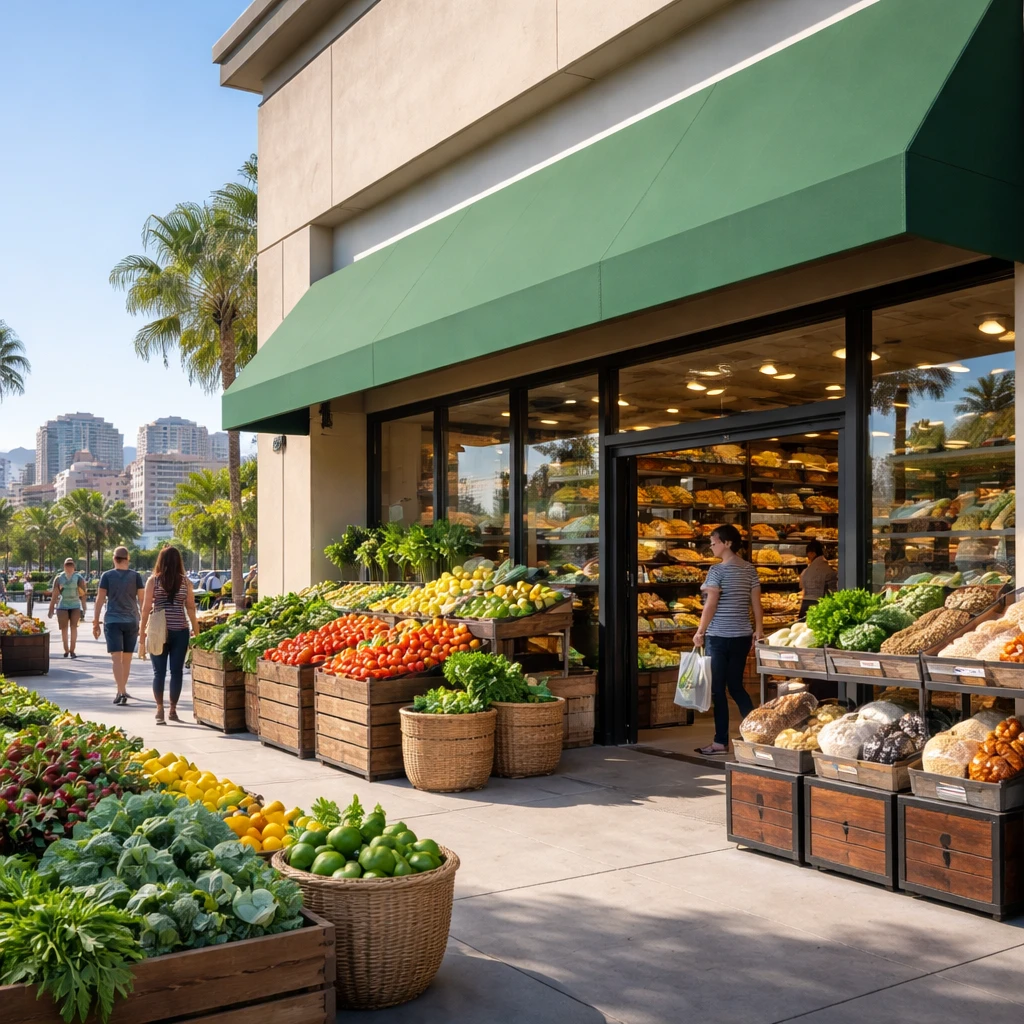
Sprouts Farmers Market operates fresh-focused grocery stores that emphasize natural, organic and value-oriented healthy food. The business mix tilts heavily toward fresh produce, bulk foods, vitamins and supplements, and specialty grocery categories. That positioning matters because consumers who trade up into healthy and specialty formats tend to be stickier and spend more per trip than pure discount shoppers; it supports higher margins than traditional supermarkets when execution is on point.
From an investor perspective the combination of scale (fewer than 500 stores today, meaning expansion runway) plus the ability to generate strong free cash flow and high returns on equity is compelling. The company also carries very little financial leverage - debt-to-equity sits at only 0.06 - which gives Sprouts optionality to invest in growth, remodel stores, or return cash if management chooses.
Support from the numbers
- Current price: $74.29, prior close $75.74; 52-week range $64.75 - $182.00.
- Market capitalization: roughly $7.03 billion.
- Reported EPS (trailing): $5.38; implied trailing P/E ~14x.
- Free cash flow last reported: $467.7 million; enterprise value roughly $7.20 billion.
- Return on equity: 37.32%; return on assets: 12.59%.
- Balance sheet: debt-to-equity 0.06 and cash ratio ~0.30 suggest limited leverage risk.
Those are not the numbers of a failing retailer; they are the profile of a healthy operator that ran into a period of soft comps. The market has priced in that softness. Trading at low-teens earnings multiples for a company with high ROE and meaningful free cash flow implies an expectation that growth and margins will remain impaired for a long time. I think that is too pessimistic.
Valuation framing
On a simple trailing basis Sprouts is trading near 13-14x earnings and about 0.84x sales. Enterprise-value-to-EBITDA sits near 8.5x. For a retailer that can grow stores, improve square-foot productivity over time, and maintain mid-single-digit same-store growth, those multiples look reasonable and leave room for upside if execution normalizes.
Compare qualitatively to the broader grocery universe: commodity supermarkets often trade at compressed multiples because of heavy capex and margin sensitivity to traffic. Sprouts' higher-margin fresh and specialty mix, plus the ability to convert sales into sizable free cash flow, should command a premium to commodity grocers in a normalization scenario. The recent steep drop from a $182 52-week high to the current mid-$70s creates a favorable skew for buyers willing to tolerate near-term volatility.
Catalysts
- Comp-store stabilization and return to positive same-store sales - the primary earnings lever.
- Margin recovery as promotions normalize and SKU rationalization improves gross margin.
- Store expansion - fewer than 500 stores gives a multi-year runway for new openings to drive incremental sales growth.
- Free cash flow redeployment - buybacks or selective reinvestment could accelerate EPS growth and improve investor sentiment.
- Legal overhang resolution - the class-action timeline that surfaced in January 2026 could clear, removing an investor overhang and encouraging buyers.
Actionable trade plan
My trade is a long-term directional buy aimed at capturing a normalization of comps and margin improvement over time.
| Entry | Stop Loss | Target | Horizon |
|---|---|---|---|
| $74.00 | $64.50 | $110.00 | Long term (180 trading days) |
Rationale: Entering at $74.00 puts you near current levels while offering a clear stop below the recent 52-week low ($64.75). The $110 target reflects a re-rating toward mid-teens to low-20s P/E as growth and margins normalize; it also leaves room for upside should FCF conversion accelerate or buybacks begin. Expect to hold through operational improvement measured in quarters, so plan for a long-term holding period approximately 180 trading days to let comps and margin actions flow through the P&L.
Why this trade, not a flip
This is not a short-term momentum play. The upside will likely come as the company proves it can stabilize comparable-store sales and restore margin mix. The balance sheet and cash generation make it feasible for management to invest in the business or return capital without adding risky leverage, which is why a patient, long-term stance makes sense.
Risks and counterarguments
- Weakening consumer demand: The immediate trigger for the 2025 weakness was softer comps. If macro conditions deteriorate further, Sprouts could face prolonged traffic declines that impair margins and cash flow.
- Legal overhang: Multiple securities class action notices were filed after the October 29, 2025 guidance cut and Q3 results. Litigation costs, potential settlements, and management distraction could sap investor sentiment and capital allocation flexibility.
- Competition and pricing pressure: The healthy-food niche is contested by regional chains, national grocers and online specialists. Aggressive pricing from competitors could compress Sprouts' gross margins.
- Execution risk on expansion: Growth requires disciplined store economics; missteps in new openings or capital allocation would dilute returns and hurt valuation.
- Sentiment and technical risk: Short interest has been elevated recently, which could amplify downside in a selloff or spark volatility around news events.
Counterargument: You can make a strong case to stay sidelined or sell. The company’s comps missed and guidance was reduced in late 2025; investors who want proof of sustained improvement might wait for several quarters of positive comp growth before buying. Multiple law firms have filed suits and that legal cloud could take months to resolve. If you are risk-averse or trade purely on momentum, the current environment is noisy and patience is warranted.
What would change my mind
I will rethink this long thesis if any of the following occur: a) same-store sales continue to decline for multiple consecutive quarters, b) free cash flow materially reverses or becomes negative, or c) management abandons capital discipline and ramps leverage to pursue aggressive expansion. Conversely, evidence of margin stabilization, two consecutive quarters of positive comps and an obvious reduction in legal risk would strengthen my thesis and prompt a reassessment toward a higher target.
Conclusion
Sprouts Farmers Market offers an asymmetric trade: a well-capitalized, cash-generative grocery chain whose stock was sold off hard after a guidance cut and disappointing comps. Trading in the mid-$70s on attractive trailing multiples relative to the company’s ROE and FCF profile, SFM is a candidate for long-term investors willing to tolerate near-term noise. Use an entry at $74.00, a stop at $64.50, and a long-term target of $110.00 over approximately 180 trading days, and remain disciplined about reassessing if comps and cash flow do not cooperate.
Key monitorables: comp-store trends, gross margin trajectory, free cash flow, and any material developments on the class-action suits.