
Hook / Thesis
Sandisk just handed traders a clean, actionable setup: a forced sell-off from Western Digital has temporarily disrupted the tape, but the underlying demand picture for NAND - driven by AI hyperscalers and data center expansion - remains intact. That dislocation creates a mid-term opportunity to own a high-quality NAND franchise at an entry price that offers a defined risk and asymmetric upside if fundamentals hold.
This is not a call to buy-and-forget. Valuation is elevated versus free cash flow and price-to-sales metrics, so this is a tactical, position-sized play intended to capture a rebound as supply/demand clarity returns and the WD exit completes.
What Sandisk does and why it matters
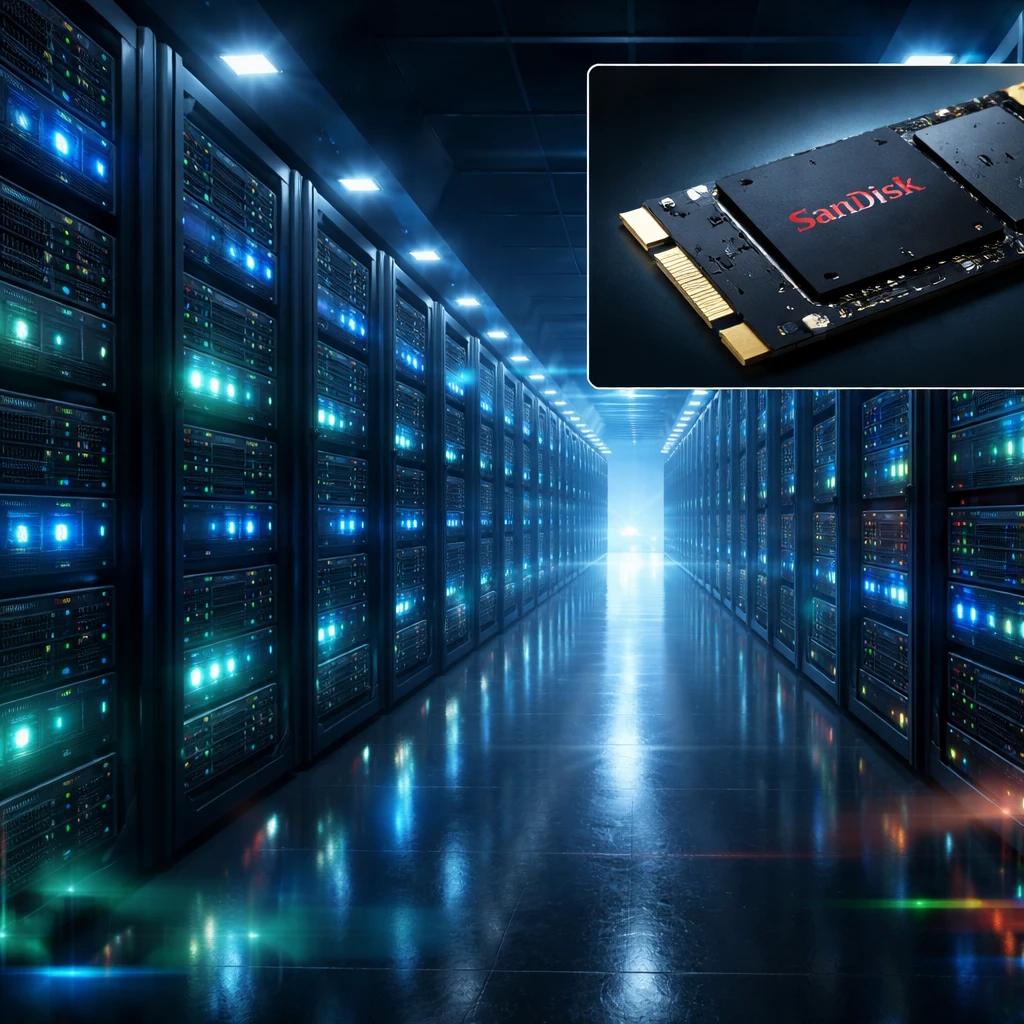
Sandisk manufactures NAND flash-based storage: SSDs, memory cards and USB flash drives. As AI workloads scale, hyperscalers are shifting system architectures toward larger, faster flash tiers to feed models and to provide low-latency persistent storage. That structural demand should benefit a pure-play NAND supplier like Sandisk more directly than diversified storage peers.
Why the market should care now
- Hyperscaler spending on AI infrastructure is front-and-center for capital allocation decisions; NAND is a high-volume, high-dollar component in modern AI stacks.
- Sandisk is a direct beneficiary of a NAND cycle that analysts and coverage pieces are characterizing as a structural tailwind, not just a one-quarter pop.
- Liquidity metrics and a modest leverage profile give the company optionality to fund growth without near-term solvency concerns.
Key data points that matter
- Market cap: approximately $94.26 billion, enterprise value about $93.29 billion.
- Free cash flow: $1.449 billion; price-to-free-cash-flow roughly 65x.
- Price-to-sales: 10.55; EV-to-sales: 10.45.
- Liquidity and leverage: current ratio ~3.11, quick ratio ~1.92, debt-to-equity very low at ~0.06.
- Recent technicals: 10-day SMA $616.49, 20-day SMA $599.62, 50-day SMA $431.60; RSI ~62, MACD showing short-term bearish momentum (negative histogram), implying a consolidation rather than trend breakdown.
- Trading activity: 2-week average volume around 21.3M shares; recent single-day volume spiked to ~30.4M as the secondary hit the tape.
Valuation framing
On headline multiples the stock looks expensive. At a ~$94B market cap and $1.449B in free cash flow, the implied yield is low and P/FCF sits around 65x. EV/EBITDA (~71x) and price-to-sales (~10.6) imply expectations for continued revenue and margin expansion. That said, this premium arguably prices in a long runway of NAND upsizing into AI infrastructure. If revenue and margin improvements materialize, those multiples compress rapidly; if demand disappoints, this multiple profile is the reason downside could be steep.
Put differently: you're buying growth priced for perfection. The short-term dislocation from the $3.17B secondary has created a tactical entry that reduces immediate downside risk relative to the prior run-up, but the trade still requires conviction in a multi-quarter demand story.
Catalysts (what will drive the trade)
- Completion and absorption of Western Digital's secondary sales - as that selling pressure eases, shares typically recover.
- Quarterly results and guidance that show revenue and gross-margin expansion driven by data center SSDs and hyperscaler contracts.
- Public confirmations from large cloud customers of increased NAND/SSD purchasing for AI workloads.
- Any signs of improved free cash flow conversion or margin leverage on the income statement that improve the P/FCF story.
- Technical stabilization above $600 and reclaim of the 20-day SMA with volume confirmation.
Trade plan (actionable)
This is a position trade intended to play out over the mid-term. Specifically:
| Entry | Target | Stop | Horizon |
|---|---|---|---|
| $625.00 | $820.00 | $560.00 | mid term (45 trading days) |
Rationale: the $625 entry sits below the recent $638 printed price and under the 10-day and 20-day SMAs, giving a cushion for intraday volatility tied to secondary absorption. The $820 target is a recovery toward a level that starts to price in more of the upside from AI-driven NAND demand while leaving room for seller exhaustion. The $560 stop is beneath the early February short-term support band and limits downside to a defined risk if NAND prices or sentiment deteriorate fast.
Position sizing and execution notes
- Given the valuation and event risk, keep position size moderate relative to portfolio - this is a trade, not a core long (consider 1-3% of portfolio capital).
- Scale in using limit orders; consider adding on a verified washout day with breadth confirming retail/secondary selling exhaustion and heavy volume reversal.
- Trailing stops or partial profit-taking above $725 (recent 52-week high area) can lock gains if the rebound proves strong.
Risks and counterarguments
- Valuation risk: Multiples imply a lot of growth already. At ~65x price-to-free-cash-flow and EV/EBITDA ~71x, the margin for error is small if revenue or margin assumptions slip.
- Secondary supply pressure: Western Digital's $3.17B secondary and ongoing gradual exit could continue to weigh on the float and keep a lid on near-term upside.
- Cyclicality of memory markets: NAND pricing is volatile and can reverse quickly if inventory builds or end-market demand slows.
- Execution and concentrated demand: If hyperscaler demand is concentrated among a few customers, any change in their buying cadence materially affects Sandisk's topline.
- Negative earnings base: Reported EPS in the trailing period is negative, which underscores that profitability still has variability and that headline multiples may be distorted.
Counterargument: One could reasonably argue this is still a momentum bubble. The stock ran ~1,500% in the past year; market cap near $94B with a relatively modest free cash flow base is a classic setup for mean reversion if AI spending cools or if the secondary triggers a larger supply overhang. That scenario would invalidate the trade and is why the stop is intentionally tight relative to the position size.
What would change my mind
I would step back from this idea if any of the following occurred:
- Sandisk reports guidance showing inventory build and falling NAND pricing on the next quarterly call.
- Western Digital completes an accelerated exit that floods the market beyond the priced-in $3.17B secondary.
- Free cash flow fails to improve or turns negative materially, removing the capital base that supports investment in capacity and R&D.
- Technical breakdown below $560 on sustained, high-volume selling (that would trigger the stop and also indicate a regime change in investor appetite).
Conclusion
Sandisk presents a clear, disciplined trade: buy the secondary-driven weakness at $625 with a $560 stop and $820 target, over a mid-term horizon of about 45 trading days. The company is a pure-play on NAND flash exposure to AI infrastructure, supports healthy liquidity and generates meaningful free cash flow, but it trades at premium multiples that demand execution and demand tailwinds to be sustained.
This is not a low-risk buy-and-hold. Treat it as a tactical position: respect the stop, size appropriately, and monitor secondary absorption, quarterly guidance and NAND pricing closely. If those items trend in Sandisk's favor, the reward-risk on this entry looks attractive; if they don't, the trade will exit quickly and cleanly.
Trade parameters recap - Entry: $625.00, Target: $820.00, Stop: $560.00. Horizon: mid term (45 trading days).