
Hook & Thesis
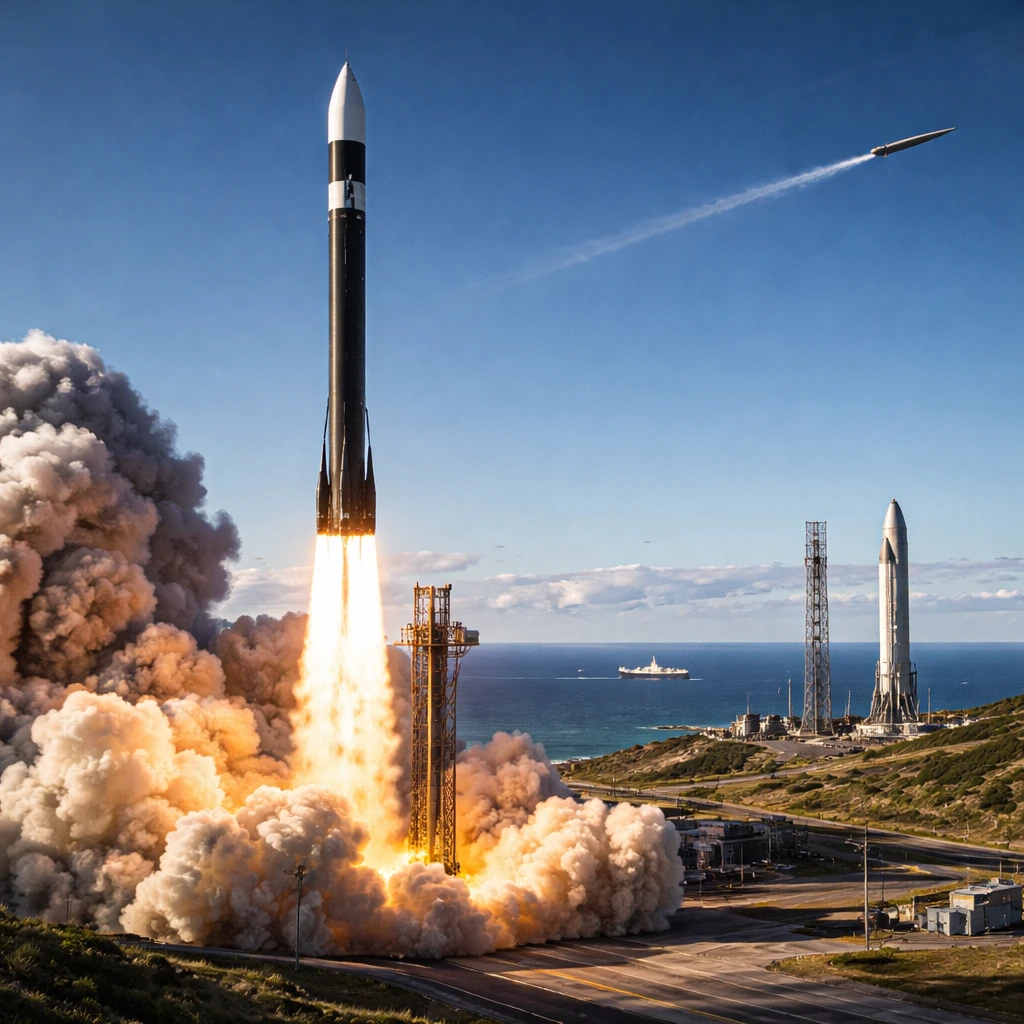
Rocket Lab’s market reaction to the Neutron delay was predictable: the stock gave up ground after management pushed the Neutron inaugural flight to Q4 2026 following a Stage 1 tank failure. Short-term headlines focus on a missed milestone, but the operational story underneath remains intact. The company reported record annual sales of $602 million, produced $179.65 million in Q4 revenue, completed its 83rd Electron launch, and holds a $1.85 billion backlog. Those are not trivial data points for a growth aerospace business.
My trade idea: buy a tactical long in RKLB around current levels to play a near-to-mid-term rebound driven by defense revenue, sustained launch cadence, and margin recovery. This is a swing trade that accepts volatility from Neutron timing risk but leans on tangible backlog and recurring mission wins to deliver upside within the next 45 trading days.
Why the market should care - business in one paragraph
Rocket Lab operates two core businesses: Launch Services (Electron and future Neutron rockets) and Space Systems (spacecraft components, manufacturing and on-orbit operations). Launch cadence and mission success underpin revenue growth today, while Space Systems and government contracts - notably hypersonic test platforms for the Defense Innovation Unit - create higher-margin, recurring revenue opportunities that de-risk reliance on Neutron timing. The company’s ability to run multiple launch complexes and to serve both commercial and defense customers is the fundamental driver here.
Supporting evidence from the recent run
- Revenue momentum: Q4 revenue was $179.65 million and full-year sales were a record $602 million, implying the company is scaling sales despite product development headwinds.
- Backlog: management is carrying approximately $1.85 billion in backlog - a multi-year revenue cushion that helps justify a premium multiple in a growth phase.
- Operational execution: Rocket Lab completed its 83rd Electron launch and executed two hypersonic test missions for the Defense Innovation Unit with a 100% success rate on HASTE launches. That operational tempo matters to defense customers who value reliability and repeatability.
- Balance sheet and coverage: market capitalization sits around $39.8 billion and enterprise value near $39.12 billion; cash metrics show $2.48 billion in cash (reported metric), while free cash flow remains negative at -$321.8 million in the most recent period, indicating ongoing investment in growth and development.
Valuation framing
At a current market cap of about $39.8 billion and enterprise value roughly $39.1 billion, valuation metrics look stretched on headline multiples: price-to-sales and EV-to-sales are in the mid-60s. Price-to-book and other multiples also reflect a growth premium. Those multiples are high because the market is pricing in a very large future addressable market and execution of Neutron - which would meaningfully expand TAM and revenue trajectories.
That said, valuation can be looked at in two buckets: (1) near-term revenue supported by backlog and launch services, and (2) longer-term upside from Neutron and space systems expansion. With $1.85B backlog and record annual revenue of $602M, the company has several quarters of booked demand that should alleviate revenue cliff concerns even if Neutron slips. In short, the premium is not irrational if Rocket Lab converts backlog, grows defense revenues, and eventually delivers Neutron. My trade expects partial re-rating as the market re-focuses on recurring revenue and defense wins rather than a single program slip.
Key technical and market context
- Share price context: current price near $70.11, 52-week high $99.58 (01/16/2026) and 52-week low $14.71 (04/07/2025) - the stock has shown extreme breadth of moves.
- Momentum: RSI ~46 and a small positive MACD histogram suggest the immediate sell-off may be stabilizing; 50-day SMA sits at $77.43 above the current price, so this trade is tactical, not a claim the downtrend is fully reversed.
- Short interest: notable decline in short interest in recent settlement reports and days-to-cover near or below 1.2 on the most recent data point - this lowers the risk of a large short-squeeze reversal while showing prior bearish positions have been trimming.
Catalysts (what could drive the trade higher)
- Defense revenue recognition and repeat HASTE missions - further government contracts or a cadence of hypersonic test launches would prove recurring defense revenue potential.
- Quarterly updates that show backlog conversion and improved guidance cadence following the Neutron re-plan; even conservative guidance that emphasizes launch cadence can beat investor expectations.
- Positive technical follow-through around $72-$76 that convinces momentum traders the post-earnings low is in.
- Acquisitions or strategic partnerships expanding Space Systems revenue and margin profile - the company recently added small component manufacturers to its fold, underlining vertical integration strategy.
Trade plan - actionable and explicit
Entry Price: $70.00
Target Price: $88.00
Stop Loss: $61.00
This is a swing trade - mid term (45 trading days). The thesis is that Neutron's slip is already discounted and that defense contract cadence plus backlog conversion will recalibrate sentiment within roughly two months. Entry at $70 captures the present level of investor discomfort; the $88 target is a meaningful move toward the prior trading range and leaves room for follow-through if market attention turns back to revenue durability rather than a single program timeline. Stop loss at $61 limits downside if broader execution risk or a materially worse guidance scenario emerges.
Position sizing & risk framing
Treat this as a high-risk, high-reward swing: keep the position size small relative to portfolio volatility (suggestion: 2-4% of portfolio capital). Be prepared for intraday swings of 5-10% on news flow, and re-evaluate if the company issues materially weaker guidance or if launch cadence slows.
Risks and counterarguments
Below are the principal risks that could invalidate the trade or cause larger-than-expected losses:
- Neutron execution risk: further technical issues or additional delays to Q4 2026 would keep sentiment depressed and could force the company to revisit financing or guidance assumptions.
- Cash burn and FCF pressure: free cash flow was negative at -$321.8M in the latest report. Continued negative FCF without clear path to profitability could force equity dilution or slow investments.
- Defense concentration risk: while defense revenue looks promising, dependence on a small number of government programs can create lumpiness and revenue timing risk if budgets or priorities change.
- Valuation tautness: headline multiples are extreme (P/S and EV/Sales in the mid-60s). If backlog conversion disappoints, the re-rating could be swift and severe because expectations are elevated.
- Macroeconomic and capital markets risk: a broad tech sell-off or rising rates would disproportionately impact high-growth, negative-earnings companies like Rocket Lab.
Counterargument: the market is right to mark down shares because Neutron is the company’s biggest growth lever; without it, the business could struggle to justify a multibillion-dollar market cap. If Neutron is delayed beyond Q4 2026 or development costs escalate materially, the backlog may not be enough to sustain the current valuation. That scenario would invalidate the thesis and argue for either waiting for clearer execution or short exposure.
What would change my mind
- If management pushes Neutron beyond Q4 2026 or provides a materially higher cost estimate for completion, I would abandon the long and consider a more conservative stance.
- If cash burn accelerates and the company signals a need to raise equity at depressed prices, I would expect a significant reset in valuation and cut exposure.
- Conversely, a clear timeline for Neutron revalidation, or a multi-launch cadence win with defense customers that demonstrates durable revenue, would increase conviction and warrant adding to the position.
Conclusion
Rocket Lab’s Neutron delay is an important negative but not the whole story. A $1.85 billion backlog, record $602 million annual sales, repeated successful launches and a growing defense business mean the company is not a one-program story. For traders willing to accept volatility, a tactical long around $70 with a $61 stop and an $88 target over approximately 45 trading days offers a reasonable asymmetric bet: downside is capped into execution risk, while upside is driven by backlog conversion and defense cadence re-rating the stock. Monitor guidance closely and treat further Neutron timeline slippage as a strict invalidation trigger.
| Metric | Value |
|---|---|
| Current Price | $70.11 |
| Market Cap | $39.78B |
| Enterprise Value | $39.12B |
| FY Sales | $602M |
| Q4 Revenue | $179.65M |
| Backlog | $1.85B |
| Free Cash Flow (latest) | -$321.8M |
| 52-week range | $14.71 - $99.58 |
Trade plan recap: enter at $70.00, target $88.00, stop $61.00. Mid term (45 trading days). Position size small, monitor guidance and launch cadence closely.