
Hook - Thesis
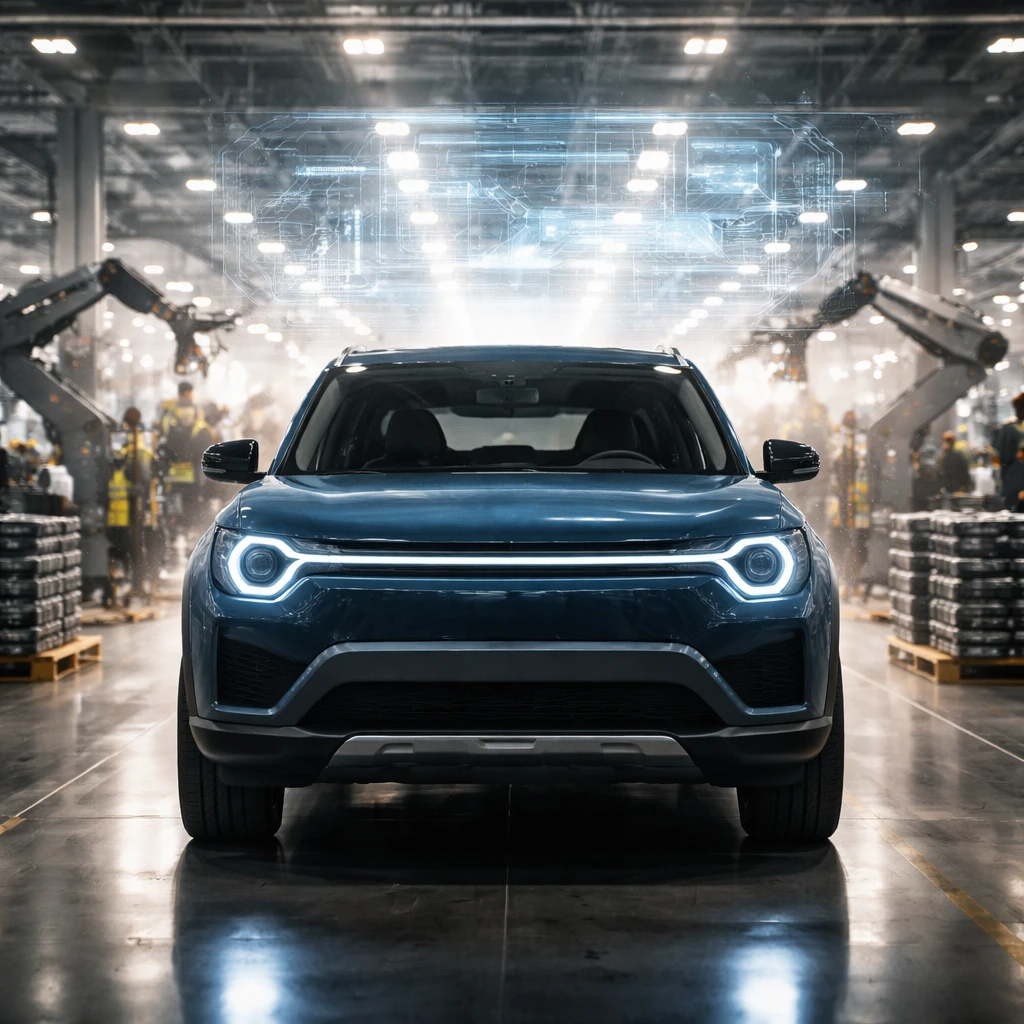
Rivian is entering the most important phase in its corporate life cycle: the R2 launch. If Rivian can produce a mass-market R2 priced around $45,000 and hold recent margin gains, the stock has meaningful upside from current levels. At the same time, the company still burns cash and reported large net losses in 2025, so this trade is conditional on execution at the factory level and margin discipline.
My trade thesis is straightforward: buy Rivian as a long-term trade tied to R2 ramp and ongoing software/AI monetization. I view the current price - $16.75 - as a reasonable entry if you accept the execution risk. The market is rewarding improving unit economics already: Rivian posted its first full year of gross profit ($144 million) in 2025 even while losing $3.6 billion at the net level, and management is guiding R2 volumes to meaningfully expand the addressable market.
The business and why the market should care
Rivian designs and manufactures electric vehicles and related software/services across two segments: Automotive and Software & Services. The company has vertically integrated elements not only in manufacturing but increasingly in software and AI - pursuing in-house AI chips, conversational assistants, and autonomy work that management says could be a differentiator. The R2 is positioned as the company's mainstream product: a smaller, less expensive SUV aimed at buyers under the $50,000 EV price point.
Why this matters to investors: the R2, if produced at scale, materially expands Rivian's TAM beyond premium adventure trucks and vans into the volume SUV segment. Management's 2026 delivery target range for R2-related volume is 62,000-67,000 units, which would be a step-change from prior years. Combined with improving gross margins (Rivian posted $144 million gross profit for 2025), this could shift the narrative from 'scale-up' to 'unit-economics improvement' and justify a higher multiple.
What the numbers say
- Current price: $16.75. Market cap: approximately $20.8 billion.
- Valuation metrics: price-to-sales ~ 3.66x, price-to-book ~ 4.31x, enterprise value ~ $20.56 billion, EV-to-sales ~ 3.82x.
- Profitability and cash flow: full-year 2025 gross profit came in at $144 million while the company posted a $3.6 billion net loss in 2025. Free cash flow remains negative at about -$2.489 billion.
- Balance sheet/operating items: shares outstanding ~ 1.241 billion, float ~ 813.7 million. 52-week range: $10.36 to $22.69.
- Trading activity and technicals: two-week average volume ~ 24.56 million, today’s volume ~ 34.7 million. RSI ~ 59.4, short interest ~ ~144 million shares (recent settlements), MACD showing bullish momentum.
Valuation framing
At a market cap near $20.8 billion and EV roughly $20.56 billion, Rivian is valued today as a high-growth EV maker that still has to prove sustainable profitability. Price-to-sales of ~3.66x reflects market expectations of future sales growth and margin expansion, but it is a far cry from the premiums assigned to dominant incumbents. The positive here is that Rivian's gross-profit inflection in 2025 is a first proof point that its cost structure and mix can improve; the investor question is whether R2 scale will sustain or accelerate that trend.
Put another way: the stock is priced for a meaningful recovery in volumes and margins, not for immediate profitability. If Rivian reaches the mid-double-digit thousands of annual R2 sales while holding gross margins, the company could justify a re-rate even without immediate GAAP profits. Conversely, a messy R2 ramp or margin erosion would likely reverse the re-rating and reset expectations lower.
Catalysts to watch (2-5)
- R2 production ramp and delivery cadence - on-time production ramp with volumes toward the 62k-67k range would be the primary positive catalyst.
- Margin disclosure - quarterly gross-margin retention or improvement from the $144 million gross-profit base in 2025.
- Software/AI monetization - evidence of recurring revenue growth from software, subscriptions, or autonomy features would lift the multiple.
- Free cash flow trajectory - evidence of materially smaller negative FCF or a path to breakeven would be a major valuation driver.
- Factory uptime and supply-chain stability - fewer manufacturing stoppages and stable input costs would reduce execution risk.
Actionable trade plan
I recommend a directional long with explicit risk controls. Trade parameters:
- Entry price: $16.75
- Target price: $28.00
- Stop loss: $12.50
- Horizon: long term (180 trading days) - this reflects the multi-quarter nature of production ramps and margin realization. Expect the R2 ramp and related margin evidence to unfold across several quarters; avoid treating this as a quick swing trade.
Rationale: the $28 target assumes that successful R2 production and margin stabilization can re-rate Rivian closer to what you would expect for an EV maker that demonstrates scalable unit economics and growing software revenue. The $12.50 stop provides room for regular volatility while capping downside if the market re-prices the story on a missed ramp or material margin deterioration.
If you prefer a layered approach, initiate half the position at $16.75 and add on a confirmed production/margin beat or sustained volume guidance lift. Size the position to limit portfolio exposure given the company's negative free cash flow and recent net losses.
Risks and counterarguments
There are several meaningful risks that argue for conservative sizing and active monitoring:
- Execution risk at factories - the R2 ramp is a production exercise. Any delays, quality problems, or lower-than-expected yields will compress margins and delay the revenue inflection.
- Cash burn and funding - free cash flow was negative about -$2.489 billion. Continued cash burn at that magnitude without a pathway to positive FCF will force dilutive financing or constrain growth investments.
- Competition and pricing pressure - the mainstream EV market sub-$50k is competitive. Price cuts or incentives from rivals could force Rivian to sacrifice margin to hit targets.
- Macro demand sensitivity - EV demand is still cyclical and influenced by incentives, interest rates, and consumer sentiment. A downturn in demand would disproportionately hurt a still-loss-making OEM.
- Autonomy/AI expectations mismatch - Rivian's ambitions in AI and in-house chips are bullish for the story, but if these initiatives take longer or cost more than expected, they could become a cash drain rather than a value driver.
Counterargument: skeptics would point out that Rivian is still loss-making at scale, with a large negative FCF and net losses that require durable operational improvements to overcome. They would argue that Tesla's scale and software lead make it hard for smaller competitors to win significant share without aggressive cash consumption. Those are fair points; this trade therefore assumes visible evidence of execution - not just promise.
What would change my mind
I would materially reduce conviction or flip bias if any of the following occur:
- R2 production misses guidance materially or is delayed beyond the current quarter cadence with visible margin degradation.
- Free cash flow does not show improvement over two consecutive quarters and the company announces a dilutive financing that meaningfully increases share count beyond recoverable levels.
- Software monetization stalls or cannot be shown to be a meaningful recurring revenue stream within the next 4 quarters.
Conversely, I would increase conviction if Rivian posts sequential margin expansion, reduces FCF burn, and provides clear subscription or software ARR metrics that indicate recurring revenue growth.
Conclusion
Rivian's stock at $16.75 reflects a conditional opportunity: the company has proven that gross-profitability is achievable while still facing large net losses and cash burn. The R2 is a clear strategic inflection point. For patient, risk-tolerant investors, a long position sized conservatively with the entry and stop above provides an actionable way to participate in a positive outcome while protecting against the real downside scenarios. Execution - not faith - is the arbiter here. Monitor production metrics, margin cadence, and cash flow closely over the next 180 trading days.
Trade idea: Buy Rivian at $16.75, target $28.00, stop $12.50, hold for long term (180 trading days) while monitoring R2 ramp, margins, and FCF trajectory.