
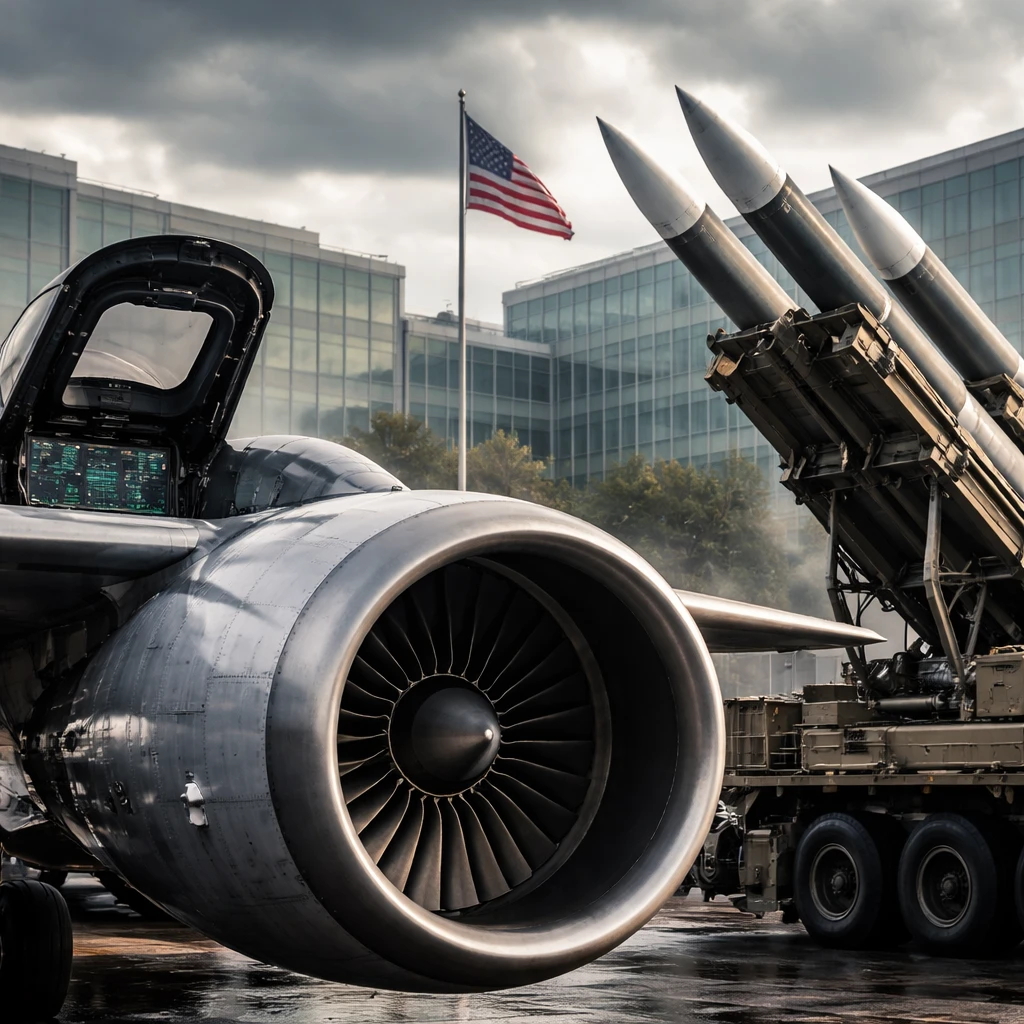
Hook / Thesis
RTX is not a momentum trade — it is the industrial backbone that governments lean on when conflict risk rises and air travel recovers. At $209.30, the stock sits inside striking distance of its 52-week high of $214.50 while delivering predictable free cash flow and visible backlog across Pratt & Whitney, Collins Aerospace, Raytheon Intelligence & Space and Raytheon Missiles & Defense. For investors willing to take a directional view on defense spending and steady commercial aerospace service revenue, RTX offers a defined risk-reward opportunity.
Our trade: enter at $209.305, place a stop at $195.00 and target $240.00 on a long-term horizon (180 trading days). We like the setup because the business combines recurring aftermarket revenue, multi-year military programs and margin-enhancing investments in production capacity. That mix gives RTX optionality through geopolitical spikes while underpinning cash generation in calmer times.
What RTX does and why it matters
RTX is a diversified aerospace and defense conglomerate operating four core segments: Collins Aerospace (avionics, interiors, mission systems), Pratt & Whitney (aircraft engines and auxiliary power), Raytheon Intelligence & Space (sensors, cyber, training) and Raytheon Missiles & Defense (sensors and weapons). The company is positioned at the intersection of commercial aviation aftermarket services and defense prime contracting, which provides a soft landing when one end-market weakens and tailwinds when the other strengthens.
Why the market should care: defense spending tends to surge unpredictably, and RTX is a primary beneficiary. Recent geopolitical developments have already triggered re-rating episodes: headlines on U.S.-led military actions pushed defense names higher on 03/02/2026, and RTX has continued to pick up contract wins in Europe and with U.S. defense agencies. Meanwhile, commercial aftermarket work and engine service programs create a recurring cash base that funds dividends and capital allocation.
Hard numbers that support the thesis
Here are the figures that matter for investors considering the trade:
| Metric | Value |
|---|---|
| Current price | $209.305 |
| Market cap | $280,874,182,500 |
| Enterprise value | $307,678,250,848 |
| Price / Earnings | ~41.6x |
| Price / Book | ~4.25x |
| Price / Sales | ~3.13x |
| EV / EBITDA | ~23.7x |
| Free cash flow (trailing) | $7.94B |
| 2025 Sales (reported) | >$88B |
| Dividend | $0.68 quarterly (payable 03/19/2026) |
Two things stand out: first, RTX generates strong absolute free cash flow ($7.94B), providing room for dividends, buybacks and capex to expand production (see Pratt & Whitney expansion plans). Second, valuation metrics are elevated versus what many would call a steady industrial - P/E ~41.6x and EV/EBITDA ~23.7x imply the market is pricing in continued growth and defense tailwinds.
Valuation framing
RTX is not cheap on headline multiples today, but context matters. The company has a large installed base of engines and avionics, which supports high-margin aftermarket revenue and recurring service contracts. Higher defense budgets or sustained conflict risk can lift program revenues and margins quickly for prime contractors. Market cap stands near $281B with enterprise value about $308B, while trailing free cash flow is almost $8B. That gives a rough free cash flow yield in the low-single digits at current prices, reflecting the premium the market assigns to the business.
Put another way: you are paying for quality and optionality. If geopolitical risk persists, multiples can expand further; if events normalize, the stock will need either accelerating organic growth or improved buyback/dividend returns to justify the current multiple. For the trade laid out below, we are betting on a mix of continued defense demand, execution on engine production expansions, and the market maintaining a modest multiple premium.
Near-term catalysts (2-5)
- Geopolitical risk - recent U.S. military actions and regional tensions (03/02/2026 headlines) have already driven investor flows into defense; additional escalations would support further upside.
- Contract awards and program ramps - recent wins include a DARPA deal and a German Armed Forces contract announced 02/25/2026; more awards or visible production ramps at Pratt & Whitney would be positive.
- Capacity expansion visibility - the $200M Pratt & Whitney Columbus expansion and announced investments in Singapore ($139M) boost medium-term production capability and aftermarket service revenue.
- Quarterly dividend cadence - board declared $0.68 quarterly dividend (payable 03/19/2026), supporting income buyers and reinforcing capital return policy.
Trade plan (actionable)
Trade direction: Long
Entry: $209.305
Stop loss: $195.00
Target: $240.00
Time horizon: long term (180 trading days) - we expect the trade to play out over several quarters as contract deliveries, engine production increases and defense budget clarity converge. If geopolitical risk continues to support premiums or Pratt & Whitney execution accelerates, the move to $240 can materialize within this window.
Rationale: entry near $209 locks in a price under the daily highs and still gives room to trade around the 52-week high at $214.50. The $195 stop sits below recent moving average support levels and limits downside to a defined amount while allowing for normal volatility in an industrial with sizeable daily volume. The $240 target implies roughly 15% upside and positions the trade to capture re-rating or fundamental growth without stretching expectations.
Technical & liquidity notes
The 9-day EMA is roughly $204.63, the 21-day EMA $201.81 and the 50-day EMA $195.60, giving a bullish near-term technical posture. RSI sits near 61, and MACD shows bullish momentum. Average volume across recent periods is multi-million shares per day, and short interest days-to-cover hovers around 1.9 days on the most recent settlement - manageable liquidity for this size name.
Risks and counterarguments
No trade is without downside. Key risks we monitor:
- Geopolitical normalization - the same geopolitical tailwind that helps RTX can reverse quickly. If conflicts de-escalate, defense premiums can compress rapidly and pressure the multiple.
- Execution risk on engine ramps - Pratt & Whitney is investing to raise capacity; any delays, quality issues or missed production targets would hit near-term revenue and margins.
- Valuation vulnerability - RTX trades at lofty multiples (P/E ~41.6x, EV/EBITDA ~23.7x). In a broader market selloff or rotation away from defense, multiples could contract and erase gains even if operations remain steady.
- Commercial aviation slowdown - an unexpected hit to global air travel or airline capex would reduce aftermarket revenue and engine services over a multi-quarter horizon.
- Political and ethical scrutiny - concentrated defense spending can attract congressional attention; media scrutiny about insider holdings among lawmakers (noted in headlines on 03/02/2026) could create reputational and regulatory pressure.
Counterargument: The principal counter to our thesis is valuation resilience. If the market decides defense is a short-duration trade (buy-the-news on conflict spikes and sell-on-deescalation), current multiples may be unsustainable without materially higher margins or accelerated buybacks. That scenario would undercut our target and make the position a tougher hold through normalization.
What would change our mind
We would reassess or close the position if any of the following occur within the trade window:
- Significant execution trouble at Pratt & Whitney evidenced by delayed deliveries or material quality problems.
- Clear signs of multiple contraction across the defense sector driven by a rapid de-escalation in geopolitical risk and poor macro liquidity conditions.
- Material downward revisions to free cash flow guidance or an unexpected increase in net leverage beyond the current debt-to-equity of ~0.58.
- A sustained break below $195 on heavy volume, which violates our technical support and increases downside risk materially.
Conclusion
RTX is a high-quality defense and aerospace compounder with meaningful free cash flow, a broad technology suite and direct exposure to defense budgets. The trade we outline - long at $209.305 with a stop at $195 and a $240 target on a 180 trading day horizon - is designed to capture both operational progress (engine production and aftermarket strength) and sustained geopolitical support while keeping risk defined. The trade is not without valuation and execution risk, so position sizing should reflect the premium multiple and the potential for volatility if conflict narratives change.
If you agree with the view that defense demand will remain elevated and that Pratt & Whitney and Collins execution will be steady, RTX offers a pragmatic way to play that thesis with clear guardrails. If those assumptions start to break down, the stop and the reassessment criteria above provide a disciplined exit and a process to revisit the thesis.