
Hook & thesis
Oshkosh Corp. looks attractively priced today for investors who believe defense spending and heavy-equipment replacement cycles will remain constructive over the next year. The shares trade around $149.48 with an enterprise value near $10.09 billion, free cash flow of $754.8 million and a P/E in the mid‑teens. Those fundamentals, combined with a 52-week range that includes a low of $76.82 and a high of $158.53, argue the market is offering a favorable entry into a company with solid cash generation and limited leverage.
That said, uncertainties persist at the business level - particularly in the Access segment - and momentum indicators are mixed. This is why the recommendation is a disciplined long trade (upgrade) with explicit risk controls: enter at $149.48, stop at $137.00 and target $175.00 for a longer-term position.
What Oshkosh does and why it matters
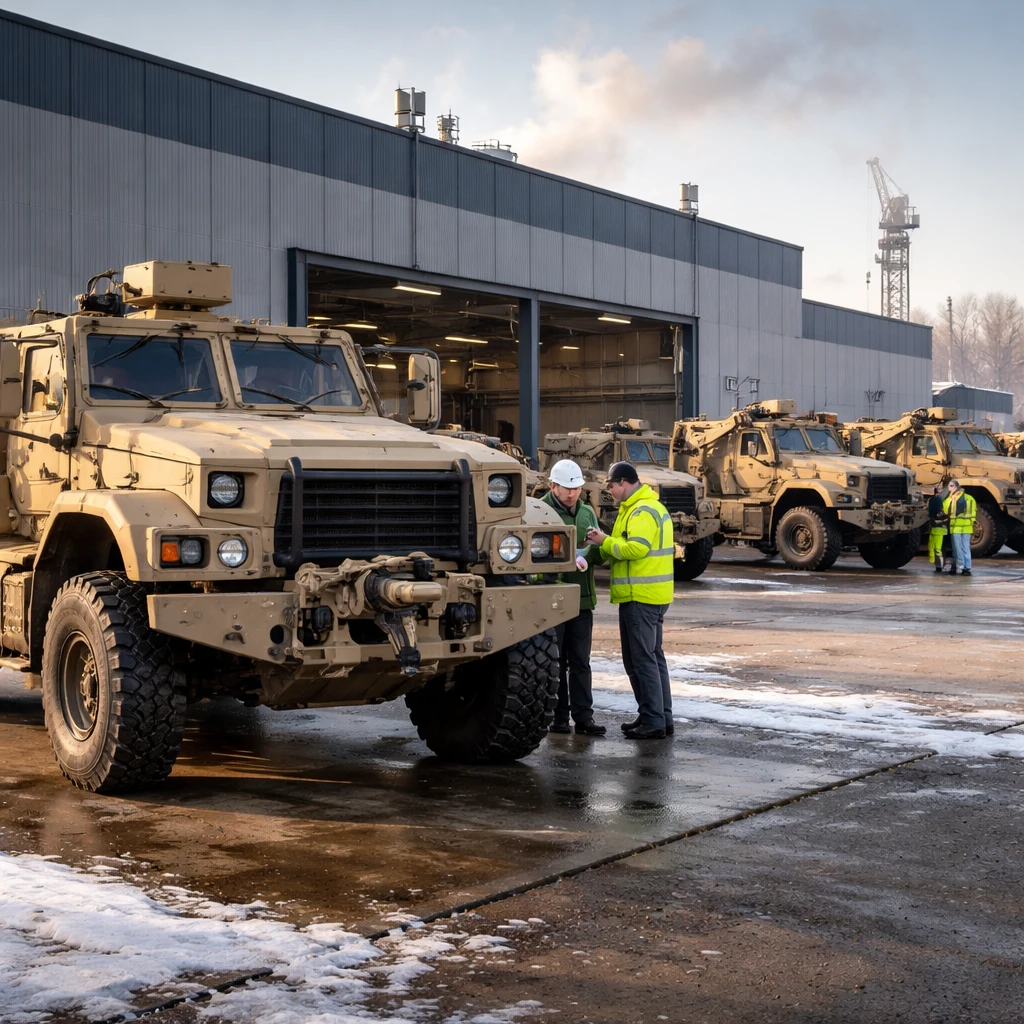
Oshkosh Corp. is a diversified industrial company that designs and manufactures purpose-built vehicles and equipment across three segments: Access, Defense and Vocational. The Defense segment is a structural advantage: demand for armored and specialized military vehicles has a multi-year runway driven by modernization programs, modular vehicle requirements and growing budgets in North America and allied markets. Industry reports in 2025-2026 highlight expanding markets for armored and mine disposal vehicles, which directly benefit Oshkosh's product set.
For investors, Oshkosh is attractive for two fundamental reasons:
- Cash generation: the company reported free cash flow of $754.8 million in the latest reported metrics, a meaningful source of optionality for buybacks, dividends and balance-sheet strengthening.
- Defensive exposure with commercial optionality: the Defense business provides higher-margin, recurring revenue characteristics versus cyclicality in Access and Vocational segments. That mix offers a buffer in softer macro periods while retaining upside if construction or municipal spending recovers.
Recent results and numbers that matter
Relevant financial and market metrics:
| Metric | Value |
|---|---|
| Market cap | $9.45B (snapshot) |
| Enterprise value | $10.09B |
| Free cash flow | $754.8M |
| P/E (trailing) | ~14 |
| EV / EBITDA | 8.58x |
| Debt / Equity | 0.27 |
| Return on Equity | ~14.7% |
| 52-week range | $76.82 - $158.53 |
These numbers sketch a company that generates meaningful cash, has modest leverage and is trading at what looks like a reasonable multiple for an industrial with large defense exposure. EV/EBITDA of 8.6x and a P/E around 14 suggest valuation is not demanding—especially when free cash flow exceeds $750M and could accelerate if Defense margins expand or Access stabilizes.
Valuation framing
Valuation here is straightforward: Oshkosh's enterprise value is roughly 13% above market cap, reflecting modest net debt and the capital intensity of the business. With FCF near $755M, the EV/FCF multiple is below 14x. For a business with steady aftermarket and defense backlog characteristics, that pricing offers potential upside if margins normalize and management continues to return cash to shareholders.
We don't have a detailed peer table in this note, but qualitatively Oshkosh's multiples are moderate versus large defense primes and heavy-equipment peers. The combination of lower net leverage (debt/equity 0.27) and a solid ROE (~14.7%) supports the case that multiples can expand if revenue and margin mix shift favorably toward higher-margin Defense work.
Catalysts (what could drive shares higher)
- Proof of Defense demand persistence - contract awards and sustained backlog growth, supported by industry reports indicating growth in armored and mine-disposal vehicle markets (noted in market reports dated 01/29/2026 and related armored vehicle analyses).
- Margin recovery in Access or Vocational segments, or better-than-expected mix shift toward Defense work in quarterly reports.
- Stronger than expected free cash flow conversion and more aggressive share repurchases or dividend increases.
- Positive read-throughs from broader defense spending increases or allied procurement programs.
Trade plan - actionable, with horizon
Recommendation: upgrade to a Long trade (position) with clear risk controls.
- Entry price: $149.48.
- Stop loss: $137.00. This level guards against a break below the recent consolidation zone and trims downside while leaving room for normal volatility.
- Target price: $175.00. This target reflects multiple expansion toward the low-teens EV/FCF range plus some cyclical improvement in margins; it sits comfortably below the recent 52-week high of $158.53 for a first objective and anticipates further upside if catalysts materialize.
- Time horizon: long term (180 trading days). Expect this position to take several quarters to play out as backlog, bookings and margin improvements become visible in reported results.
Trade sizing should respect your portfolio risk tolerance. With a stop at $137.00 from an entry at $149.48, the single-trade nominal risk is roughly 8.3%. Scale in if you prefer a staggered approach: partial entry near $145 and add toward $135 if weakness appears and fundamentals remain intact.
Technical and sentiment context
Technicals are mixed but not prohibitive. The 9-day EMA is around $148.53 and the 21-day EMA about $146.31, so recent price action is above short-term moving averages. RSI sits near 57, indicating room before overbought levels. MACD shows bearish momentum in the short term, so expect choppy action; position sizing and the stop are therefore essential. Short interest has seen variability, and recent short-volume data shows meaningful activity—this can amplify swings on news.
Risks and counterarguments
- Access and Vocational weakness. The Access segment has shown softness in prior quarters; if this continues or deteriorates, aggregate revenue and margins could compress, weakening FCF conversion.
- Execution risk on Defense programs. Large defense contracts can be lumpy and carry program execution or cost-overrun risk. Any significant program hiccup would pressure margins and the stock multiple.
- Macro sensitivity. Municipal and construction budgets (affecting Vocational and Access demand) are cyclical; a broad economic slowdown would weigh on those segments even if Defense remains stable.
- Valuation compression if multiples re-rate. Even with solid cash flow, market sentiment can reprice cyclicals and industrials lower if broader risk aversion returns.
- Short-term technical risk. Given mixed momentum indicators, there could be near-term downside before the fundamental story reasserts itself.
Counterargument: One could argue the market is correctly cautious — Access weakness is not yet healed and civil-market recovery timelines are uncertain. If Defense wins do not offset commercial declines or margins slip on new program deliveries, the company may not generate the FCF needed to justify multiple expansion. In that scenario, holding cash or waiting for clearer margin improvement would be prudent.
What would change my mind
I would reduce conviction or exit the trade if any of the following occurs:
- Quarterly results show a renewed, sustained decline in free cash flow or rising structural costs that undermine margin assumptions.
- Management withdraws guidance or materially trims long-term goals presented at recent investor forums.
- Significant program execution problems in large Defense contracts that result in contract adjustments or penalties.
- Share buybacks or other capital-allocation moves are halted in favor of value-destructive investments without clear return prospects.
Bottom line
Oshkosh offers a pragmatic, measured long opportunity. The company generates meaningful free cash flow, carries limited leverage and sits in an end-market that is currently benefiting from defense spending tailwinds. Execution and Access-segment health remain the primary unknowns, and technical momentum suggests the path higher likely will be choppy. For investors willing to accept a 180‑trading-day horizon and use strict risk management, the current pricing presents an asymmetric upside that justifies upgrading to a long trade with the entry, stop and target outlined above.