
Hook and thesis
Oracle's share price has been punished aggressively into February 2026 amid headlines about massive AI infrastructure spending, a bondholder lawsuit, and confusion over its role in the OpenAI supply chain. The market's reaction pushed ORCL into deep oversold territory - current price $147.25 with an RSI around 23 - presenting a tactical opportunity: buy a controlled bounce now that management's financing plan looks more explicit.
My thesis is simple: the company's recent bond package and the $50 billion allocation toward small modular reactors (SMRs) reduce one of the greatest tail risks - an immediate crushing capital bill that forces emergency financing at punitive rates. That matters to equity holders. Pair that with extreme technical oversold conditions and you have a mid-term swing opportunity. This is not a take-all-the-way-to-the-top call. Oracle still carries heavy leverage and an ambiguous OpenAI story, so the trade is sized for risk management with a strict stop and a defined target.
What Oracle does and why the market should care
Oracle sells enterprise software, cloud infrastructure, hardware systems, and professional services. Its reporting segments are Cloud and License, Hardware, and Services. Investors care because Oracle sits at the intersection of corporate IT and the AI build-out - customers need software, but large language model-era infrastructure requires massive new power and data center capacity. If Oracle mismanages that transition, its secular software profits can be strained; conversely, successful execution could lock in long-term revenue from cloud and infrastructure deals.
Key facts and recent financial picture
- Market cap: roughly $421.5 billion.
- Price-to-earnings: about 29x based on a reported EPS near $5.37.
- Enterprise value: about $533.4 billion, giving EV/EBITDA around 21.3x.
- Free cash flow is negative at about -$13.18 billion in the most recent published figure, driven by heavy capital allocation and likely timing effects.
- Debt-to-equity sits at roughly 3.61, indicating significant leverage; return on equity is very high at ~51.5% but is mechanically boosted by buybacks and leverage.
- 52-week range: $118.86 low to $345.72 high; the stock has retraced sharply off its 09/10/2025 peak.
The valuation is not cheap by traditional metrics. A P/E near 29x and an EV/EBITDA north of 21x price in a premium multiple for a large-cap software and cloud vendor. That premium assumes predictable cash generation and limited balance-sheet surprises. The market moved to deeply discount Oracle on fears of $275 billion of cumulative capex through fiscal 2028 as flagged by an analyst note - a figure that, if true, would imply material increases in gross leverage and stress free cash flow over the medium term.
Why the recent financing moves matter
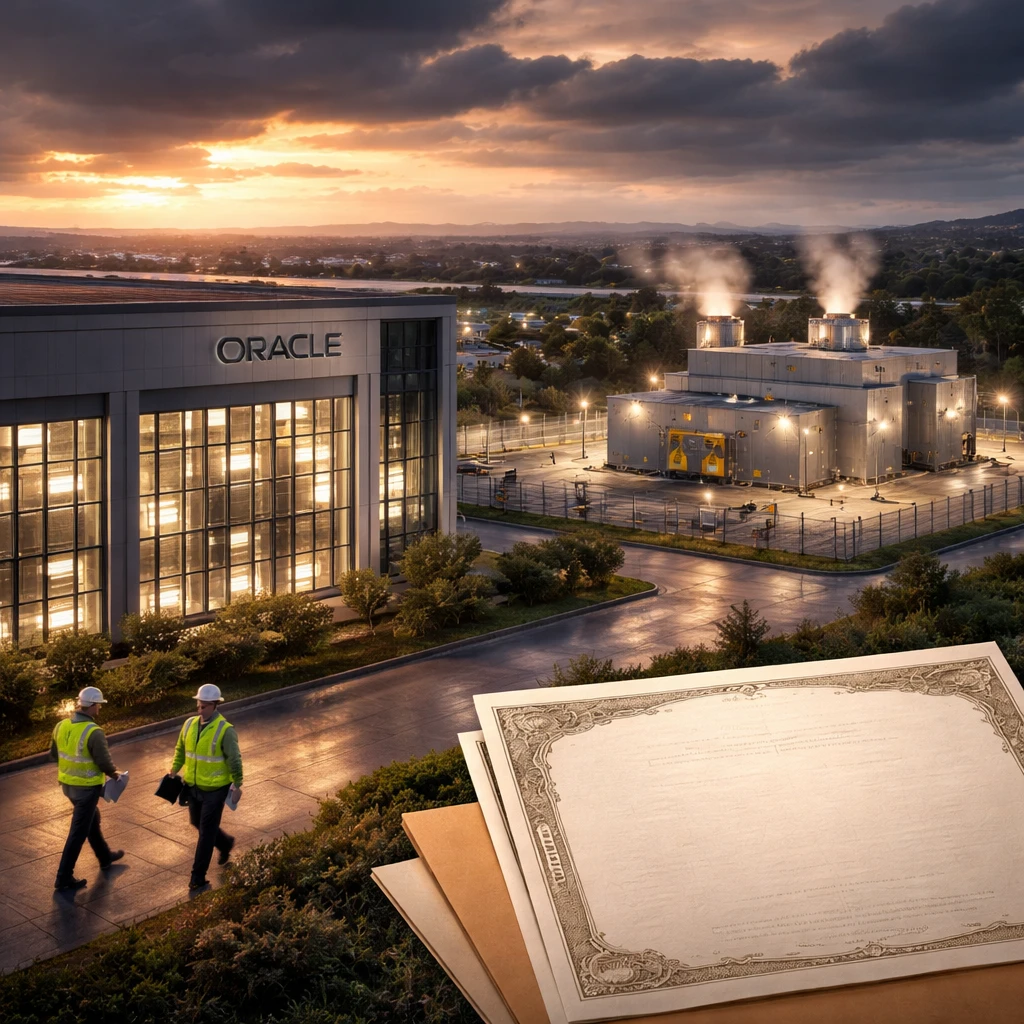
On 02/04/2026 headlines flagged a $50 billion bond offering earmarked for SMRs to address AI data center power constraints. While the optics of enormous capex remain troubling, a structured bond package for a discrete, strategic program is different from an open-ended capex commitment. A transparent financing vehicle reduces the likelihood of surprise equity dilution or emergency financings that would crush the stock. That is the constructive part of the story and the reason I am willing to take a tactical long.
Technical picture - why now
- Current price: $147.25; today's low $144.43.
- SMA/EMA context: 10-day SMA ~ $168.05, 9-day EMA ~ $164.34 - the stock is trading far below short-term moving averages, leaving room for a technical bounce toward $164-$170 as mean reversion.
- Momentum: RSI ~ 23 and MACD histogram negative - momentum is deeply oversold but not yet signaling a confirmed reversal.
- Short interest and short volume are meaningful; recent daily short volume has been large, which can exacerbate moves on a squeeze or cover.
Trade plan (actionable)
Setup: Buy Oracle for a mid-term swing anticipating a rebound as financing clarity reduces panic and traders cover oversold positioning.
- Trade direction: Long.
- Entry price: $148.00.
- Target price: $165.00.
- Stop loss: $140.00.
- Horizon: mid term (45 trading days) - expect the trade to play out within one to two months as headline noise decays, short covering subsides, and the stock mean-reverts toward the 9-21 day EMA band.
Position sizing note: treat this as a tactical swing - size the position so that a stop at $140 represents a controlled, predefined capital loss consistent with your portfolio rules. Consider taking partial profits at $158 and moving stops to breakeven after a 6-8% move in your favor.
Catalysts that could drive the trade
- Management communications and bond issuance details - specific use-of-proceeds language or tranche structure that clarifies capital allocation and timing (likely to be released in the near-term commentaries around the bond placement).
- Legal developments in the bondholder class action filed in early February - dismissals or favorable settlements would remove headline tail risk.
- Signs of OpenAI-related orders or contract confirmations (or lack thereof) from key enterprise customers; any booking disclosures that quantify Oracle's exposure to external AI hyperscalers can materially change the narrative.
- Technical triggers - a close above $164 (near the 9-day EMA) on expanding volume would strengthen the bounce thesis and justify adding to the position.
Risks and counterarguments
- Balance-sheet and capex shock - if cumulative capex truly runs toward analyst fears (e.g., the cited $275 billion through fiscal 2028), Oracle may need to raise more debt or equity, which would be dilutive and pressure the stock. High debt-to-equity near 3.6 is a real lever that amplifies downside.
- Free cash flow weakness - reported negative free cash flow of about -$13.18 billion is an acute red flag. If FCF remains negative while debt levels increase, credit markets could demand higher yields that translate to refinancing risk.
- OpenAI exposure ambiguity - the company's role with large AI customers and OpenAI remains unclear; if Oracle is counting on large, near-term OpenAI orders that do not materialize, revenue and cash expectations could be cut sharply.
- Macroeconomic and rate environment - rising rates or tighter credit could raise Oracle's financing costs and make large bond offerings less digestible, affecting equity sentiment.
- Market sentiment and software multiple compression - an ongoing re-rating of software stocks due to AI-driven insourcing could further punish Oracle's premium multiples and keep the stock range-bound or lower.
Counterargument
One could argue the stock should be sold into any bounce: the market is correctly pricing in a multi-year, capital-intensive transformation that will compress margins and require persistent refinancing. In that view, the $50 billion bond for SMRs is only the beginning of capital requirements, and the company's leverage and negative FCF justify a much lower multiple. That is a valid point and the principal reason this trade is sized as a tactical swing with a tight stop rather than a long-term buy-and-hold.
Conclusion and what would change my mind
My stance: tactical long for a mid-term rebound, based on financing clarity and extreme technical oversold conditions. Entry at $148, target $165, stop $140. This is a risk-managed, event-driven swing trade sized to withstand headline volatility.
I would change my view if any of the following occur: management discloses materially higher, open-ended capex without a matching financing plan; the bondholder lawsuit produces an adverse preliminary ruling that accelerates debt remediation; or free cash flow remains substantially negative in the next reported quarter without a credible path to normalization. Conversely, clear contract bookings tied to AI infrastructure and incremental disclosures that convert the $50 billion program into graded, non-dilutive financing would reinforce the bullish thesis and support a move toward longer-dated exposure.
Trade carefully. This is a tactical swing based on beaten-down technicals and a narrower financing risk profile; the long-term fundamental picture still requires close monitoring of capex, FCF, and OpenAI exposure.