
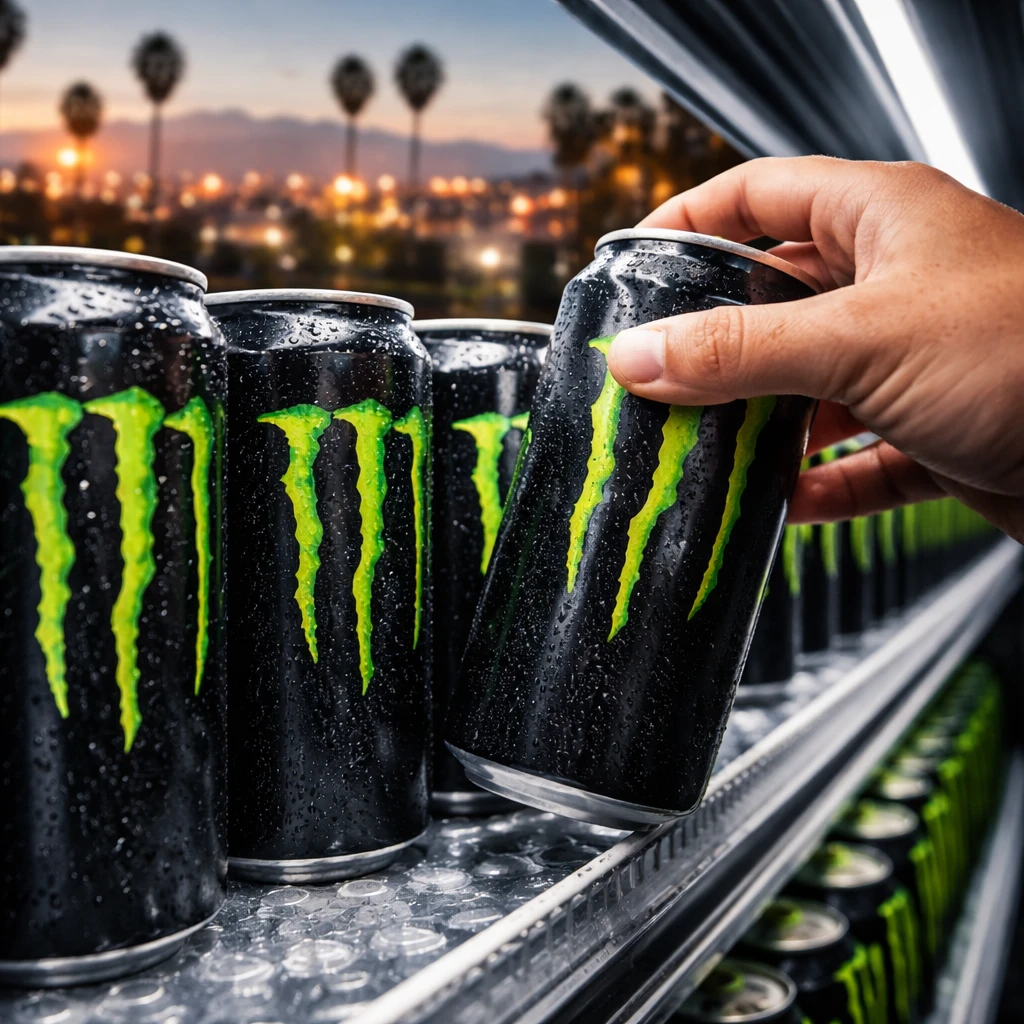
Hook - Thesis
Monster Beverage (MNST) looks like a classic case of a structurally strong business running into tactical weakness. The stock has slipped below its short- and mid-term moving averages and carries bearish momentum signals, but the company's profitability, free cash flow and distribution partnership dynamics remain intact. For traders willing to look past near-term technical pressure, the risk/reward favors a long, measured position sized for a recovery over the next 180 trading days.
In short: buy the company, not the daily tape. The trade plan below targets a return to valuation levels consistent with Monster's ROE, FCF generation and market position, while limiting downside with a disciplined stop.
Business overview - why the market should care
Monster Beverage is a focused energy-drink company that develops, markets and sells ready-to-drink packaged energy drinks and beverage concentrates. Its core Monster Energy Drinks segment serves bottlers and full-service beverage distributors. The company benefits from a concentrated product set with high incremental margins, low capital intensity and a global distribution footprint supported by strategic distribution relationships.
Why investors should care: Monster combines scale and margin. The company trades with a market cap near $71.6 billion and generates meaningful free cash flow - $1.97 billion most recently - with return on equity north of 23% and return on assets around 19%. Those numbers explain why the market is willing to pay a premium multiple for a business that consistently converts volume into cash and has limited leverage (debt-to-equity is 0).
What the numbers say
| Metric | Value |
|---|---|
| Current Price | $73.18 |
| Market Cap | $71.6B |
| PE | ~37.5x |
| Price-to-Sales | ~8.6x |
| Free Cash Flow | $1.97B |
| ROE | 23.08% |
| Cash (on balance) | $1.44B |
| Shares Outstanding | 978.3M |
Those data points tell a consistent story: high profitability and cash conversion justify a premium multiple, even as the stock trades below recent short-term averages. The enterprise value sits roughly at $69.3B, which underscores how much of the valuation is equity-driven (low leverage keeps EV close to market cap).
Technical and sentiment backdrop
Momentum is weak near-term. The 10-, 20- and 50-day simple moving averages sit at $75.04, $77.16 and $79.73 respectively, while the current price is $73.18. The RSI is low at 31.2, signaling oversold conditions but also confirming recent selling pressure. MACD shows bearish momentum with a negative histogram.
Short interest is meaningful but not extreme: the latest reported short interest (03/13/2026 settlement) was about 22.16M shares, which equates to roughly 3.45 days to cover on average volume. Recent short-volume data show elevated activity on certain days, which can amplify downside but also creates a possible squeeze tailwind should sentiment improve.
Valuation framing
At roughly 37.5x trailing earnings and a price-to-sales near 8.6x, Monster trades at a premium to broader consumer peers, but that premium reflects high margins, strong ROE and notable free cash flow. Compare that to the company's own history: the stock has routinely traded at elevated multiples due to durable brand strength and the Coca-Cola distribution relationship that supports global reach. If growth remains steady and cash conversion persists, the market can justify current multiples; if volume growth slows materially, the premium will compress quickly.
Trade plan (actionable)
- Direction: Long
- Entry Price: 73.00
- Stop Loss: 64.00
- Target Price: 95.00
- Horizon: long term (180 trading days) - allow time for seasonality, new product cycles and a technical mean reversion toward longer-term averages.
Rationale: Entry near $73 captures the current pullback while keeping a tight, defined stop below recent intra-session lows. The stop at $64 protects capital if the near-term momentum shift accelerates and signals a deeper volume or margin problem. The target of $95 is a price that would reflect both a multiple re-rating and sustained revenue/earnings recovery; it is not an extreme expectation relative to the 52-week high of $87.38 (achieved on 02/27/2026) and allows room for upside if sentiment and fundamentals align.
Catalysts to watch (2-5)
- Seasonal demand and new SKUs. Monster often benefits from seasonal volume swings and limited-edition flavors that re-energize retail sell-through.
- Distribution and partnership moves. Any expansion or change in the Coca-Cola relationship or bottler dynamics could materially change growth visibility.
- Quarterly results showing margin resilience and FCF stability. Continued free cash flow near $2.0B will support buybacks or strategic investments.
- Technical improvement: RSI recovery above 50 and price reclaiming the 50-day SMA would attract momentum flows and reduce short pressure.
Risks and counterarguments
- Valuation compression: At ~37.5x earnings and >8x sales, the stock is vulnerable to multiple contraction if growth stalls. A disappointed print or weaker-than-expected volume would likely knock the multiple down quickly.
- Competition and category risk: Red Bull and other entrants continue to pressure pricing and market share. Innovation from competitors or retailer shelf shifts could impact Monster's top line.
- Distribution dependence: Strategic channel relationships (including Coca-Cola exposure noted in the market narrative) are a double-edged sword. Any change to distribution economics or prioritization could reduce reach or increase costs.
- Technical and sentiment risk: Short-volume spikes and an RSI that remains oversold can prolong downtrends. Days-to-cover in the ~3 day range can create volatility in both directions.
- Input cost and margin pressure: Commodity or packaging cost inflation could squeeze margins if not passed to consumers.
Counterargument to the trade: Some investors should prefer exposure through Coca-Cola (which holds a strategic stake) or large-cap beverage ETFs that offer dividend yield and lower valuation risk. If you prioritize yield and lower multiple risk, Coca-Cola's 2.9% yield and more conservative valuation might be a better route to consumer-beverage exposure. That said, direct exposure to Monster gives pure-play upside if energy category growth and margin strength persist.
What would change my mind
I would be materially less bullish if: (1) quarterly free cash flow or margins declined meaningfully from the current ~$2.0B FCF figure; (2) Coca-Cola materially reduces distribution support or alters the commercial terms; or (3) the company issued disappointing guidance pointing to a structural slowdown in the energy beverage category. Conversely, sustained FCF above current levels, accelerating volume growth and evidence of new product traction would strengthen the bull case and justify adding size or raising the target.
Conclusion
Monster is a high-quality cash-generative business trading on elevated multiples. The near-term technical picture is weak and the stock has attracted elevated short activity, which explains recent pressure. For traders with a 180 trading day horizon, the combination of premium cash flows, strong ROE, low leverage and a favorable distribution footprint makes a disciplined long with defined risk and a clear profit target an attractive trade. Execute around $73.00, stop at $64.00 and target $95.00, and watch cash flow, distribution news and technical indicators to manage the position.
Key points
- Strong free cash flow (~$1.97B) and high ROE (23%) support a premium valuation.
- Current price ($73.18) is below multiple short-term moving averages; RSI ~31 suggests oversold conditions but momentum is negative.
- Actionable long trade: entry $73.00, stop $64.00, target $95.00, horizon long term (180 trading days).
- Watch distribution dynamics, quarterly FCF/margins and technical recovery as primary catalysts.