
Hook and thesis
MP Materials is the U.S. rare-earth poster child: it controls Mountain Pass mining and has begun to move up the value chain into magnetic precursor production at the Independence Facility. The company trades at about $58.83 today and, in my view, offers measurable upside over the next 45 trading days as higher rare-earth prices, binding supply agreements, and structural deficits push realized margins higher.
The trade here is simple: buy MP around $58.83 with a clear stop and a mid-term target of $75. The rationale is not pure momentum chasing. It is a valuation-versus-cycle call. MP already carries a premium - market cap roughly $10.45 billion and price-to-sales north of 38x - but that premium looks defensible if the firm converts policy support and product integration into faster revenue growth and margin expansion. I lay out the why, the numbers, the catalysts, and the guardrails below.
What MP does and why the market should care
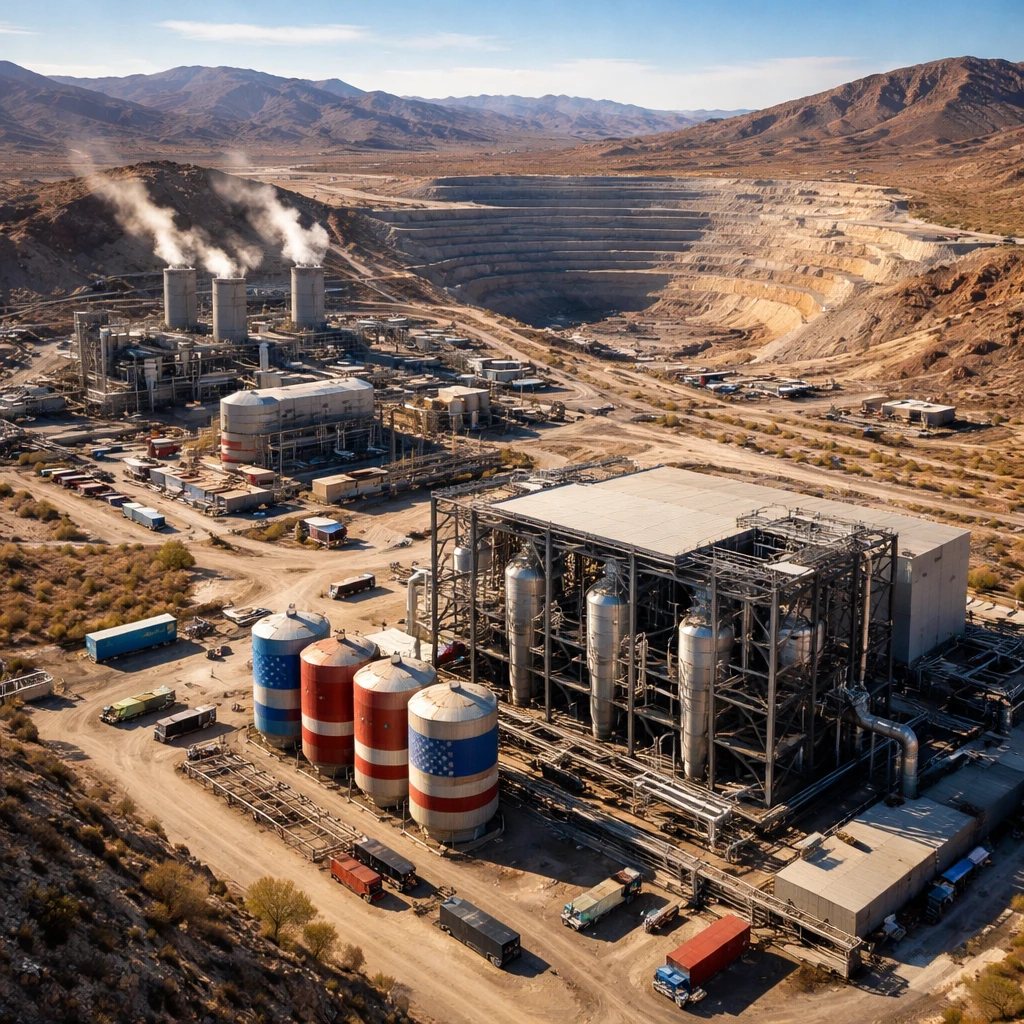
MP Materials operates two core segments: Materials and Magnetics. The Materials segment runs Mountain Pass, producing refined rare-earth oxides and concentrates. The Magnetics segment is the newer growth leg, where the Independence Facility is producing magnetic precursor products. This vertical integration matters because most of the world still relies on China for heavy rare-earths and finished rare-earth magnets. MP is one of the few U.S.-based players with scale in both mining and value-added processing, positioning it to capture outsized pricing when Western demand rises for secure supply chains.
Why care now? Several structural drivers are converging:
- Demand growth from electrification, defense, and renewable energy - these require permanent magnets that use rare-earth materials.
- Concentration of global supply - China dominates refining and magnet production, creating a geopolitical premium for U.S. supply.
- Government support and commercial price floors that de-risk revenue and provide minimum realized pricing on key magnet inputs.
Hard numbers that support the case
Start with the snapshot: MP trades at $58.83 with a market cap of about $10.45 billion and an enterprise value near $10.37 billion. The company shows a negative EPS - approximately -$0.48 per share - and free cash flow was negative $328.13 million on the most recently reported basis. Those are real headaches for a pure income investor, but they also reflect a company reinvesting to move up the value chain.
On balance-sheet liquidity, MP shows strong current and quick ratios (current ~7.24, quick ~6.67) and roughly $3.9 billion in cash on the books. Leverage sits at about 0.5 debt-to-equity. Those numbers give the company runway to execute production ramp plans and to weather short-term volatility while capital is deployed to the independence magnetics ramp.
Valuation metrics look aggressive: price-to-sales is about 38.25 and EV-to-sales roughly 37.64. By those measures, the market is pricing in a significant improvement in sales and profitability. If MP can translate higher realized prices and higher-margin magnetics sales into even a fraction of the expected revenue growth, the valuation will look less stretched. Conversely, failure to scale magnetics or weaker market prices would leave the stock vulnerable.
Technical and sentiment context
Technically, MP is trading just below its 10- and 20-day averages (SMA 10 ~ $59.56, SMA 20 ~ $59.39) and below the 50-day (~ $61.49). Momentum indicators show muted bearish momentum but an RSI near 48, which is neutral. Short interest has been meaningful historically - recent settlement shows roughly 23.3 million shares short with days-to-cover varying; recent short-volume reports show substantial shorting interest in multiple sessions. That dynamic increases both volatility risk and squeeze potential if positive catalysts arrive.
Valuation framing
It is worth stating plainly: MP is priced for success. Market cap roughly $10.45 billion and EV-to-sales ~37.6x imply the market expects a material ramp in revenue and margin conversion. The company’s current negative EPS and negative free cash flow mean that the path to earnings must come from either sustained high realized rare-earth prices, ramping magnetics volumes at attractive margins, or both.
Qualitatively, that framing is reasonable. MP owns a strategic asset in Mountain Pass, and the Independence Facility gives it an edge other U.S. players do not yet have at scale. If policy tailwinds (DoD investments, supply contracts) and commercial price floors hold, MP can grow into the valuation. If they do not, the stock will likely reprice lower quickly because multiples are not supported by current cash-generation metrics.
Catalysts to watch (2-5)
- Government/commercial contract announcements - binding supply agreements or additional DoD/DOE investments would materially de-risk revenue and support price floors. Recent coverage has referenced a $400 million DoD investment that already underpins part of revenue expectations.
- Quarterly results showing margin improvement - any quarter with expanding adjusted margins or moves toward positive operating cash flow will likely be a positive inflection.
- Magnetics ramp milestones at Independence Facility - commercial volumes or customer qualification wins would turn a story into visible revenue growth.
- Sector pricing shifts - if rare-earth oxide prices and magnet pricing rise because of structural supply deficits, MP will be a direct beneficiary given its integrated footprint.
Trade plan
Action: Go long MP at an entry of $58.83. This trade is sized as a swing trade with a defined stop and target.
Risk controls: Stop-loss at $52.00 to limit downside if either the magnetics ramp stalls or broader risk-on demand collapses.
Target: $75.00, to be taken within the mid-term window described below unless new information dictates earlier action.
Horizon: mid term (45 trading days). I choose a 45-trading-day horizon because catalyst realization - contract announcements, margin inflection, or production milestones - typically unfolds over multiple reporting cycles and operational milestones. Mid-term allows time for buyers to digest quarterlies and for magnetics ramp to produce quantifiable sales, yet is short enough to keep risk exposure contained relative to a multi-quarter position.
Why this risk-reward? From $58.83 to $75 implies roughly 27% upside. Stop at $52 limits downside to about 12%. Given the confluence of potential positive catalysts and the stock’s tendency to re-rate on visible operational progress, a 2:1 reward-to-risk is attractive for a swing-sized allocation.
Risks and counterarguments
- Valuation risk: MP’s valuation (price-to-sales ~38x, EV-to-sales ~37.6x) is lofty. If the market’s growth assumptions do not materialize, the stock could drop sharply. This is the primary bear argument - the multiple requires execution.
- Execution risk: Scaling magnetics from pilot to commercial volumes is technically demanding. Delays, qualification setbacks, or capital overruns would hit the narrative and the share price.
- Negative free cash flow: Recent free cash flow was negative about $328.13 million. Continued negative FCF would necessitate either additional capital raises or slower growth, both of which would be deleterious to the equity multiple.
- Policy dependence and competition: A meaningful portion of the company’s de-risking has come from government support and long-term contracts. A change in policy or aggressive competition from other domestically funded projects could undercut pricing power or margin assumptions.
- Market volatility and short interest: Elevated short interest and active short-volume sessions increase the odds of sharp, two-way moves. That can work for or against this trade and increases execution risk on stops.
Counterargument: One valid counterargument is that the market has already priced a successful magnetics ramp into MP. The stock rallied strongly in 2025, and the current multiple may reflect optimism around full vertical integration. If that optimism is warranted, upside will follow; if not, downside will be swift. The trade therefore relies on an operational or policy catalyst within the mid-term window to justify holding beyond short-term noise.
Conclusion and what would change my mind
My stance: constructive but disciplined. I am long MP in a swing-sized allocation at $58.83, targeting $75 in mid term (45 trading days) with a hard stop at $52.00. The thesis is that the combination of higher realized rare-earth pricing, secure supply contracts, and the magnetics ramp will materially improve revenue and margins and allow the company to grow into its premium valuation.
I would change my view if any of the following occurs: (1) a quarterly update shows a meaningful miss on magnetics production or customer qualification, (2) the company reports a fresh, large negative cash surprise that implies further dilution, or (3) government support or major supply agreements are withdrawn or altered materially. Conversely, I would increase conviction - or take profits early - if the company posts consecutive quarters of margin expansion, converts magnetics orders to binding purchase commitments, or announces additional strategic contracts that lock in higher pricing.
Quick trade summary table
| Ticker | Entry | Stop | Target | Horizon | Risk Level |
|---|---|---|---|---|---|
| MP | $58.83 | $52.00 | $75.00 | mid term (45 trading days) | medium |
Keep sizing sensible and use the stop. MP can move quickly in both directions; the play is to capture a fundamental rerating backed by operational momentum rather than to gamble on headline noise alone.