
Hook / Thesis
Legacy Housing (LEGH) is the kind of small-cap housing name that gets polarized coverage: one camp points to cyclical headwinds and execution uncertainty; the other sees cheap, durable cash generation and a valuation that already prices in little to no growth. At roughly $19.20 today, Legacy sits at a market cap of about $457M, a trailing P/E near 11, and a price-to-book below 1. Those are textbook value multiples for a business that still generates free cash flow — free cash flow was reported at $28.15M — and shows positive EPS of $1.76 per share.
My trade idea: buy LEGH at $19.20 with a disciplined stop and a target that assumes the market rerates the company closer to its 52-week range as operational shots from recent management moves begin to show up in sales. This is a long trade - a value-for-recovery setup, not a momentum chase.
Business overview - why the market should care
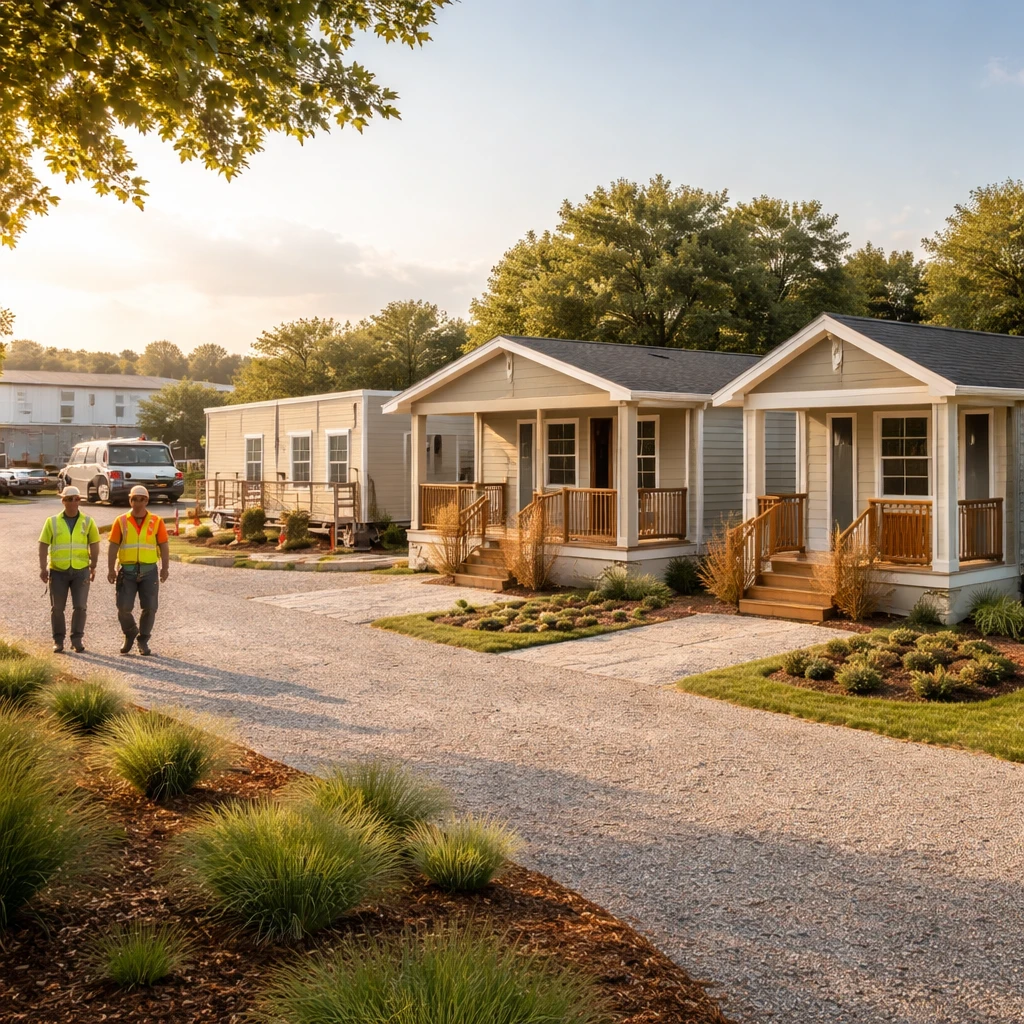
Legacy Housing builds and sells manufactured homes and tiny houses, distributed through independent retailers and company-owned stores, with a concentration in the southern U.S. The company sells singlewide and doublewide homes, tiny homes, and workforce/park housing solutions. Manufactured housing is a niche within homebuilding that has stronger demand sensitivity to financing availability, interest rates, and local zoning but benefits from lower per-unit cost and a steady demand for affordable housing.
The market should care because Legacy is a profitable, cash-generative player in an affordable-housing segment where supply shortages and housing affordability discussions persist. Management has recently relocated focus: founders returned to emphasize cost discipline and sales, the company acquired the AmeriCasa assets including the FutureHomeX platform (announced 11/07/2025), and added senior revenue-focused leadership to accelerate channel integration. If those operational actions translate into higher gross throughput without margin erosion, this business can expand its intrinsic value materially from current levels.
Recent performance and the fundamentals that matter
Key numbers everyone should have top of mind:
- Current price: $19.20.
- Market cap: ~$457.2M.
- Trailing EPS: $1.76 which implies a trailing P/E of about 11 (dataset shows ~10.94).
- Price-to-book: ~0.86.
- Free cash flow: ~$28.15M.
- EV: ~$449.9M, EV/sales ~4.8x.
- Liquidity: average daily volume ~152k (2-week average ~152k; 30-day ~129.5k), and today's volume ~238k.
Operationally, the company has had mixed recent top-line signals: product sales of $28.8M in Q3 2025 were down 4.6% year-over-year, and full-year 2024 revenue was down 2.6%. But earnings metrics look better: net income and EPS improved in the most recent comparable annual result (net income rose 13.2% and basic EPS rose 14.3% in 2024). Book value per share increased 10.2% in the third quarter of 2025. These moves suggest management extracted margin or cost benefits even as sales softened.
Valuation framing
On simple multiples, LEGH looks cheap. A P/E around 11 and P/B under 1 are low for a company that produces positive free cash flow of ~$28M on a market cap of $457M. The implied earnings yield (1 / P/E) is roughly 9%, which is attractive versus many small-cap peers and certainly compared to risk-free rates if you accept the business’ fundamentals.
There are wrinkles. EV/EBITDA is negative in the dataset (reported as -21.92), which signals accounting or timing distortions in reported EBITDA, or seasonal/one-time effects that make EBITDA temporarily negative. That inconsistency is a caution: cheap on earnings, but not uniformly cheap on all enterprise metrics. Still, the combination of positive EPS, tangible free cash flow, and a sub-1 P/B suggests the market is pricing in flat-to-declining long-term growth rather than the upside of even a modest recovery.
| Metric | Value |
|---|---|
| Price | $19.20 |
| Market Cap | $457.2M |
| EPS (TTM) | $1.76 |
| P/E (trailing) | ~11 |
| Price / Book | ~0.86 |
| Free Cash Flow | $28.15M |
| EV | $449.9M |
Catalysts (what could re-rate the stock)
- Management execution on the AmeriCasa / FutureHomeX integration (acquired 11/07/2025) that leads to measurable channel acceleration and higher per-store throughput.
- Quarterly results and conference call on 03/12/2026 - 03/13/2026 where management gives color on margins, backlog, and sales discipline.
- Evidence of sustained margin expansion: book value growth or improved gross margins that replicate recent improvements which lifted EPS while revenue was under pressure.
- Reduction in short interest or a positive revision cycle as same-store deliveries stabilize and sales growth returns.
Trade plan (actionable)
Thesis: buy the earnings yield and free-cash generation while buying optionality on growth from recent acquisitions and senior hires. This is a long trade sized to your risk tolerance.
- Entry price: 19.20
- Stop loss: 17.00
- Target price: 28.00
- Trade direction: long
- Horizon: long term (180 trading days) - give management multiple quarters to show that new revenue channels and cost discipline are sustainable and to let any seasonal demand patterns play out.
Why 180 trading days? The key catalysts - integration of acquired technology, senior sales hires, and the company's quarterly disclosure cadence - will likely take multiple quarters to feed into consistent top-line growth and a re-rating. A 6- to 9-month window allows time for backlog to convert to deliveries, for the FutureHomeX platform to be leveraged in sales processes, and for investors to re-evaluate the valuation if margins hold.
Stop rationale: $17.00 sits comfortably below the recent 52-week low area and provides a strict downside control should the recovery thesis fail or macro demand for manufactured homes deteriorate materially.
Target rationale: $28.00 implies a move toward the higher end of the 52-week range ($29.45) and reflects a ~45% upside from entry. That re-rating assumes modest revenue upside and improved sentiment toward the company’s multiples (for example, moving from a P/E ~11 closer to the mid-teens if earnings grow and risk premium compresses).
Risks and counterarguments
- Cyclicality and rate sensitivity: Manufactured housing demand is sensitive to mortgage rates, consumer financing availability, and local policy. A sustained rise in financing costs would weigh on unit demand and deliveries.
- Execution risk on integrations: Acquisitions and senior hires (AmeriCasa assets and a new Chief Revenue Officer announced 11/07/2025) can take longer to produce revenue. If the integration fails to accelerate sales, the cheap multiples may be justified.
- Mixed enterprise metrics: EV/EBITDA is reported negative (-21.92), which indicates inconsistency across accounting metrics and suggests investors should watch for one-off items or seasonally depressed EBITDA that could persist.
- Short interest and market liquidity: Short interest has been meaningful (most recent settlement ~870,499 shares with days-to-cover ~9.68), which can amplify downside on bad news and create volatility.
- Valuation trap: Low P/B and low P/E can sometimes reflect structural decline or a permanently lower multiple if the company cannot grow or sustain margins. Cheap alone is not a buy signal without operational improvement.
Counterargument to the bullish thesis: The market could be correct that Legacy is facing secular or structural headwinds in certain regional markets, meaning multiples should remain compressed. If the FutureHomeX integration and new revenue hires do not materially lift same-store deliveries, the company’s EPS could stagnate or decline and the cheap P/E will not lead to a rebound. In that case, the prudent move is to respect the stop and reassess only once management demonstrates consistent sequential revenue growth.
What would change my mind
I would upgrade the thesis if we see two things in combination: (1) consecutive quarters of top-line growth driven by higher unit sales and (2) margin stability or improvement that is repeatable (not driven by one-time cost reductions). A confirmed reduction in short interest and a clear timetable for how FutureHomeX contributes to channel sales would also materially reduce the risk profile and support a higher price target.
I would lower conviction if EBITDA remains negative on an adjusted basis, if backlog declines materially with no clear explanation, or if macro financing conditions for manufactured home buyers tighten (for example, a notable contraction in consumer financing options for manufactured homes).
Bottom line
Legacy Housing is a classic value-for-recovery trade: cheap on earnings and free cash flow, but not without execution and cyclical risk. Buying at $19.20 with a $17 stop gives an asymmetric payoff if management can execute on its recent organizational and product moves; the target of $28 assumes that modest re-rating and improved operational traction follow. Size the position for the risk of macro-driven headwinds and watch the 03/12/2026 - 03/13/2026 earnings window closely for early confirmation or disconfirmation of the thesis.
Key next dates: earnings release 03/12/2026 and conference call 03/13/2026.