
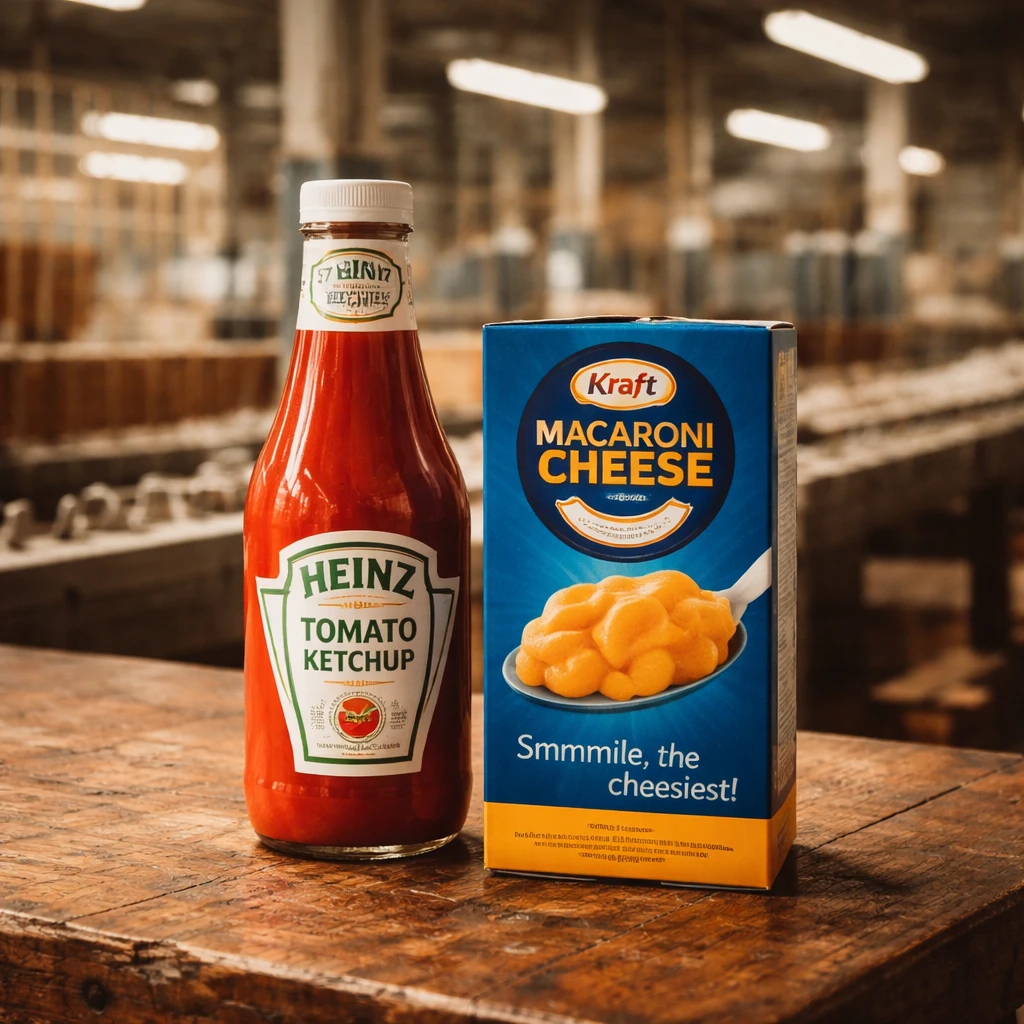
Hook + thesis
Kraft Heinz (KHC) is the kind of stock value investors circle on their spreadsheets: established brands, steady cash generation and an equity market valuation that already prices in significant execution risk. At a $21.76 market price and a market cap of roughly $25.8 billion, trailing free cash flow of $3.661 billion implies an FCF yield just above 14%—an uncommon starting point for a large-cap consumer packaged goods company.
My thesis is straightforward: buy KHC as a tactical long on the premise that cash generation is durable enough to support the dividend and provide optionality for buybacks or focused reinvestment, while any modest improvement in top-line trends or margins should trigger a multiple expansion from deeply discounted levels. This is not a low-volatility income trade; it is a value-for-recovery idea where downside is limited by strong cash generation, but upside requires execution.
What Kraft Heinz does and why the market should care
KHC manufactures and markets food and beverage products across North America and internationally. The business rests on strong, recognizable brands and deep distribution into grocery channels. For investors, packaged-food businesses are attractive when they produce steady free cash flow, sustain shareholder distributions and can reposition portfolios to take advantage of changing consumer tastes.
The market cares because Kraft Heinz currently combines a high income profile with an unusually cheap valuation: a dividend yield around 7.35% and price-to-free-cash-flow of roughly 7.0. Those numbers convert a base case—stable cash flow—with a significant margin of safety. If management can stop revenue declines and recover margins, the path to double-digit upside in a mid-term window is credible.
Where the numbers come alive
- Market cap: ~$25.8B.
- Free cash flow (trailing): $3.661B, implying an FCF yield near 14%.
- Price-to-free-cash-flow: ~7.04; price-to-cash-flow: ~5.77.
- EV/EBITDA: ~7.97, enterprise value about $44.66B.
- Dividend yield: ~7.35% (sizable income component for holders).
- Balance sheet: debt-to-equity ~0.52, current ratio ~1.15 (adequate liquidity).
- Profitability: trailing EPS is negative at -$4.94 and ROE is negative (-14.03%), reflecting recent operating pressures.
Put another way: the market is valuing KHC as a deeply out-of-favor cash generator rather than a growth story. If free cash flow remains near current levels while investor confidence recovers, the multiple gap to peers and historical norms can compress substantially.
Valuation framing
Valuation looks cheap on multiple fronts. At a market capitalization of $25.8B and trailing FCF of $3.661B, FCF yield is around 14%. P/FCF of ~7 is low for a business with durable brands and widely diversified distribution. EV/EBITDA under 8 reinforces the cheapness argument. Price-to-book around 0.62 signals a significant discount to book equity.
Compare qualitatively: many stable food companies trade at higher EV/EBITDA and P/FCF multiples because of steadier growth profiles and cleaner earnings. KHC’s discount is largely due to negative trailing EPS, weaker returns and skepticism about its ability to reverse revenue declines. If Kraft Heinz can demonstrate even modest margin stabilization and revenue stabilization, market multiples have room to expand back toward more typical sector levels.
Catalysts (2-5)
- Execution on brand revitalization - product innovations and marketing campaigns can arrest share loss in core categories.
- Cash allocation decisions - management prioritizing buybacks or targeted M&A can signal confidence and lift per-share metrics.
- Cost and supply-chain improvements - small margin recovery would be highly accretive to EPS given low starting multiples.
- Dividend safety and yield draw - a sustained dividend at the current yield keeps income-focused investors in the stock, supporting the floor.
- Any positive commentary or action involving large shareholder Berkshire Hathaway could change sentiment quickly.
Technical and sentiment backdrop
From a technical perspective the stock is near its 52-week low ($21.64) and has an RSI around 30, which is close to the oversold threshold. Average daily volume is elevated (~17M), and short activity has been meaningful—days-to-cover in recent filings sits in the mid-single digits—indicating the potential for volatile moves if sentiment flips.
Trade plan - actionable and time-boxed
This is a long idea with a primary time horizon of long term (180 trading days). Execution plan:
- Entry: $21.76 (current market price).
- Stop-loss: $19.00. A break below $19 suggests the market is repricing the durability of cash flow and increases the probability of further downside; exit to preserve capital.
- Target: $27.50. This level captures partial re-rating toward sector multiples and allows room for upside if execution improves; secondary target to consider near $31.15 (prior 52-week high) for opportunistic exits.
- Horizon: long term (180 trading days). I expect this trade to require several quarters for execution improvements or clarity on cash allocation to re-rate the stock; the dividend also supports a lower-volatility carry while waiting.
Rationale for horizon: the business needs time to show stabilized organic trends or margin recovery. Quarterly cadence of results and the company’s ability to show cash-flow stability will be the primary triggers over a 3-6 month period.
Risks and counterarguments
Always pair an upside case with sober risks. The primary risks I see are:
- Structural revenue decline: Persistent share loss and consumer shift toward fresher, health-oriented alternatives could keep top line under pressure and erode margins despite cost controls.
- Execution risk: Brand revitalization and R&D programs take time and money. If initiatives fail to move the needle, the market may demand deeper restructuring or asset sales.
- Dividend risk: The 7.35% yield is attractive, but it's contingent on stable FCF. A material drop in cash flow could force a cut, which would pressure the stock.
- Input-cost volatility and margin compression: Commodity inflation or distribution cost shocks can compress margins rapidly and reduce free cash flow.
- Sentiment and headline risk: Large shareholders altering positions, negative analyst coverage or an adverse regulatory event could exacerbate selling pressure—short interest and high short-volume days make the name susceptible to sharp moves.
A credible counterargument: Critics will say the valuation is cheap for a reason—negative EPS, poor returns and weak organic growth make KHC a value trap rather than a turnaround. If management cannot arrest revenue declines or if product revitalization is ineffective, even robust cash flow today may erode. In that scenario a dividend cut and a materially lower share price are plausible outcomes.
Conclusion and what would change my mind
Recommendation: tactical long at $21.76 with a stop at $19.00 and a target of $27.50 over a 180 trading-day horizon. The idea is not a low-risk trade; it is a risk-controlled value play that bank on KHC’s ability to sustain meaningful free cash flow and to show incremental improvement in growth or margins. The current setup offers an attractive combination of income and upside potential, underpinned by a roughly 14% implied FCF yield.
What would change my mind? I would reduce conviction materially if: (a) trailing free cash flow declines meaningfully below $2.5B on a sustained basis, (b) the company announces a dividend reduction, or (c) sequential quarterly organic sales continue to decline with no visible improvement in new product traction. Conversely, better-than-expected margin recovery, share buybacks or clear evidence of top-line stabilization would increase conviction and likely lead me to add to the position.
Bottom line: KHC is a high-yield, value-for-recovery trade. If you buy it, do so with a strict stop, a clear horizon of 180 trading days and the expectation of volatility while management executes on turning the ship around.