
Hook & thesis
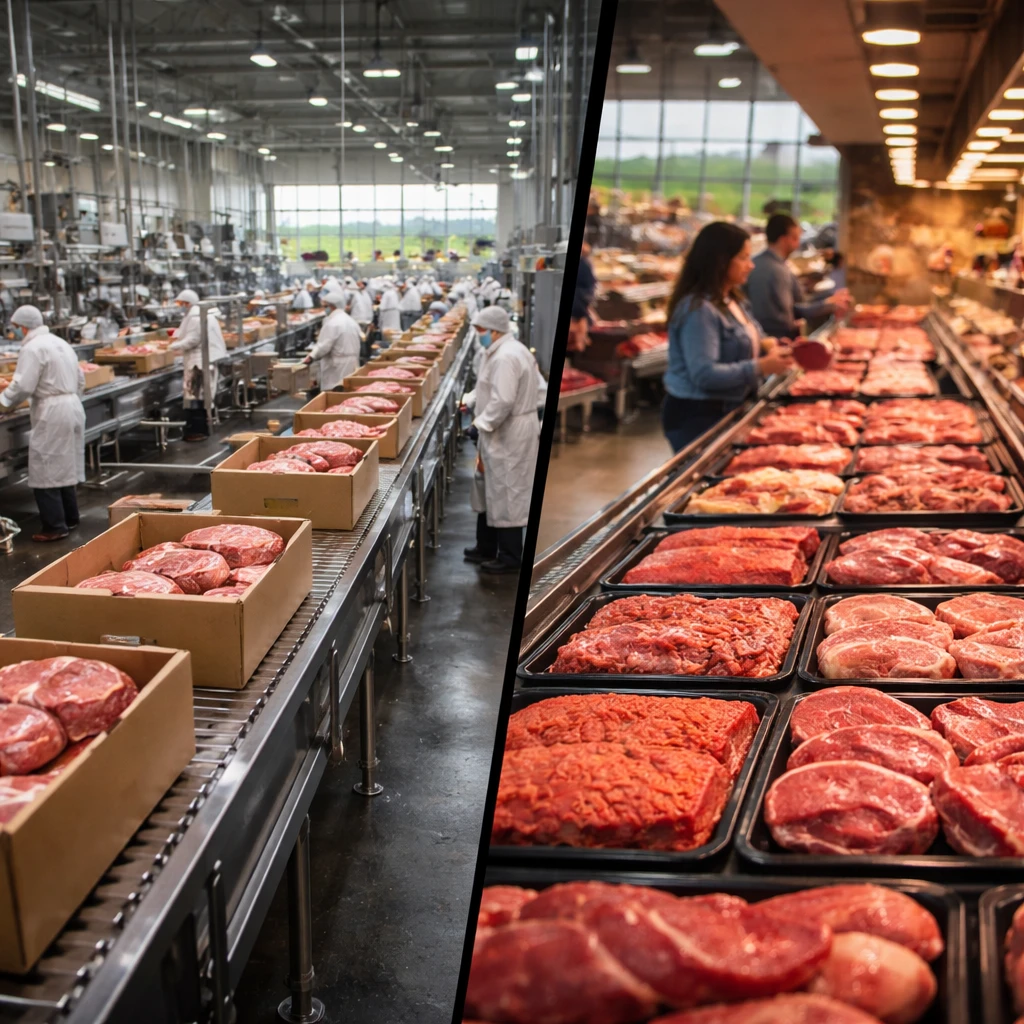
U.S. ground beef printed a record $6.67 per pound on 02/19/2026, a price level driven by a cattle herd down to roughly 85 million head - the smallest since 1951. That is not a one-week anomaly: the USDA forecasts lower beef production into 2026 and higher cattle prices (expected average cattle prices near $240 per cwt in 2026). For an integrated protein giant like JBS N.V., these supply-driven price gains create a clear earnings lever.
JBS trades at $15.53 per share with a market cap of about $16.6 billion, a trailing P/E of 10.2 and a 52-week range of $10.68 to $18.02. The combination of cheap valuation, ongoing market tightness for beef and recent corporate liability management argues for a defined bullish trade: buy JBS at current levels, place a disciplined stop, and take profits near the 52-week high if protein prices remain elevated.
Business primer - what JBS does and why the market should care
JBS is a global food company focused on beef, pork, lamb and poultry. It supplies supermarkets, club stores, retail distributors and foodservice customers across multiple geographies. The company's scale matters: when input fundamentals swing - like a sharply smaller U.S. cattle herd - large processors that can move product across channels and geographies tend to preserve volume and pricing power better than smaller competitors.
The market should care for three reasons:
- Supply-driven revenue tailwind: A shrinking herd means persistently tighter beef availability. USDA guidance points to lower production through 2026 and cattle prices averaging higher - a direct revenue tailwind for processors if they maintain throughput.
- Valuation supports upside: With a market cap of $16.59B and a P/E of 10.2, JBS looks inexpensive relative to historical multiples for global protein players during commodity upcycles. That gives upside if profits expand.
- Liability and portfolio moves: JBS completed exchange offers on $5.25B of senior notes in January 2026, which improves registration and liquidity on those obligations. The company is also expanding protein exposure in the U.S. via Mantiqueira’s acquisition moves, diversifying downstream revenue optionality.
Supporting numbers
| Metric | Value |
|---|---|
| Current price | $15.53 |
| Market cap | $16.59B |
| Trailing P/E | 10.2 |
| Price / Book | 1.84 |
| Shares outstanding | 1,068,509,184 |
| Dividend yield | ~1.5% |
| 52-week range | $10.68 - $18.02 |
Technically, JBS sits below its 10- and 20-day SMAs (10-day SMA $16.32, 20-day SMA $16.20) and just above the 50-day SMA ($15.40). Momentum indicators show modest bearish tilt (RSI ~42.8 and a MACD histogram slightly negative), suggesting room to consolidate before a larger breakout. Short interest dynamics are notable: recent days-to-cover sits around 5, and short-volume readings show material shorting activity on several recent trading days, which can amplify moves if the tape turns positive.
Valuation framing
At a $16.6B market cap and a P/E of 10.2, JBS is priced for modest growth and stable margins. In an industry where commodity swings materially alter profit pools, a sustained period of higher beef prices should translate into above-trend operating profit, at least until input costs or demand patterns change. Without a full peer table in front of us, compare this logic qualitatively: if peers re-rate during a protein tightness cycle, JBS has levers - global scale, diversified channels and balance-sheet actions - that support multiple expansion. If earnings rise materially through the next two quarters as U.S. beef tightness persists, the stock has clear runway to revisit or exceed the prior $18.02 high.
Catalysts (2-5)
- Persistently high U.S. beef prices and lower cattle inventories - continued price prints above current levels would flow through to reported revenue and potentially margins.
- Quarterly results that show better-than-expected pricing spread and stable volumes as retailers absorb higher retail prices.
- Further liability management or refinancing that reduces cash interest costs or improves maturity profile after the $5.25B exchange offers settled 01/14/2026.
- Operational progress in the U.S. protein portfolio (e.g., Mantiqueira-related moves expanding protein mix) that boosts U.S. revenue mix and margin resiliency.
Trade plan - actionable and time-defined
Setup: Buy JBS at $15.53 (market).
Entry price: $15.53
Target: $18.00 (primary profit-take near the 52-week high)
Stop loss: $13.50 (protect capital; invalidates the thesis if price breaks below recent longer-term support)
Horizon: position (180 trading days). I expect this trade to play out over a multi-month window because the supply-side constraints in U.S. cattle inventories are structural and will take time to work through the supply chain - new herd expansion won’t meaningfully affect retail beef until well into 2028. A 180-trading-day stance gives time for quarterly results, USDA supply updates and margin improvement to show in the P&L.
Why these levels: The entry is the current liquid market price; the $18.00 target is conservative versus the $18.02 52-week high and assumes the market re-rates as earnings show benefits. The $13.50 stop sits below the 50-day SMA and prior intraday lows; a move below $13.50 would indicate the thesis on pricing/earnings transmission is at risk.
Risks and counterarguments
- Input-cost squeeze risk: If cattle prices accelerate faster than retailers and consumers are willing to pay, processors like JBS could see margin compression. Increased cattle prices raise the cost base before retail pass-through occurs.
- Demand destruction / substitution: Persistent retail price inflation for beef can push consumers to chicken, pork or plant-based substitutes, reducing volumes and limiting JBS’s ability to pass cost increases fully to end prices.
- Leverage and corporate-risk events: JBS carries sizable liabilities. While the January 2026 exchange offers for $5.25B of notes improve registration and marketability, adverse refinancing conditions or large one-off charges would pressure equity.
- Regulatory, food-safety or trade disruptions: Meat processors face concentrated regulatory oversight. Any recall, plant shutdown or trade restriction could curtail production and damage the near-term earnings outlook.
- Technical/crowded short dynamics: Short interest and elevated short-volume days can create volatility on both directions. While this can amplify upside in a squeeze, it can equally accelerate downside if technical momentum turns negative.
Counterargument to the thesis: Higher wholesale beef prices do not automatically convert to higher processor profitability. If retailers absorb a larger share of price increases to protect margins or if consumers reduce purchases, JBS may face both higher input costs and stagnant volumes, leaving earnings constrained. That scenario would likely push the stock below our $13.50 stop.
What would change my mind
I will reconsider the bullish stance if any of the following happen within the next 90 days: (1) official USDA supply reports show a quicker-than-expected recovery in cattle stock or forward beef production estimates are revised materially higher; (2) JBS reports a quarter with materially worse gross margin or an unexpected large non-recurring charge; (3) signs of meaningful demand destruction in retail beef sales data; or (4) a deterioration in the funding environment that impairs JBS’s ability to service or refinance maturing liabilities.
Conclusion
JBS offers a defined asymmetric trade: it is inexpensive on headline multiples (P/E 10.2) and sits squarely on the right side of a supply squeeze in U.S. beef that should boost processors’ top-line and — if transmission holds — bottom-line. Risk is real: higher cattle costs, demand elasticity, and corporate liabilities could spoil the party. For traders and longer-term investors who want exposure to protein-price upside but also want disciplined risk control, the plan above - buy at $15.53, stop at $13.50 and target $18.00 over a position (180 trading days) horizon - is a pragmatic, data-driven way to play the theme while protecting downside.