
Hook & Thesis
International Seaways (INSW) has been one of the shipping market's comeback stories: the stock is trading near its 52-week high at roughly $75.50 after bouncing from a low near $27 earlier in the cycle, and it now offers an attractive mix of cash return, fleet renewal and margin leverage if freight markets stay constructive. For traders willing to accept cyclical swings, INSW's balance sheet and recurring free cash flow make a controlled long the sensible way to capture upside while keeping risk tight.
I'm presenting a defined trade: enter at $75.50, stop at $68.00, target $95.00, with a long-term horizon (180 trading days). The rationale: valuation is reasonable relative to the company's cash flows (EV/EBITDA ~10.3), the firm pays a yield near 4% and leverage is modest (debt/equity ~0.41). That combination lets shareholders benefit from freight rate recovery without banking on an extreme re-rating.
What the Company Does and Why the Market Should Care
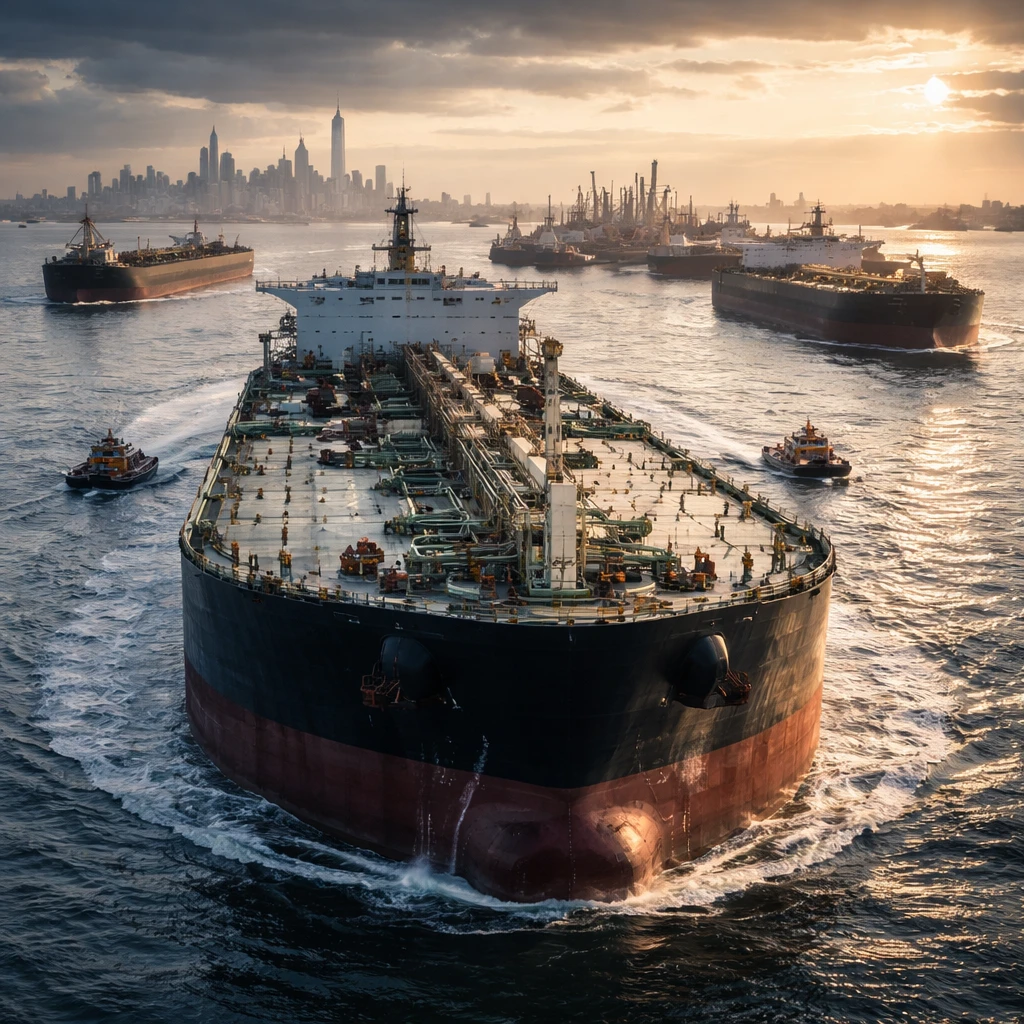
International Seaways operates crude tankers and product carriers transporting crude oil and refined products worldwide. Shipping is a classic cyclical business - freight rates move with global oil demand, refinery runs and tanker tonnage supply. Investors care because a meaningful upswing in spot rates translates rapidly into higher margins and free cash flow for owners of modern, efficient vessels.
Two practical strengths for INSW stand out: fleet quality and liquidity. Management has been modernizing the fleet, which helps with fuel efficiency and regulatory compliance - a competitive advantage as charterers favor compliant, lower-emission tonnage. On liquidity, the company reports solid cash on the balance sheet and a current ratio of 1.75, giving management flexibility to manage dry-dock schedules, debt maturities and shareholder distributions.
Numbers That Matter
| Metric | Value |
|---|---|
| Current Price | $75.53 |
| Market Cap | $3.73B |
| P/E (TTM) | ~17.2 |
| EV / EBITDA | ~10.3 |
| Debt / Equity | 0.41 |
| Current Ratio | 1.75 |
| Free Cash Flow (last reported) | $70.8M |
| Dividend Yield | ~4% |
| 52-Week Range | $27.20 - $78.51 |
These figures show a company with scale ($3.7B market cap), earnings power (reported EPS near $4.40), and a valuation that is not stretched given the asset-heavy nature of the business. EV/EBITDA around 10x implies the market is not fully pricing peak cyclical upside, but also is not assuming a return to boom-era margins. The balance sheet looks conservative for the sector: debt/equity ~0.41 and over $1.2B of cash on hand give management options if markets soften.
Technical & Positioning Notes
Price momentum is strong: the stock is above its 10-, 20- and 50-day moving averages and the MACD shows bullish momentum. RSI is elevated (~80), so near-term mean reversion risk exists. Short interest has fallen materially from multi-million share highs earlier in the cycle to about 1.25M most recently, which reduces the likelihood of aggressive short-covering squeezes but still leaves room for volatile moves on news.
Valuation Framing
Valuing a shipping firm requires blending asset replacement logic with cyclically adjusted earnings. At a market cap near $3.73B and EV/EBITDA about 10.3x, INSW trades at a modest premium to where distressed shipping names sit in downturns and a discount to peak-cycle multiples. Price-to-book is near 1.93, which suggests the market values the fleet close to its stated book replacement value. With a roughly 4% yield and recurring free cash flow, the opportunity isn't purely speculative - the stock offers an income cushion while the cycle improves.
Without a direct peer set in this write-up, think of the valuation as mid-cycle: not cheap enough if rates collapse, not expensive if rates normalize or slowly improve. That supports a risk-controlled long rather than an all-in growth bet.
Catalysts (what can drive the trade higher)
- Freight-rate improvement from higher global refinery runs or stronger crude flows, which would expand daily charter rates and bump margins.
- Continued fleet modernization and selective disposal/renewal of older tonnage, improving EBITDA per vessel and earnings sustainability.
- Investor events and visibility - management is participating in the Capital Link forum on 03/09/2026, which could lift sentiment if guidance or commercial insight is positive.
- Shareholder returns - a consistent quarterly dividend (ex-dividend 03/20/2026, payable 03/30/2026) supports investor demand at current yields.
- Macro tailwinds: any uptick in seaborne crude demand or chokepoint disruptions that tighten available tonnage could lift rates quickly.
Trade Plan (Actionable)
Thesis: Long with defined risk controls to capture a freight-driven earnings reacceleration and multiple expansion.
- Entry: $75.50 (enter near the current market price).
- Stop-loss: $68.00 (hard stop; cut the position if price closes below this level).
- Target: $95.00 (primary target; take profits into strength). If momentum is strong, consider partial trimming near $85.00.
- Horizon: long term (180 trading days). Expect the freight cycle and contract renewals to play out over multiple quarters; allow time for earnings and cash flow to catch up with sentiment.
Position sizing: given shipping cyclicality and an elevated RSI, keep the initial position moderate (e.g., 2-4% of portfolio capital), using the stop to limit downside to an acceptable fraction of portfolio risk. Reassess exposure after quarterly disclosures or material changes in freight rate trends.
Risks (what can break the trade)
- Freight-rate reversal: The company's earnings are highly dependent on spot and time-charter rates. A sustained downturn in global oil flows or a rapid influx of tonnage would compress EBITDA and pressure the stock.
- Macro demand shock: Recessionary pressure or a sharp drop in refinery throughput would reduce demand for tankers and lower utilization.
- Regulatory / logistics disruption: Geopolitical events or new regulatory costs (IMO rules, emissions compliance) could increase operating expenses or idle vessels for retrofits.
- Market multiple contraction: If investor risk aversion returns to the sector, valuation multiples could compress even if earnings hold, pushing the stock lower.
- Execution on fleet strategy: If modernization projects slip or capex overruns hit liquidity, free cash flow and the dividend could be at risk.
Counterargument
One could argue INSW is richly priced for the sector given current spot market strength and sentiment. RSI near 80 suggests the rally may be driven more by momentum than fundamental improvement, and a single quarter of weak charter rates could quickly erase gains. For that reason, a more cautious investor could prefer waiting for a pullback toward the mid-$60s or a lower RSI before starting a position. That is a reasonable alternative strategy; this trade accepts shorter-term overbought risk in exchange for earlier exposure to potential upside from a sustained freight recovery.
Conclusion and What Would Change My Mind
International Seaways is a pragmatic long: respectable free cash flow generation, a manageable balance sheet and a dividend near 4% give downside support while a freight-rate recovery offers upside. The trade outlined (entry $75.50, stop $68.00, target $95.00, horizon long term - 180 trading days) balances those dynamics and keeps losses limited if the cycle reverts.
I would change my view if any of the following occur: (a) freight rates deteriorate across the board and utilization falls materially, (b) the company announces major unexpected capital spending or a dividend cut, or (c) total leverage rises meaningfully above current levels (debt/equity well above 0.6). Conversely, accelerating earnings and upward guidance from management, or sustained higher spot rates, would make me more aggressive on sizing and push my target higher.
Key Metrics Snapshot
| Metric | Value |
|---|---|
| Market Cap | $3.73B |
| EV / EBITDA | ~10.3x |
| Debt / Equity | 0.41 |
| Current Ratio | 1.75 |
| Free Cash Flow (recent) | $70.8M |
Bottom line: this is a risk-aware, income-supported way to play a potential cyclical recovery in tankers. Keep the stop in place, size carefully, and monitor freight markets closely.