
Hook & thesis
Intel is at a possible inflection point: years of capex and process rebuilds are beginning to intersect with real demand from AI and hyperscalers. Market prices convey skepticism - the stock trades near $46.48 after a pullback from a $54.60 52-week high - but recent developments (Apple signaling capacity stress at TSMC and talk of partnership, plus Intel's push into high-NA lithography) create a credible path for revenues to re-accelerate into 2027.
My actionable view: buy Intel on weakness around current levels with a clear stop and a multi-month horizon. The trade is a bet that process execution (18A/14A ramp) and foundry deal flow re-price the company from a recovery story into visible growth, while existing balance-sheet metrics limit downside for patient traders.
Business snapshot - why the market should care
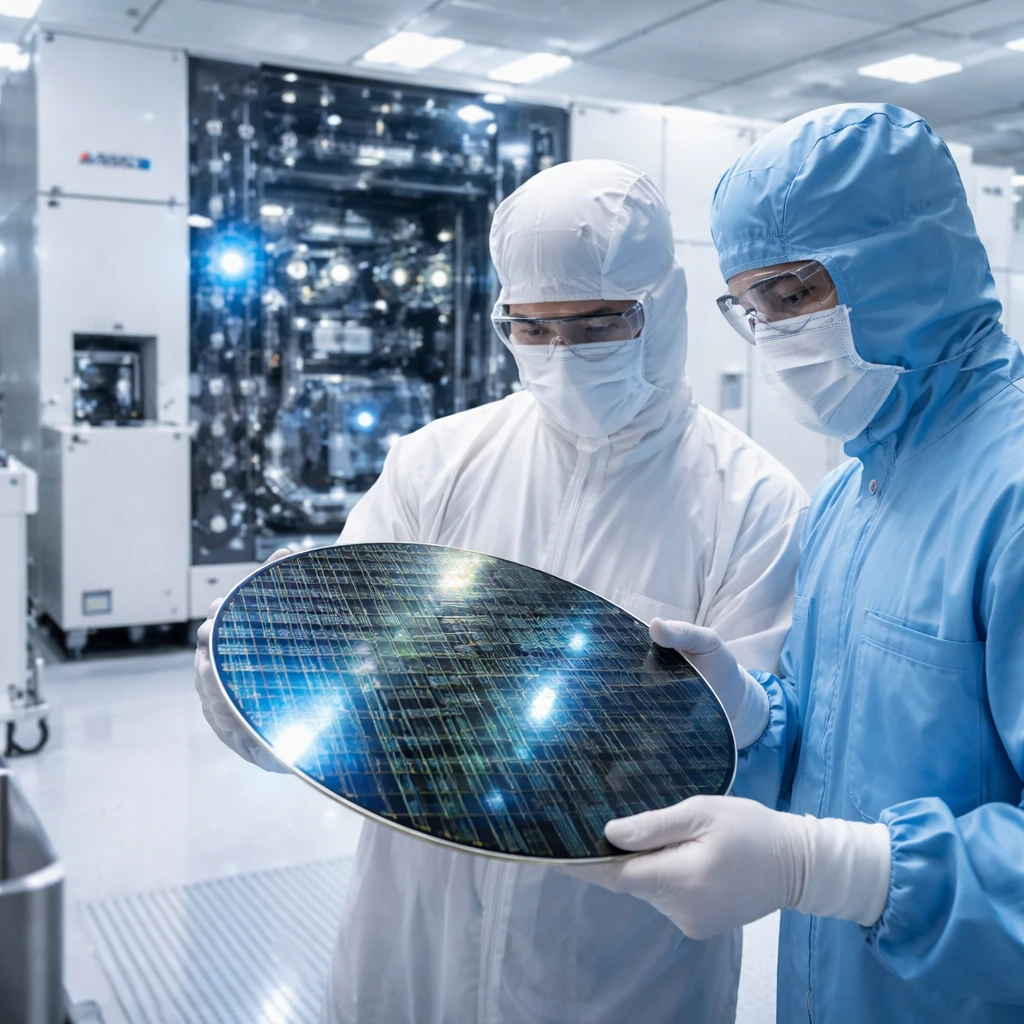
Intel is a vertically integrated semiconductor company that operates Client Computing Group (CCG), Data Center and AI (DCAI), Intel Foundry Services (IFS) and other units. The strategic pivot that's most market-relevant today is IFS and DCAI: Intel is investing in advanced nodes (including 14A and 18A aspirations) and in high-NA EUV capacity via heavy ASML spending to win back advanced logic volume.
Why this matters: hyperscalers, GPU makers and large OEMs are all scrambling for advanced foundry capacity as AI accelerates demand for custom logic. If Intel can secure foundry contracts and achieve competitive yields on 18A-class processes, the revenue and margin upside is substantial because of the scale and pricing power of AI fabrics.
What the numbers say
- Market cap: about $232.2 billion; enterprise value: roughly $264.4 billion.
- Profitability: EPS is negative at -$0.05 and the company generated negative free cash flow of about -$4.95 billion in the latest period, consistent with heavy capex and buildout.
- Leverage and liquidity: debt/equity sits around 0.41, and current/quick ratios are 2.02 and 1.65 respectively - indicating near-term liquidity is reasonable despite negative earnings.
- Valuation metrics place the company in a middle ground: price-to-book ~2.03 and price-to-sales ~4.39, while EV/EBITDA is ~22.64. Those multiples implicitly price in improvement, but not a clean execution of a foundry ramp and meaningful DCAI growth.
- Technicals and market sentiment: the 10-day SMA is $47.95 and the 20-day SMA $45.80; RSI sits near 53 - neutral; MACD is slightly bearish. Short interest is material at ~134M shares on the latest settlement and recent daily short-volume has been a significant portion of overall volume.
Valuation framing
Intel's market valuation of ~$232B intersects two big facts: (1) it carries scale and an installed base that competitors cannot instantly replicate; (2) it is priced for operational uncertainty - negative EPS, negative free cash flow, and a multi-year rebuild plan. The key question is whether future cash flows from winning foundry business and higher-margin AI silicon can be realized soon enough to justify a re-rating.
Without reliable public peer multiples for identical business mixes, think of valuation qualitatively: the current EV/EBITDA of 22.6 is rich for a company currently unprofitable, but acceptable if EBITDA grows meaningfully in 2027-2028. If Intel hits a credible 18A yield ramp and signs a few large foundry customers, a re-rating into a lower-teens EV/EBITDA multiple on much higher EBITDA could logically push the equity substantially higher from here.
Trade plan (actionable)
| Signal | Price |
|---|---|
| Entry | $46.50 |
| Stop loss | $43.00 |
| Target | $60.00 |
| Horizon | Long term (180 trading days) |
Rationale: an entry at $46.50 is essentially at the current price and offers a favorable risk/reward. Downside to the stop at $43.00 is roughly $3.50 per share (~7.5% of the entry), while upside to $60 is $13.50 (~29% upside) - a reward/risk of ~3.8x. The 180-trading-day horizon gives time for foundry deal announcements, early high-NA ASML milestones, and Q2-Q4 incremental revenue visibility to surface.
Position sizing: given the execution risk, limit any single-trade exposure to a small percentage of portfolio capital (5% or less of risk capital). If results confirm the thesis (improving guidance, customer wins, stabilizing FCF), increase exposure on confirmation rather than averaging into weakness.
Catalysts to watch (2-5)
- Foundry contract announcements - particularly any confirmation of Apple or large OEM designs being committed to Intel's 18A/14A process.
- ASML high-NA delivery and early yield milestones - public commentary that high-NA tools are performing to Intel specs would be a major de-risk.
- Quarterly guidance improvements - sequential revenue and margin beats in DCAI or IFS over the next two quarters.
- Order or capacity commitments from hyperscalers or GPU makers that increase forward revenue visibility.
Risks and counterarguments
Below are the primary downside scenarios that could break the trade thesis.
- Execution risk on 18A/14A yields: Advanced-node manufacturing is technically unforgiving. If Intel fails to reach acceptable yields on 18A or high-NA tools are delayed, the revenue ramp stalls and the market will reprice the stock lower.
- Customer allocation and timing: Apple or other large customers could elect to deepen or extend relationships with TSMC instead of shifting volume to Intel. An explicit decision against Intel for meaningful volume would be a material negative.
- Continued negative free cash flow: The company reported negative FCF of roughly -$4.95 billion recently. If negative FCF persists beyond 2026 without visible customer wins, financing needs or dilutive capital raises become a threat.
- Competitive pressure and pricing: TSMC and other foundries continue to scale density and capacity. Even if Intel wins designs, pricing pressure and market share erosion in CCG or DCAI could blunt margin expansion.
- Counterargument: The market is right to price skepticism. Intel has suffered revenue declines and profitability pressure in recent years, and a single slip in yields or a lost customer could keep the company unprofitable and pressure the equity. That path would invalidate the trade and is why a tight stop is essential.
Mitigants and why the trade still makes sense
Despite the risks above, several facts limit downside magnitude and increase asymmetric upside: Intel's balance sheet liquidity is adequate in the near term (current ratio ~2.02), debt is not excessive (debt/equity ~0.41), and the company has a unique installed base and strategic importance to customers facing severe wafer shortages. Additionally, public reports of potential Apple/Intel foundry talks and Intel's investments in ASML high-NA indicate the company is moving the pieces required to win business - if even a portion of that succeeds, the re-rating could be swift.
What would change my mind
- Missed public yield milestones for high-NA/18A in 2026 with clear signs that the technology is not maturing as expected.
- Explicit loss of a prospective large foundry customer to TSMC with supporting contract details that show long-term volume locked away from Intel.
- Worsening free cash flow trends beyond 2026 without credible capex-to-EBITDA payback timelines.
Conclusion
This trade is a calibrated bet on execution. At $46.50, Intel offers asymmetric upside if the 18A/14A roadmap and IFS deal flow begin to translate into visible revenue and margin improvements within the next 6-9 months. The company is not a binary safe-harbor - execution risk is real - which is why the plan ties a tight stop at $43.00 to a longer horizon target of $60.00 and recommends disciplined position sizing.
If you are constructive on the foundry narrative and willing to accept execution noise as part of the path to upside, this is a pragmatic way to play an 18A inflection without overpaying for optimism.