
Hook / Thesis
InfuSystem (INFU) is an operationally improving niche provider in home infusion and device services that the market can re-rate if regulatory or reimbursement clarity favors outpatient infusion growth. The company trades at roughly $8.04 per share with a market cap near $163.5 million and is showing positive free cash flow and improving profitability metrics that, combined with a potential regulatory catalyst, create an asymmetric mid-term trade opportunity.
This trade idea is actionable: enter at $7.95, use a $7.20 stop loss, and target $10.50 over a mid-term holding period of 45 trading days. The thesis rests on three pillars: 1) steady revenue and margin progress in Device Solutions and oncology services, 2) a conservative valuation relative to cash generation (free cash flow of $14.34 million and EV/EBITDA ~7.6x), and 3) the potential for policy or reimbursement developments that would accelerate outpatient infusion demand and drive re-rating.
What InfuSystem does and why the market should care
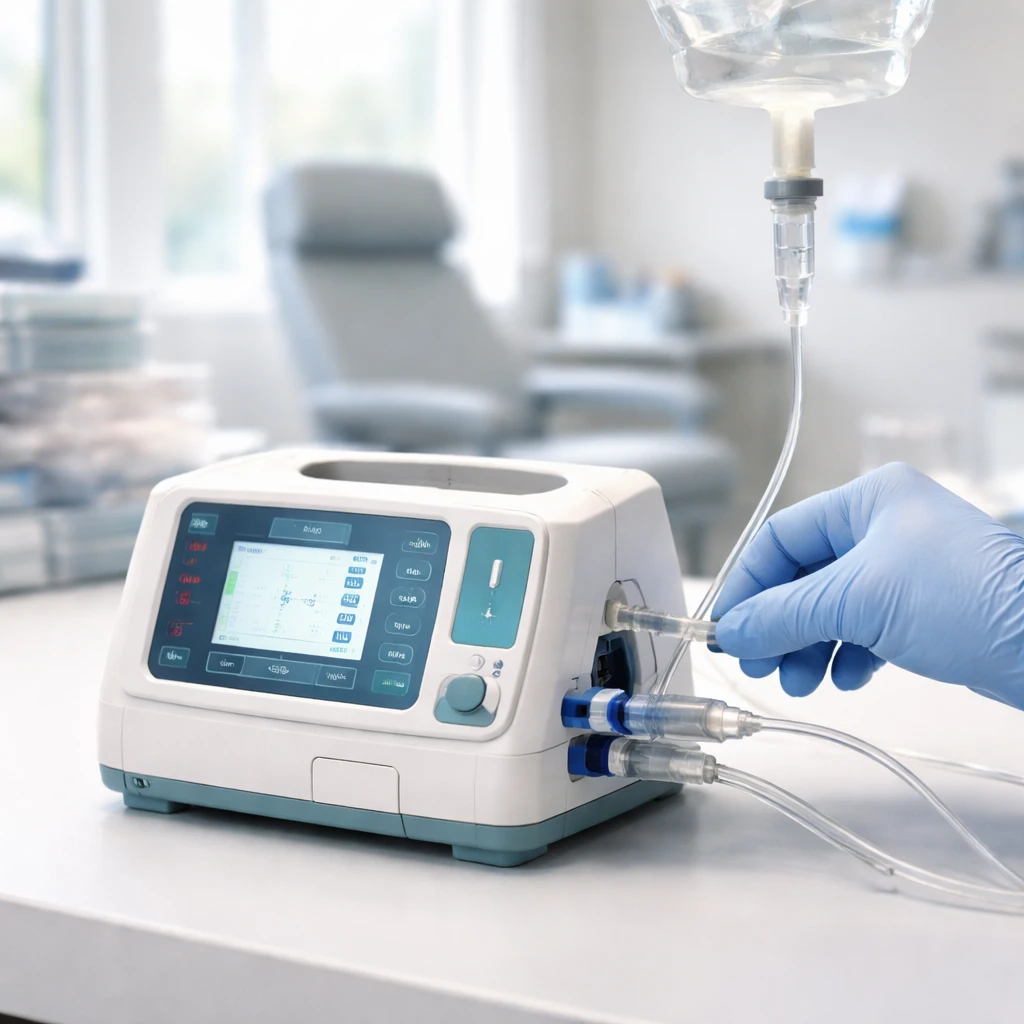
InfuSystem is a healthcare services company operating two segments: Patient Services (durable medical equipment, clinic-to-home care, logistics, billing and oncology) and Device Solutions (sale and rental of infusion pumps, consumables, biomedical recertification and repair). The business model blends recurring service revenue from pump rentals and consumables with episodic device sales and value-added support to oncology clinics and other outpatient providers.
The market cares because outpatient and home-based infusion services are a cost-saving alternative to inpatient care for many therapies. If policy or payer decisions expand coverage or reimbursements for home infusion, that can materially accelerate utilization and drive both top-line growth and higher margin recurring revenue for InfuSystem. Even without an explicit policy change, the company’s steady operational improvement makes it an easy target for re-rating once the narrative shifts from recovery to durable growth.
Key operating and financial picture
Recent reported Q2 results showed an EPS jump (quarterly EPS of $0.12) driven by a 6.8% revenue increase to $36.0 million and operational improvements in Device Solutions and oncology segments. On the profitability and balance-sheet side, the company reports:
- Market capitalization: $163.5 million
- Enterprise value: $183.68 million
- Free cash flow: $14.34 million (the company is generating cash)
- EV/EBITDA: ~7.6x - a modest multiple for a small-cap services business
- Price-to-earnings: ~29.6x (based on the latest EPS of $0.27 per share)
- Price-to-sales: ~1.16x
- Debt-to-equity: 0.38 - manageable leverage
- Current ratio: 1.9 / Quick ratio: 1.6 - adequate near-term liquidity
Those numbers point to a company that is not burning cash, has a healthy FCF stream relative to market cap (implied FCF yield roughly 8.8%), and carries reasonable leverage. For investors who focus on cash generation and multiple compression/expansion, InfuSystem looks like a candidate for a positive re-rate if growth momentum picks up.
Valuation framing
At a market cap around $163.5 million and EV $183.7 million, InfuSystem is trading at EV/EBITDA ~7.6x and price-to-sales ~1.16x. Those multiples are modest for a healthcare services provider showing improving operations and positive free cash flow. The P/E near ~29.6x reflects a small-company growth premium but also low absolute EPS amounts (EPS $0.27 most recently).
Put simply: the market is valuing InfuSystem like a slow-but-stable services operator rather than a high-growth health-tech name. That creates room for multiple expansion if either: (a) revenue growth accelerates above recent mid-single-digit levels or (b) margin expansion lifts EBITDA and free cash flow materially. Given the company’s free cash flow of $14.34 million versus market cap, even a modest re-rating (for example, an expansion to a mid-teens EV/EBITDA on higher margins) would move the stock meaningfully higher.
Catalysts (what could move the stock)
- Regulatory/reimbursement shifts that favor home infusion or outpatient administration of therapies - this is the primary thematic catalyst that could accelerate utilization and durable revenue growth.
- Further margin improvement in Device Solutions and oncology operations documented in quarterly updates - incremental margin gains drive cash flow and valuation multiple expansion.
- Commercial wins or contract rollouts with oncology practices or durable medical equipment partners - can provide visible recurring revenue and higher pump utilization rates.
- Share buyback activity or other capital deployment that signals management confidence - the company previously authorized repurchases, and any renewed program would be a positive signal.
Trade plan (actionable)
Thesis: Long InfuSystem to capture a re-rate driven by operational improvement and potential regulatory/reimbursement clarity.
| Entry | Stop Loss | Target | Horizon |
|---|---|---|---|
| $7.95 | $7.20 | $10.50 | Mid term (45 trading days) |
Rationale: Entering at $7.95 places the trade near the intraday support area and below shorter-term moving averages, offering a reasonable risk entry if momentum reverses higher. The stop at $7.20 sits below a nearby support band and limits downside if the market decides the regulatory story does not materialize. The $10.50 target is below the 52-week high of $11.04 but leaves room for multiple expansion if either policy or operational catalysts show up in the coming 45 trading days.
Time frame: mid term (45 trading days). This period gives time for regulatory commentary, quarterly operational updates, or visible improvement in device utilization to influence the stock. If the thesis is playing out, the stock should show clear technical improvement and volume confirmation within this window. If it’s flat or down after 45 days without catalyst receipt, re-evaluate the position.
Technical and market structure considerations
Technicals show a recent pullback with the 10- and 20-day SMAs above price and the 50-day SMA higher still, indicating the stock has corrected from earlier highs. RSI around 36 signals it is closer to oversold than overbought. Short interest is relatively modest (settled short interest ~172k shares) and days-to-cover is low, which suggests aggressive short squeezes are unlikely but retail momentum could still amplify moves.
Risks and counterarguments
Be explicit: this trade is not without material risks. Key downside risks include:
- No guaranteed regulatory tailwind - the primary upside catalyst is contingent on policy or reimbursement moves that may not materialize or may be delayed.
- Reimbursement pressure - payers could push back on home infusion reimbursement or increase administrative hurdles, suppressing utilization and revenue.
- Operational variability - device recalls, supply-chain disruptions, or increasing costs for consumables could compress margins quickly.
- Small-cap liquidity and volatility - average daily volume ~125k shares means bigger orders can move the stock, and broader market weakness can exacerbate small-cap drawdowns regardless of company fundamentals.
- Valuation sensitivity - P/E near 29.6x makes the stock sensitive to earnings misses; a single-quarter disappointment could quickly reverse any re-rating.
Counterargument: An alternative, more conservative view is that InfuSystem is a decent, steady cash-generative services business but not a near-term growth compounder. If regulatory developments do not accelerate adoption and if growth remains mid-single-digits, the stock may trade sideways and remain dependent on a slow build in cash flows rather than a re-rating. Under that scenario the better use of capital might be longer-term accumulation at lower prices rather than an outcome-driven 45-day trade.
What would change my mind
I would upgrade conviction (or move to a larger position) if we saw one or more of the following: a clear and favorable reimbursement determination or CMS guidance that materially expands home infusion coverage; a quarter with clear acceleration in Device Solutions revenue and margin expansion beyond recent mid-single-digit growth; or visible large commercial contracts with oncology networks that increase recurring utilization and provide revenue visibility. Conversely, I would reduce exposure or exit if quarterly revenue and margin trends roll over, if management signals weaker demand or higher costs, or if reimbursement negotiations show adverse outcomes.
Conclusion
InfuSystem is a pragmatic trade: a cash-generative small-cap healthcare services company with an improving operations profile and a plausible regulatory/reimbursement story that could drive a meaningful re-rating. The mid-term trade setup (entry $7.95, stop $7.20, target $10.50 over 45 trading days) balances risk and reward while giving time for catalysts to materialize. Keep position size disciplined—this is a play on outcomes as much as fundamentals.
Key data points referenced in this note: market cap ~$163.5M; EV ~$183.7M; free cash flow ~$14.34M; recent quarterly revenue $36.0M and EPS $0.12; 52-week range $4.61 - $11.04; shares outstanding ~20.34M.