
Hook - Thesis
Himax is no longer just a niche display driver supplier. Recent product ramps - from the HX85200 on-cell OLED touch IC entering mass production to front-lit LCoS microdisplays for AR glasses - mean Himax is transitioning into higher-margin, higher-ASP product cycles that should show through in revenue and margin expansion across 2026. The market has begun to price that in: the stock is trading near $9.96 after hitting a 52-week high of $12.00 on 03/12/2026, but there is clear room for upside if production ramps and OEM adoption continue.
My trade idea is constructive: buy into the momentum and product-cycle re-rating with a defined entry at $10.00, a stop at $8.50, and a target of $13.00 over a long-term trading horizon (180 trading days). The setup combines tangible fundamental catalysts, improving technicals, and a market cap of roughly $1.71B that still leaves room for multiple expansion if growth and margins accelerate.
What Himax Does and Why Investors Should Care
Himax Technologies is a semiconductor supplier specializing in display imaging and processing technologies. Its product portfolio spans display driver ICs, timing controllers, wafer-level optics, LCoS microdisplays, CMOS image sensors, and power ICs. These products are used across TVs, laptops, tablets, mobile phones, AR/VR headsets, automotive displays, and industrial imaging systems. The company also pursues adjacent opportunities in ultralow-power AI sensing - branded WiseEye - and specialty optical modules through its subsidiary Liqxtal.
The reason investors should care now is twofold. First, Himax is moving into higher-value product segments: on-cell OLED touch controllers for IT devices and front-lit LCoS microdisplays for AR wearables both command better ASPs than commodity display drivers. Second, several of these products have moved from demo to mass production or are being evaluated by tier-1 OEMs, reducing execution risk compared with earlier stages of R&D.
Evidence - Recent Wins, Production, and Technical Momentum
- On 02/04/2026 Himax announced the HX85200 on-cell OLED touch controller entered mass production for laptop and tablet applications - a meaningful shift for the IT segment where precision touch and low interference matter.
- At CES 01/02/2026 the company highlighted WiseEye ultralow-power AI sensing, Front-lit LCoS microdisplays, and automotive display leadership; strategic partnerships with AUO and Vuzix were highlighted, showing channel validation for AR and wearable markets.
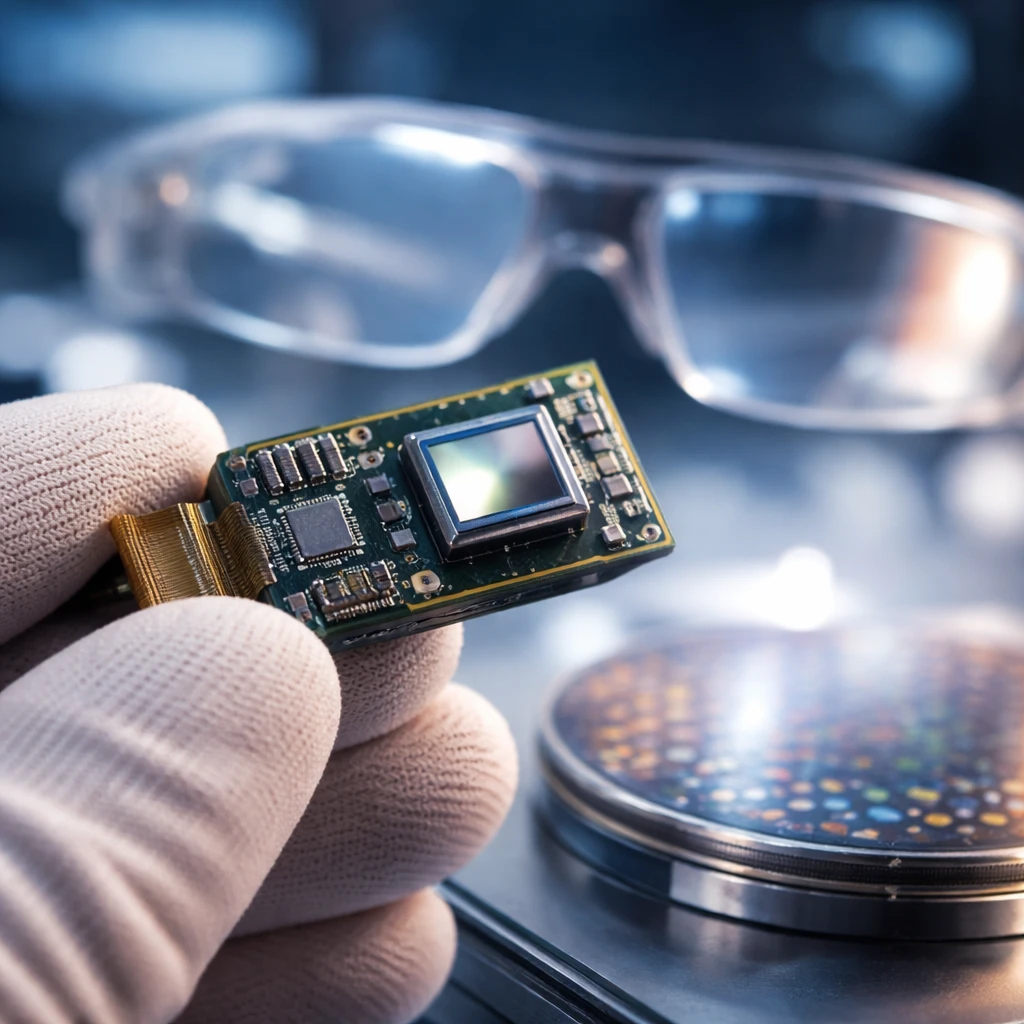
- Himax and AUO unveiled an ultra-slim high-brightness LCoS microdisplay on 12/30/2025 that is being evaluated by top-tier AR companies. The module claims 720x720 resolution, extremely low power (200 mW), and very high brightness - metrics that matter for AR glasses adoption.
- Technically the stock shows momentum: current price is $9.96, the 9-day EMA sits near $8.70, and the 10-day simple moving average is $8.25. The RSI is elevated at 72.46 and MACD shows bullish momentum with a positive histogram of 0.303, signaling trend strength in the near term.
Valuation Framing
Himax trades at a market cap of approximately $1.71B. The trailing PE reads about 39.06 and PB around 1.96. Those multiples imply the market is assigning some growth premium, but given the company's move into higher-ASP touch controllers, microdisplays, and WiseEye AI sensing, a re-rating toward the low- to mid-20s PE on sustainable revenue growth would support materially higher equity value.
To put it into practical terms: if Himax sustains meaningful design-win conversions and improves gross margins, the market could move from a valuation that reflects cyclical driver business to one that recognizes structural growth in AR/wearables and AI-sensing end markets. That is the re-rating the trade is banking on.
| Metric | Value |
|---|---|
| Current Price | $9.96 |
| Market Cap | $1.71B |
| PE Ratio | 39.06 |
| PB Ratio | 1.96 |
| 52-Week High / Low | $12.00 / $5.66 |
| Dividend Yield | 3.66% |
Catalysts to Watch
- Production ramps and revenue recognition from the HX85200 on-cell OLED touch IC as mass production scales in Q1 2026 - look for sequential revenue growth and margin improvement in the next reported quarter.
- Design wins and module shipments for the front-lit LCoS microdisplay in AR glasses - any announced OEM incorporation or qualification by a major glasses maker would be a major upside catalyst.
- Broader adoption of WiseEye ultralow-power AI in AI PCs, smart glasses, and security systems - continued customer wins like the Acer adoption will signal product-market fit.
- Further commercialization of Liqxtal optical modules and drone imaging solutions - new contracts in industrial or defense applications would diversify revenue and improve ASPs.
Trade Plan - Actionable Entry, Stops, Targets
Thesis: Buy the stock to capture upside from multiple production ramps and a likely re-rating as higher-ASP products scale.
Entry Price: $10.00 (use limit order). Stop Loss: $8.50. Target: $13.00.
Horizon: Long term (180 trading days). I expect the trade to take multiple quarters for revenue recognition and margin expansion to show in the financials; 180 trading days gives time for mass-production to translate into meaningful revenue and for the market to re-evaluate the growth profile.
Allocation and scaling: Consider starting with a partial allocation at $10.00 and adding on sustained volume-backed breakouts above $11.50 or on positive quarterly results that show revenue/margin acceleration. Tighten stops to breakeven once the position is up 10-15% and trail stops higher as the stock approaches the target.
Risk Framework - What Could Go Wrong
- Execution risk: Production does not scale as expected or OEM qualification delays push out revenue recognition. Hardware suppliers commonly face yield and qualification curves that can compress margins and delay bookings.
- End-market cyclicality: Consumer electronics demand can swing quickly. A slowdown in PC, tablet, or AR device demand would depress unit volumes and slow ASP recovery.
- Competition and pricing pressure: Competing touch controllers, microdisplays, or AI-sensing solutions could force Himax to lower prices or concede share, compressing margins and valuation.
- Valuation sensitivity: At a trailing PE near 39, the stock is vulnerable to multiple contraction if growth disappoints. Short interest and high short-volume days show some pushback from traders who may accelerate downside on missed expectations.
- Supply-chain & geopolitics: Semiconductor supply constraints, component shortages, or geopolitical issues affecting Taiwan or supply partners could disrupt production or increase costs.
Counterargument to the Thesis
One persuasive counterargument is that many product announcements in semiconductors never translate into profitable scale; the company may win evaluations and small initial orders but fail to reach mass-market economics. If Himax's new products remain niche or require heavy discounting to win production, revenues may not expand enough to justify the current multiple. That outcome would likely send the stock back toward the low end of its 52-week range.
What Would Change My Mind
I would reduce conviction in this trade if any of the following occur: a) a quarter that shows flat-to-declining revenue despite the mass-production announcement; b) material gross-margin compression indicating pricing pressure; c) a significant customer cancellation or disqualification of the LCoS or HX85200 products; or d) an acceleration in negative short-volume flows paired with persistent poor tape/wafer yields that hinder supply.
Conversely, my conviction increases if Himax posts consecutive quarters of double-digit sequential growth tied to HX85200 and LCoS shipments, or if a marquee OEM publicly names Himax as a supplier for a flagship AR or PC product.
Final Take
Himax is set up for a potential inflection. The combination of mass production for the HX85200 touch IC, promising LCoS microdisplay modules for AR, and the WiseEye ultralow-power AI sensing wins create a path to better ASPs and margins. The stock already shows bullish technical momentum, but the risk/reward is asymmetric: upside to $13.00 is plausible if product ramps continue, while a disciplined $8.50 stop limits downside if execution slips.
This is a long-term trade over 180 trading days - allow the product cycle to unfold and use incremental scaling and stop management to control risk. If the company delivers on the production and OEM adoption themes, the best for Himax is still ahead.
Trade snapshot: Entry $10.00, Stop $8.50, Target $13.00, Horizon - long term (180 trading days), Risk level - medium.