
Hook & thesis
Hess Midstream (HESM) presents a straightforward trade setup: healthy free cash flow, a yield above 8%, and valuation multiples that imply limited upside is already priced in. The balance of cash generation versus market valuation and a bullish technical backdrop argue for a mid-term long position designed to capture a re-rating and dividend carry.
We believe a disciplined entry at $36.00 with a stop at $33.00 and a target at the prior 52-week high of $44.14 offers a compelling risk/reward for a mid term (45 trading days) swing trade. The thesis is tactical rather than transformational - this is a trade to capture income, improving sentiment, and multiple expansion while respecting balance-sheet and commodity risks.
What the company does and why it matters
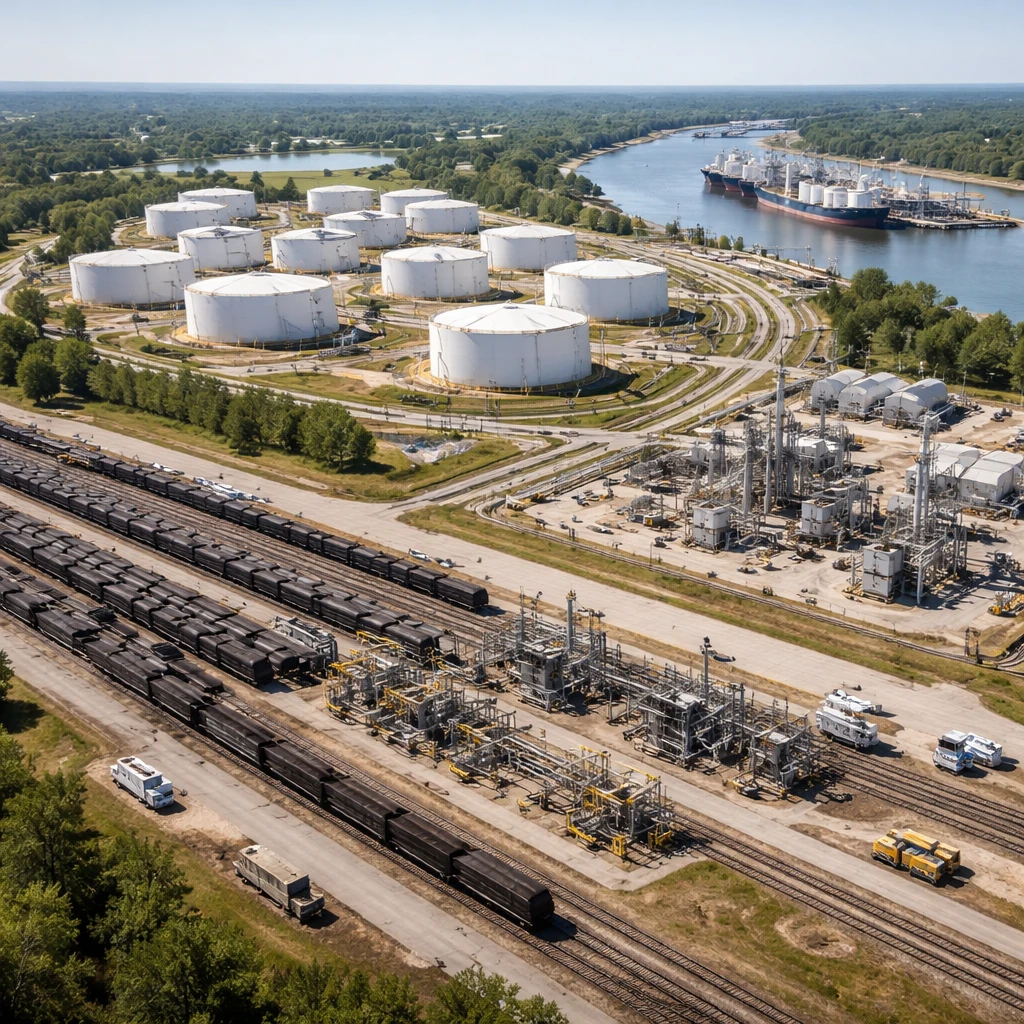
Hess Midstream LP owns and operates crude and natural gas midstream assets that serve third-party producers. Its operations are organized across three segments: Gathering, Processing and Storage, and Terminaling and Export. Key assets include the Tioga gas plant, the Ramberg terminal facility, Tioga rail terminal, crude oil rail cars and various gathering systems. Midstream companies matter because they convert volatile commodity prices into more stable fee-based cash flow via take-or-pay contracts, throughput fees and storage/terminal margins.
Why the market should care now
There are three practical reasons to care: cash generation, yield, and valuation. Hess Midstream reported free cash flow of roughly $712.7 million on an enterprise value of about $8.45 billion - giving it an attractive free cash flow profile relative to enterprise scale. The shares yield roughly 8% and trade at an EV/EBITDA of ~7.0, a level that historically has supported multiple expansion if volumes hold or improve. The stock is sitting near $35.99 with 52-week range $31.63 - $44.14; a re-test of the high would imply ~22.5% upside from our $36 entry.
Hard numbers that support the trade
| Metric | Value |
|---|---|
| Current price | $35.99 |
| Market cap | $7.47B |
| Enterprise value | $8.45B |
| Free cash flow (trailing) | $712.7M |
| EV/EBITDA | ~7.0x |
| P/E | ~14.1x |
| Dividend yield | ~8.1% |
| Debt-to-equity | 6.63x |
| RSI (momentum) | 67.7 |
How to think about valuation
At an EV of roughly $8.45B and FCF approaching $713M, the firm’s cash-generation profile supports a materially higher price if investors re-rate midstream equities back toward historical EV/EBITDA norms or if distribution stability is perceived to be stronger. The current EV/EBITDA of ~7.0x sits on the cheap side of many infrastructure peers in constructive commodity environments. That said, leverage is elevated: debt-to-equity near 6.6x signals substantial financial obligations that limit upside if volumes or commodity-linked fees fall. So the valuation case is not that the stock is “free money” but that the yield plus modest multiple expansion creates a high-expected-value trade setup.
Technicals and positioning
Momentum looks constructive near $36: the 10/20/50-day simple moving averages sit below the current price (SMA50 ~$34.07), RSI is below overbought territory but rising (~67.7), and MACD is in bullish momentum. Short interest and recent short volume have ticked up, which can add to volatility but also creates asymmetric upside if sentiment turns. Average daily volume has been healthy - roughly 1.3M shares - supporting trade execution without outsized slippage.
Trade plan (actionable)
- Direction: Long HESM
- Entry: $36.00 (aggressive limit or a small scale-in; use size discipline given leverage risks)
- Stop loss: $33.00 (booked - below recent support and the 50-day SMA)
- Target: $44.14 (prior 52-week high)
- Horizon: mid term (45 trading days) - the goal is to capture a combination of dividend carry, multiple expansion, and momentum-driven re-rating within ~9 weeks of trading days.
Rationale for sizing and horizon: midstream stocks can gap on commodity moves and distribution news. Keep position size moderate relative to portfolio risk tolerance and treat this as a swing trade: if the stock approaches the target early, consider trimming to lock gains and reassessing further upside by then.
Catalysts
- Dividend payment timing - ex-dividend on 02/05/2026 with payable on 02/13/2026: dividend capture and confirmation of distribution health can support near-term demand.
- Throughput and utilization improvements at Tioga and Ramberg terminals - flat-to-upside volumes would push consensus free cash flow higher and validate the yield.
- Commodity price stability or a modest oil/rate uptick that supports crude-by-rail economics and export margins.
- Analyst re-ratings if management signals further contract extension or additional fee-based revenue growth from terminals/rail.
Risks and counterarguments
This trade is asymmetric but not without clear downsides. Below are the major risks to weigh.
- High leverage: Debt-to-equity near 6.6x is elevated. That leverage amplifies downside in a volume or margin shock and limits the company’s flexibility on capex or buybacks. A debt-servicing squeeze could pressure the distribution and share price.
- Commodity exposure: While midstream cash flows are often fee-based, ultimate demand for crude gathering, rail, and export volumes tracks production and west Texas crude economics. A sustained commodity downturn could reduce throughput and press distributions.
- Distribution cut risk: The ~8% yield is attractive but could be trimmed if cash flow falls short or if management reallocates cash to debt paydown. Investors should treat the yield as partly compensation for this possibility.
- Liquidity & volatility: Short-interest dynamics and rising short volume may fuel sharp intraday moves. Stops could be subject to slippage in stressed markets.
- Counterargument: The market already prices in these risks; the low EV/EBITDA and elevated yield reflect concern about leverage and commodity cycles. If leverage remains a structural concern, multiple expansion may be limited and the stock could drift lower despite decent FCF, meaning this setup could fail if market risk premium for midstream assets remains elevated.
Mitigants
- Large free cash flow relative to enterprise value ($712.7M FCF vs ~$8.45B EV) provides a cushion; healthy FCF improves the probability of sustaining distributions.
- Fee-based contracts, terminal and export exposure diversify revenue beyond pure gathering, dampening the impact of localized production dips.
- Defined stop and moderate sizing reduce portfolio drawdown if the market re-prices the sector further.
What would change my mind
I’d turn bearish if any of the following occur: a management announcement signaling distribution reduction or a material credit covenant breach; clear deterioration in throughput at Tioga/Ramberg documented across subsequent monthly/quarterly reporting; or a sharp, sustained widening in borrowing costs that materially increases debt service burden. Conversely, I’d become more bullish if management accelerates fee-based contract renewals, announces incremental terminal capacity that is already underpinned by take-or-pay agreements, or if the company executes a credible debt-reduction plan while maintaining the distribution.
Bottom line: HESM is a tactical, income-forward swing trade. Enter at $36.00, protect at $33.00, and target $44.14 over a mid-term (45 trading days) horizon, while respecting elevated leverage and commodity-linked risks.
Trade sizing note: Given leverage and sector volatility, consider sizing the position as a smaller allocation of your portfolio’s equities exposure and adjust according to your risk tolerance and margin rules.