
Hook & thesis
Herc Holdings (HRI) has corrected sharply from its 52-week high of $188.35 (02/11/2026) to about $105.59 today, leaving the business trading at an EV/EBITDA multiple of 6.64 and a market cap of roughly $3.52 billion. That disconnect - an attractive cash-flow multiple on the one hand, and an elevated debt load and negative free cash flow on the other - creates a clear trade: buy on weakness with a defined stop while monitoring integration progress and cash-flow recovery.
We maintain a Buy rating because the core rental business remains resilient (Herc reported Q4 revenue growth of 14.4% and guided to 4-6% rental revenue growth for 2025), the H&E combination provides scale and $300 million in targeted synergies, and technicals suggest an oversold condition (RSI ~25). That said, leverage is material - debt-to-equity is 4.18 and free cash flow was negative $169 million - so position sizing and a hard stop are essential.
The business and why the market should care
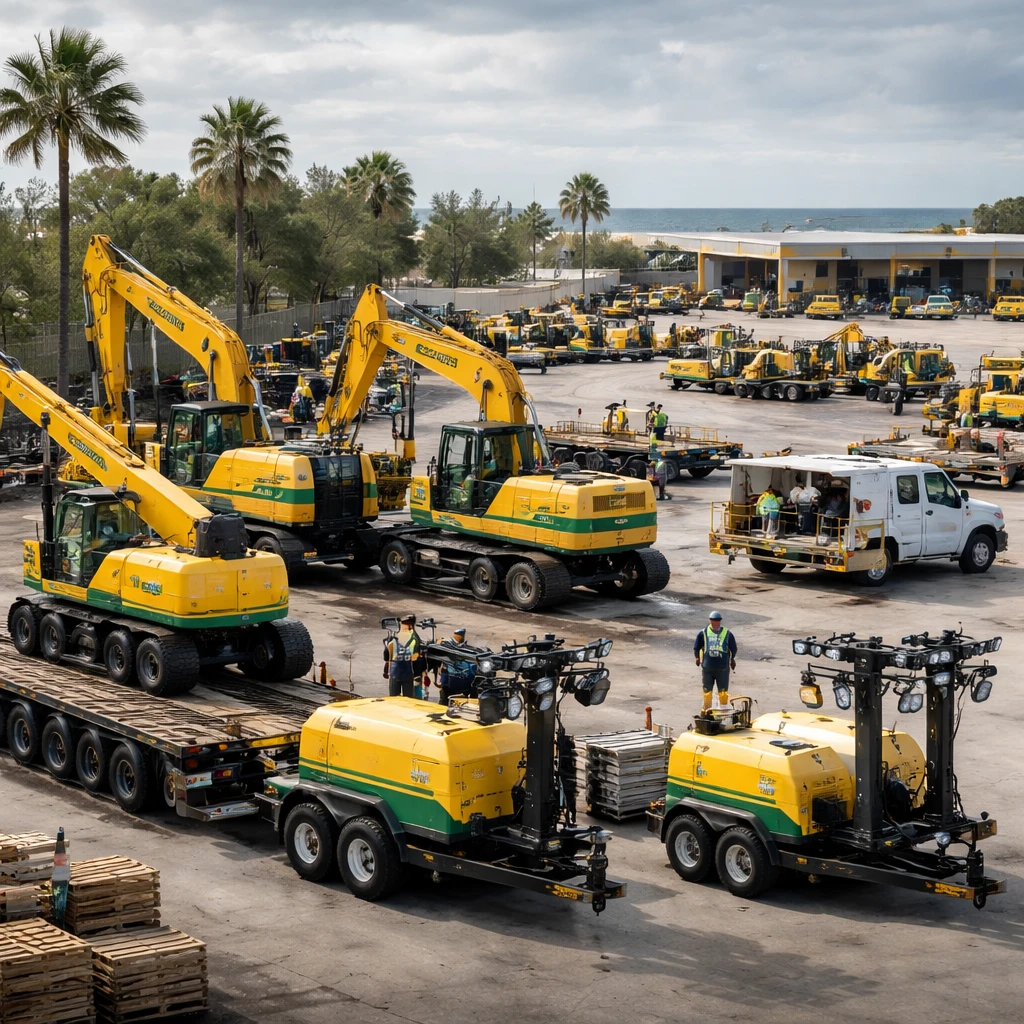
Herc is a national equipment rental platform that rents aerial, earthmoving, material handling equipment, trucks and trailers, power and lighting, and related contractor supplies and services. The company benefits when construction activity, infrastructure projects, and industrial maintenance demand temporary equipment rather than outright ownership. Scale matters in this industry: a national fleet drives utilization, lowers unit costs, and enables cross-selling of parts and services.
Why investors should pay attention now: Herc has just closed (expected close 06/02/2025) the acquisition of H&E Equipment Services, which materially increases scale and is expected to deliver $300 million of annual synergies and a combined EBITDA figure cited near $2.5 billion. If realized, those synergies should re-rate the combined business closer to peer multiple norms and materially expand cash generation — provided integration and capex plans hold to shape.
How the numbers line up
- Share price and technicals: the stock is trading at $105.59, down roughly 44% from its 52-week high of $188.35. Momentum indicators show short-term bearishness (MACD histogram negative, MACD line below signal) but RSI at ~25.25 signals oversold conditions.
- Valuation snapshot: market cap is ~$3.52B with enterprise value at ~$11.62B. At current figures the stock trades at EV/EBITDA of 6.64x and price-to-sales of ~0.81x, price-to-cash-flow of 3.25x. Those are compelling multiples for a company with scale and growth optionality.
- Profitability and cash flow: trailing EPS is effectively negligible (reported EPS $0.03, producing a headline P/E in the thousands, which is meaningless given one-off items and integration impacts). More informative are cash-based metrics: free cash flow was negative $169M in the most recent snapshot. Dividend yield sits around 2.5%, providing some income support while the business stabilizes.
- Balance sheet: leverage is the dominant governance issue. Debt-to-equity reads 4.18 and cash coverage metrics are thin (cash metric in the dataset is low). Enterprise value of ~$11.62B versus market cap of $3.52B underscores the acquisition financing and the higher indebtedness that came with scale.
Valuation framing
On face value, EV/EBITDA of 6.64x is compelling for an equipment-rental platform that should benefit from scale synergies and cross-selling. That multiple implies the market is pricing substantial execution risk on the H&E integration and a multi-quarter recovery in free cash flow. The P/E ratio is not useful today because EPS is depressed by accounting impacts and timing of acquisition-related costs; instead, EV/EBITDA and price-to-cash-flow tell a cleaner story.
Put simply: the enterprise is inexpensive on operating cash-flow multiples but expensive on structural risk terms because of leverage. If management can deliver the stated $300M of synergies and move to positive free cash flow within the next 12-18 months, the multiple could re-rate notably higher. If not, the stock remains at risk of multiple compression or value erosion due to the debt load.
Catalysts - what could unlock upside
- Integration progress and synergy realization - as management demonstrates tangible cost saves and cross-selling wins, confidence should recover and multiples expand.
- Free cash flow inflection - moving from negative FCF to positive FCF would give the market a clear path to deleveraging and higher shareholder returns (dividends, buybacks, or further M&A).
- Macro tailwinds in rental markets - infrastructure spending, power rental demand, and construction activity can boost utilization and rental rates. Industry reports point to growth in power rental markets and light-tower demand over the coming years.
- Dividend continuity and potential increases - the current yield (~2.5%) supports income investors and could become a floor if cash generation steadies.
Trade plan (actionable)
We recommend buying HRI with clearly defined risk parameters to manage the balance sheet exposure. Our trade parameters are:
| Action | Price | Horizon |
|---|---|---|
| Entry | $105.59 | Long term (180 trading days) |
| Target | $140.00 | |
| Stop loss | $95.00 |
Rationale: Entering at $105.59 captures a stock trading on depressed multiples with a material upside if synergies and FCF recovery begin to show. The $140 target reflects a return to more normalized EV/EBITDA multiple territory as integration progresses and deleveraging starts. The stop at $95 caps downside if the integration derails or macro conditions rapidly deteriorate.
Time horizon: long term (180 trading days). We want a full six-month runway to observe post-acquisition integration, early synergy delivery, and any visible trend toward positive free cash flow and leverage reduction. That timeframe balances patience for operational improvement against the reality of substantial leverage and seasonal business cycles in equipment rental.
Risks and counterarguments
- Leverage and refinancing risk. Debt-to-equity of ~4.18 and an enterprise value far above market cap underscore that the company is carrying significant debt. If rates stay elevated or cash flow underperforms, refinancing costs and covenant pressure could compress equity value.
- Integration execution risk. The $300M synergy target from the H&E deal is substantial. Failure to achieve those savings, or unexpected integration costs, would materially alter the cash-flow thesis and keep multiples depressed.
- Negative free cash flow persists. The trailing free cash flow figure was -$169M. Continued negative FCF would force the company to rely on debt markets or equity issuance to fund operations and capex, diluting equity holders or adding to leverage.
- Macroeconomic sensitivity. Equipment rental is cyclical; a slowdown in construction, infrastructure delays, or weaker industrial activity would reduce utilization and rental rates, pressuring revenue and EBITDA.
- Short-term technical pressure and sentiment. RSI and MACD show the stock is oversold but technical selling and elevated short-volumes in recent sessions could keep a lid on near-term recovery until there is visible operational proof.
Counterargument: Given the high leverage and negative free cash flow, the market may be right to price a lower multiple until Herc proves it can convert scale into durable cash flow. If integration slips or cyclical demand weakens, the valuation can compress further despite an attractive headline EV/EBITDA today.
What would change our mind?
We would upgrade conviction (move from Buy to Strong Buy) if Herc reports consecutive quarters of positive free cash flow, provides clear quarterly evidence of at least a material portion of the $300M synergy target being realized, and shows measurable progress on deleveraging (notably a falling net-debt/EBITDA trend). Conversely, we would downgrade to Neutral or Sell if free cash flow remains negative with no visible trend to improvement, if integration costs materially exceed expectations, or if management signals the need for additional equity issuance to fix balance sheet gaps.
Bottom line
HRI is a classic risk-reward trade: cheap on an EV/EBITDA basis and supported by scale benefits from the H&E deal, but carrying meaningful execution and balance-sheet risk. For investors comfortable with those risks, the trade is implementable with strict risk controls: enter around $105.59, use a $95 stop, and give the story six months to play out. If synergy realization and FCF improvement arrive, the upside to our $140 target is a realistic outcome. If not, the stop protects capital while management adjusts strategy.
Key data points (quick reference)
- Current price: $105.59
- Market cap: $3.52B
- Enterprise value: $11.62B
- EV/EBITDA: 6.64x
- Debt-to-equity: 4.18
- Free cash flow (trailing): -$169M
- 52-week range: $96.19 - $188.35