
Hook / Thesis
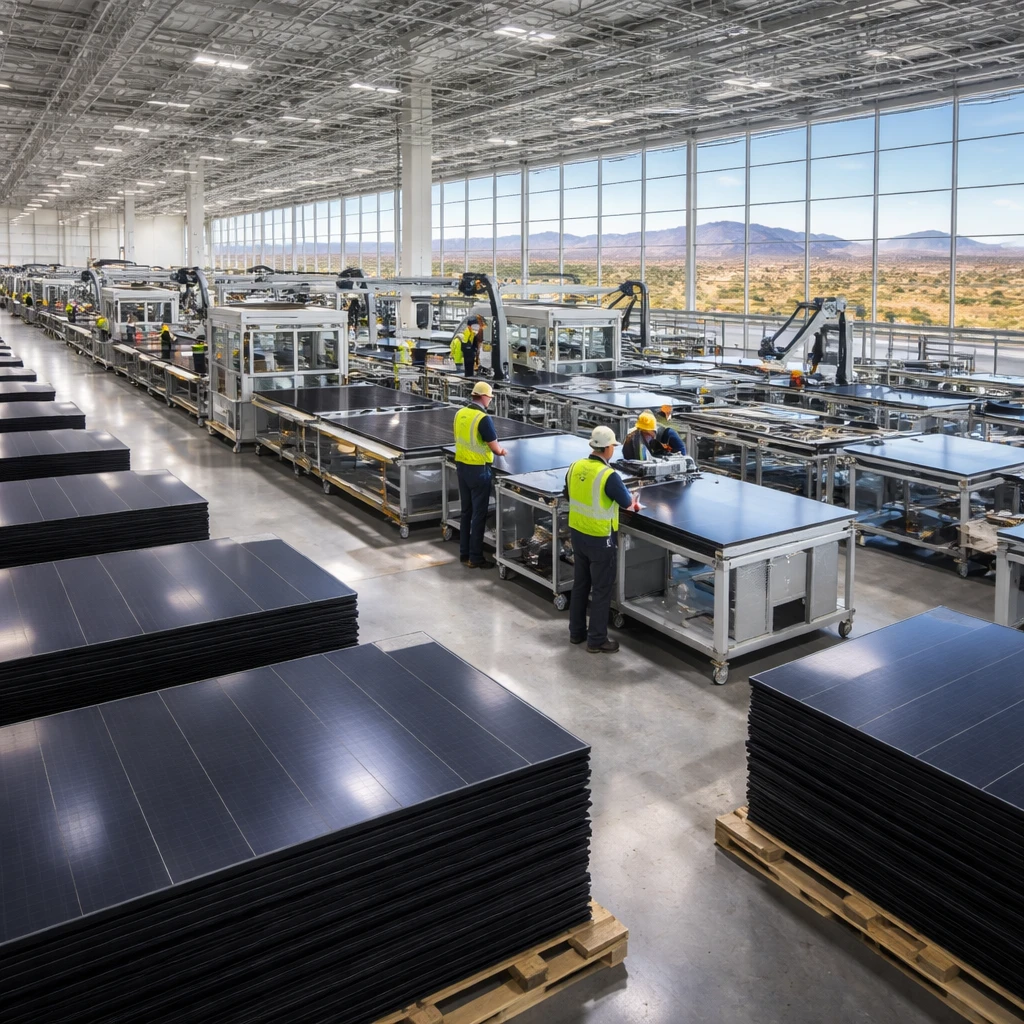
First Solar is an industrial winner in the U.S. energy transition. The company manufactures thin-film cadmium telluride (CdTe) solar modules, consistently generates free cash flow, and is sitting on a market cap that does not fully reflect its cash-generation profile or its strategic position in U.S.-centric supply chains. After a sell-off driven by weaker guidance and politics around tax credits, the pullback is an opportunity to add a high-quality solar equity at a reasonable valuation.
My trade: establish a long position at $197.26 with a stop loss at $170 and a target at $260. That setup gives asymmetric upside while protecting capital if sentiment or fundamentals deteriorate. The case is valuation- and cash-flow-driven rather than a pure growth story: FSLR trades at roughly 13x earnings and an EV/EBITDA around 8x, with more than $1.18 billion in free cash flow - numbers that support a durable, constructive overweight.
Business primer - what First Solar does and why it matters
First Solar is a U.S.-headquartered manufacturer of CdTe solar modules. Unlike the dominant crystalline silicon vendors, First Solar’s technology has a different cost and manufacturing footprint that has allowed it to capture utility-scale projects—particularly in the U.S. market — where project developers prize module reliability, energy yield in hot climates, and fast domestic supply chains. The company is vertically focused on module production and competes on large-scale commercial and utility projects rather than rooftop volumes.
Why the market should care: the U.S. remains the largest addressable market for utility-scale solar growth tied to federal incentives and state procurement. Analysts and industry reports expect solar and battery storage demand to expand meaningfully over the next decade, and any supplier with strong domestic capacity is a potential beneficiary of that buildout. For First Solar specifically, that translates into backlog, firm project wins, and pricing power in the U.S. pipeline.
Key fundamentals and valuation framing
- Current price: $197.26. 52-week range: $116.56 - $285.99.
- Market capitalization: $21.17 billion.
- P/E: ~13x. Price-to-book: ~2.08x. Price-to-sales: ~3.8x.
- Enterprise value: ~$17.52 billion with EV/EBITDA near 8.2x and EV/Sales ~3.36x.
- Free cash flow: ~$1.187 billion. Price-to-free-cash-flow ~16.7x, meaning FCF yields are meaningful for a manufacturing company.
- Returns and balance sheet: ROA ~11.5%, ROE ~16.0%, debt-to-equity extremely low at ~0.05, current ratio ~2.67, cash ratio ~1.24.
Put simply: FSLR is profitable, generates cash at scale, and sits on a clean balance sheet. That combination is uncommon among larger solar names and supports a conservative valuation multiple relative to high-growth, cash-burning peers. The stock’s P/E in the low-teens and EV/EBITDA in single digits argue for a base-case that already embeds modest growth; the upside comes from re-accelerating backlog wins and policy tailwinds.
Support from recent price action and technicals
Trading has stabilized after the sell-off earlier in the year. The stock closed today at $197.26, up on intraday strength, with RSI near neutral (around 47) and MACD showing bullish momentum. Short interest remains meaningful—settlement-era short interest in mid-March ran into the 7.7M-share range with a days-to-cover above 4 recently—so large moves can be accentuated by positioning shifts. Average two-week volume is roughly 1.93M shares, indicating good liquidity for entering and exiting a position.
Why now - triggers and catalysts
- Catalyst 1 - Policy clarity: any positive development on U.S. clean energy incentives or tax credit reinstatements would re-rate valuation quickly. The political noise around credits has been a major driver of recent volatility.
- Catalyst 2 - Project wins and backlog growth: new firm orders and expanding backlog will convert to visible revenue and reaccelerate margins; investors often re-price suppliers once pipeline visibility improves.
- Catalyst 3 - Demand from storage-solar pairings: industry forecasts expect strong growth in U.S. solar + storage deployments, which favors domestic module suppliers with secure delivery timelines.
- Catalyst 4 - Cash-flow resilience: continued FCF generation and possible share buybacks or balance sheet deployment would support a higher multiple relative to peers.
- Catalyst 5 - Positioning squeeze: elevated short interest can amplify upside when sentiment improves or when company-specific news beats expectations.
Trade plan
Entry: Buy at $197.26 (market execution or limit if you prefer).
Stop loss: $170.00 (invalidates the base thesis by signaling material sentiment or project deterioration).
Target: $260.00 (target within a long-term horizon).
Horizon: Long term (180 trading days). Expect the position to require time for backlog conversion, policy clarity, and for investors to re-price durable cash flows. If catalysts arrive sooner, take partial profits along the way; if not, be prepared for a multi-month timeframe to realize the target.
Rationale: the entry captures the stock below recent highs and at a valuation that reflects current political uncertainty. The stop at $170 protects against a deeper structural hit to the U.S. market or a sustained margin compression event. The $260 target is a midpoint between re-rating toward historical highs and multiple expansion driven by stronger-than-expected FCF conversion and backlog growth.
Risks and counterarguments
Any investment in First Solar comes with real, measurable risks. Below are primary concerns to weigh before initiating a long position.
- Policy dependence: A major critique is that U.S. federal incentives materially influence project economics. If tax credits are reduced or timelines are pushed, project volume and pricing could compress. News earlier in the year cited weakening tailwinds and controversy around credits.
- Competition and technology risk: The broader solar supply chain is rapidly adopting N-type TOPCon and other silicon-based efficiencies. Chinese manufacturers are scaling fast; an aggressive price push or capacity overhang could pressure margins and market share.
- Backlog growth uncertainty: Headlines have noted a lack of the expected backlog acceleration. If incoming orders stay flat, revenue growth and the story of demand capture may disappoint.
- Profit sustainability questions: Critiques have argued that government subsidies are a key contributor to near-term gross profit. If subsidies roll off or are restructured, reported profitability could decline.
- Execution risk: Manufacturing scale-ups, supply chain disruptions, or quality issues at module plants could slow deliveries and create cost creep.
Counterargument: The company’s conservative 2026 guidance and the political noise are already discounted in the current price. First Solar’s low leverage, >$1.18B in FCF, and mid-teens ROE mean the business can sustain investment through cycles. If the company wins a meaningful handful of utility deals or if policy is clarified in a neutral-to-positive way, the market is likely to re-rate the shares toward the company’s historical highs.
What would change my mind
I would turn neutral or bearish if any of the following occur: (1) confirmed, sustained decline in U.S. utility-scale demand and project cancellations; (2) evidence that module economics have shifted permanently against CdTe technology and into silicon-only dominance; (3) a meaningful deterioration in free cash flow (a year-over-year drop below prior levels) or a move by management to materially increase leverage; or (4) backlog and order intake remain flat-to-down for several quarters, confirming the worst-case scenario in guidance commentary.
Conclusion
First Solar is a quality, cash-generative U.S. solar producer that currently trades at attractive multiples for a company with a strong balance sheet and durable free cash flow. The stock’s recent volatility has opened a low-risk entry opportunity for patient investors who accept policy risk and execution variability. The trade proposed here is tactical but grounded in valuation and cash-flow reality: enter at $197.26, protect at $170, and look for a re-rating toward $260 over a long-term (180 trading days) horizon if demand and policy catalysts materialize.
If you take the trade, size the position in line with your risk tolerance and be ready to act quickly on meaningful news: both upside catalysts and downside risks can compound rapidly in this sector.