
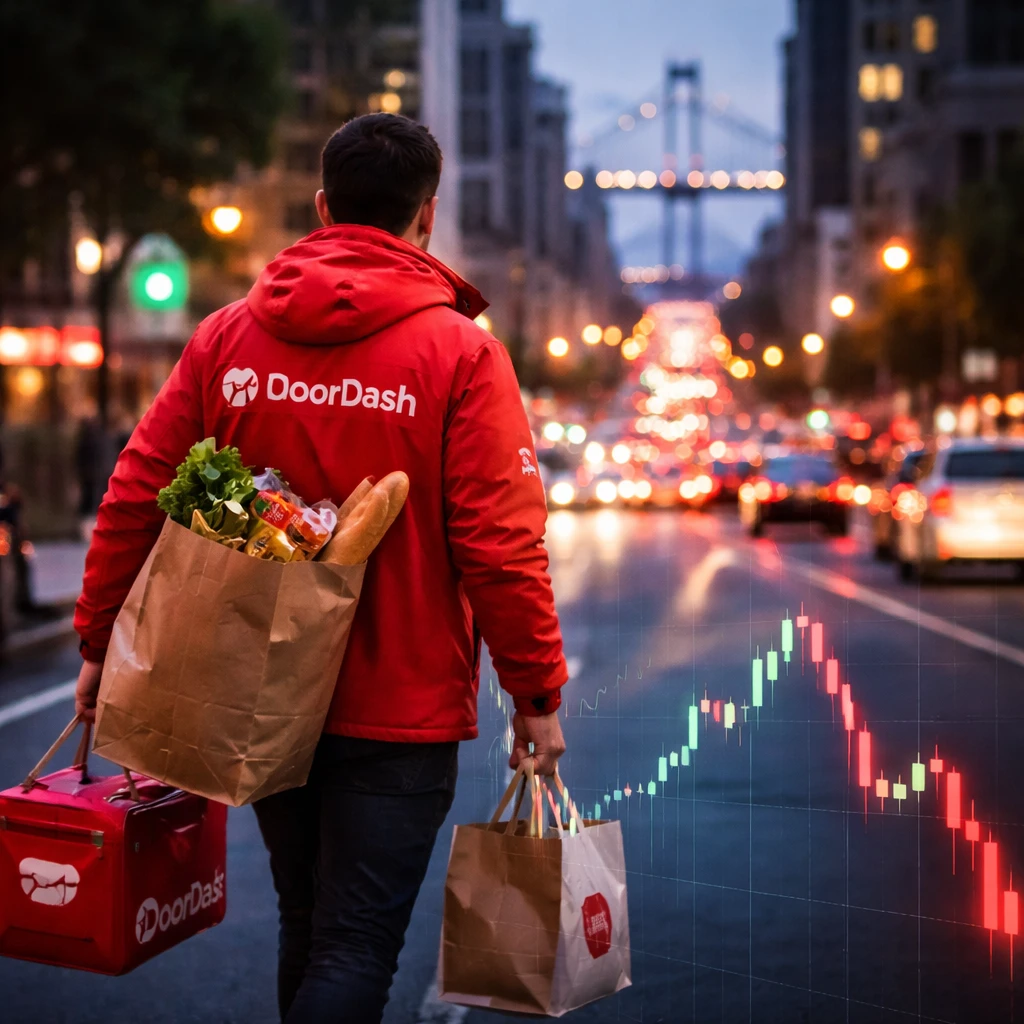
Hook & thesis
DoorDash is showing the kind of top-line performance growth investors love: the company reported roughly 40% revenue growth in Q4 and net income that rose about 51% year-over-year. Yet the stock is trading like a high-growth software name, not a capital-intensive logistics and marketplace business: the shares sit near $173 with a price-to-earnings multiple north of 75-80x and a price-to-sales around 5.4x. My view is simple — the market is rewarding growth today but not charging enough for the elevated investment cadence DoorDash needs to win grocery and retail at scale. That makes for a tradeable short where downside is clearer than the upside, until DoorDash proves margin sustainability.
Why the market should care
DoorDash operates a marketplace and logistics platform that moves food, groceries and retail items to consumers in the U.S., Canada and Australia. The company has been expanding beyond restaurant delivery into grocery and retail; headlines on 02/20/2026 highlighted DoorDash becoming the top third-party marketplace by order volume for grocery and retail in the U.S., with roughly 30% of customers ordering outside restaurants. That expansion explains the strong GOV and top-line growth — but grocery and retail scale often require upfront promotional spend, higher fulfillment complexity and, until unit economics improve, margin pressure.
Concrete numbers to anchor the argument
- Current price: $173.45.
- Market capitalization (snapshot): $75.36B.
- Q4 revenue: $3.96B (missed consensus of $3.99B), Q4 EPS: $0.48 (missed $0.60).
- Reported year-over-year revenue growth in Q4: roughly 40%; net income grew ~51% year-over-year.
- Valuation metrics: P/E ~80x, P/S ~5.4x, EV ~$72.93B, free cash flow last reported $2.174B.
- Trading range: 52-week high/low = $285.50 / $155.40. 30-day average volume ~6.73M.
Those numbers tell a mixed story. Growth is intact and cash generation is real — the company had meaningful free cash flow — yet the stock demands near-perfect execution on grocery economics and margin improvement. Any slip in execution or continued heavy investment would compress realized margins and make the current multiple vulnerable.
Valuation framing
DoorDash's P/E in the high 70s and P/S >5 place it in premium territory, comparable to fast-growing SaaS or marketplace businesses rather than legacy logistics names. For a marketplace with low gross margins in some new categories and significant variable fulfillment costs, that premium requires confidence that (a) growth will remain strong and (b) margins will expand materially. Management has indicated margin progress is expected in the second half of 2026, and analysts on 02/23/2026 modeled double-digit upside to $190-$215 ranges; but today those outcomes are assumptions, not facts.
Technical and market context
Technically, the stock has softened from its October 2025 highs and currently sits below its 20- and 50-day EMAs. Momentum indicators show modest bullish divergence (MACD histogram recently turned positive), but momentum is not yet decisive. Short interest has been trending lower from earlier peaks — days to cover recently sits under 2 — yet the short-volume metrics show active trading and episodic selling pressure. In plain terms: the market is volatile, and headlines can move price meaningfully.
Trade plan (actionable)
Direction: Short
Entry: $173.45
Stop loss: $190.00
Target: $150.00
Risk level: High
Horizon: mid term (45 trading days). I expect the trade to play out over multiple market-moving updates: 1) initial Q1 2026 guidance and early 2026 cadence, and 2) incremental evidence on grocery/retail unit economics into late Q2 / early Q3. The 45 trading day window gives time for sentiment to normalize after the recent post-earnings bounce and for the market to reassess margin execution. If the stock trades sharply lower early, the position can be scaled or hedged; if it rallies toward $190, the stop protects capital.
Why this risk/reward?
From $173.45 to $150 the decline is about 13%; the stop at $190 is ~9.6% above entry. That asymmetry is attractive given the binary nature of the upside thesis: for the stock to justify multiples >70-80x, DoorDash must deliver sustained margin improvement and prove grocery unit economics materially better by mid-year. Against that, downside catalysts are many: execution misses, continued promotional intensity, or macro-driven slowdown in discretionary spend — each could quickly pressure the premium multiple.
Catalysts
- Q1 2026 guidance and quarterly results: any revenue or margin softness will reprice expectations (next major event window within the 45 trading-day horizon).
- Progress on grocery unit economics: headlines in late H1 2026 that grocery profitability is further delayed would be negative; conversely, proof of improved unit economics would be bullish.
- Analyst revisions: several boutiques reaffirmed targets post-earnings on 02/19/2026 and 02/23/2026 — upgrades or downgrades could move the stock sharply.
- Macro/market sentiment shifts: risk-off moves or higher-for-longer rates would favor lower multiples for growth names.
Risks and counterarguments
- Counterargument - Growth and improving margins: DoorDash has real revenue momentum and reported healthy free cash flow (~$2.174B). Management expects margin improvement in H2 2026 and analysts have highlighted double-digit upside targets. Institutional investors have been buyers on balance for several quarters; if grocery unit economics turn positive faster than expected, the stock could re-rate higher and squeeze shorts.
- Execution risk: The short thesis depends on grocery and retail requiring continued investment to scale. If DoorDash can scale these verticals with limited promotional cost and logistics friction, margins could expand and the short will be at risk.
- Headline-driven volatility: The market has recently shown sensitivity to guidance and macro headlines (e.g., geopolitical risk and macro updates earlier in February). Sharp moves due to news can trigger the stop even when the fundamental picture is intact.
- Valuation support from FCF: The company reported positive free cash flow, which provides a floor for the valuation relative to slower-growth peers. That floor may limit downside if the market prizes cash conversion over near-term margin swings.
- Short-squeeze risk: Short interest remains non-trivial and active short-volume indicates potential for squeeze dynamics, especially if DoorDash posts an unexpectedly strong quarter.
What would change my mind
I will abandon or flip this short if DoorDash delivers one of the following clear outcomes: 1) an interim report showing grocery and retail unit economics turning positive materially earlier than guidance (sustained positive contribution margin for those verticals), 2) management provides concrete, durable margin guidance for H2 2026 that materially exceeds current sell-side expectations, or 3) the company announces a structural change that meaningfully reduces execution risk (for example, a profitable third-party logistics partnership or an earnings-accretive capital allocation move). Until we see that proof, I view the premium multiple as vulnerable.
Execution checklist for the trade
- Enter a short at $173.45 with position sizing capped to limit portfolio risk to the stop distance.
- Place a stop loss at $190 — if price reaches this, exit to avoid a larger squeeze on the position.
- Monitor quarterly guidance, grocery unit economic commentary, and analyst revisions closely; tighten stop or hedge if headlines go decisively positive.
- Reassess by day 45 (approximately 45 trading days) — either take profits around $150 or re-evaluate if price action and fundamentals diverge from the thesis.
Bottom line
DoorDash is a growth story with real scale, but growth is not free. The stock currently embeds high expectations for flawless execution on grocery and margin expansion. That leaves room to trade the name to the downside until the company can prove the new verticals contribute sustainably to margins. My tactical stance is a defined short from $173.45 with a $190 stop and a $150 target over a mid-term (45 trading days) horizon — a trade that bets on patience and execution uncertainty, not on a long-term view of the business.