
Hook / Thesis
The transition to cleaner-burning fuels is playing directly into Cheniere Energy's hands. Cheniere owns and operates major U.S. LNG export terminals and liquefaction capacity that supply Europe and Asia. With electric demand rising, particularly from data centers and AI infrastructure that require reliable power and often push grids toward gas-fired generation, LNG exporters with low incremental cost curves stand to benefit.
At today's levels around $252, Cheniere offers a play on structural demand and free cash flow generation. The company's valuation metrics are not frothy: enterprise value to EBITDA is 7.16 and price-to-earnings is around 10, while free cash flow last reported was $2.461 billion. That combination argues for a long trade over the next 180 trading days, with a defined entry, stop and target to capture upside while limiting downside risk.
What the company does and why the market should care
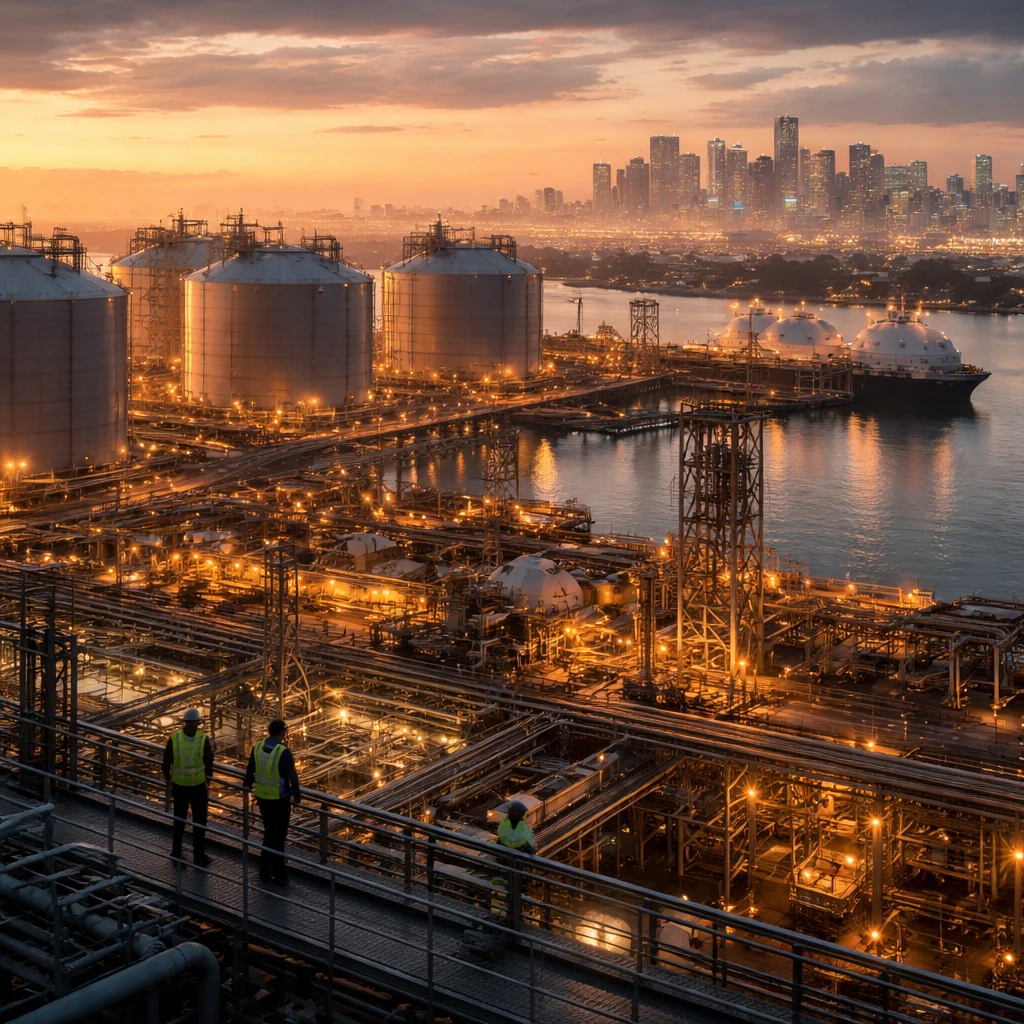
Cheniere Energy, Inc. develops, owns and operates LNG terminals and liquefaction facilities near Corpus Christi and at Sabine Pass. The company monetizes U.S. natural gas production by converting it to liquefied natural gas for export to global buyers. For energy markets, Cheniere is effectively a levered play on global natural gas flows, infrastructure bottlenecks, and pricing spreads between the U.S. and demand centers overseas.
The market should care because Cheniere sits at the intersection of two durable trends: (1) an ongoing fuel shift in many regions away from coal and oil toward gas, which supports steady export volumes; and (2) rising electricity demand driven by cloud services and AI computing. AI datacenters increase baseload and peaking power needs, and where renewables or grid upgrades lag, incremental gas generation becomes the fallback - which can push gas demand and pricing in Cheniere's favor.
Supporting numbers and recent trends
Key items from the company's public profile and recent trading picture:
- Market capitalization is roughly $53.0 billion and enterprise value about $74.7 billion, implying an EV/EBITDA multiple of 7.16.
- Reported free cash flow of $2.461 billion provides real optionality for returning capital, debt paydown, or funding expansions.
- Trailing earnings per share is strong at $25.29 with a price-to-earnings ratio near 10 (P/E ~9.98 in the ratios dataset), suggesting the stock is not priced for perfection.
- Balance sheet and liquidity: current ratio ~0.8 and quick ratio ~0.67 indicate working-capital tightness typical for capital-intensive infrastructure companies; cash ratio sits at 0.28. Debt-to-equity is elevated at ~2.88, so leverage is appreciable.
- Shareholder returns: dividend yield is modest (about 0.85%), but the sizable free cash flow and strong earnings make targeted buybacks plausible as a driver of EPS expansion if management prioritizes returns.
- Technicals: the stock is trading above its 50-day and 20-day SMA (SMA50 ~$219.48, SMA20 ~$239.12) and RSI is elevated at ~68.6, signaling near-term bullish momentum but limited near-term overbought risk. Short interest and short-volume data show persistent activity but low days-to-cover (around 1.7), meaning shorts are not extended.
Valuation framing
At an EV/EBITDA of 7.16 and price-to-earnings around 10, Cheniere sits at a valuation more commonly associated with stable midstream assets rather than a high-growth commodity disrupter. That multiple implies the market is paying for the company's cash flow but also discounting some execution and commodity risk. Given an enterprise value of about $74.7 billion against free cash flow near $2.46 billion, the EV/FCF multiple is reasonable and suggests room for valuation expansion should volumes, pricing spreads, or capital-return policy improve.
We do not have exhaustive peer multiples here, but qualitatively the argument is: if global LNG demand growth continues and Cheniere sustains utilization near current levels, modest multiple expansion toward historically higher midstream ranges would be justified. Conversely, any sustained decline in global arbitrage or spot spreads would compress this thesis.
Catalysts to push the stock higher
- Continued strength in global gas demand driven by power generation and near-term restarts, especially in Europe and Asia, which keeps export volumes and realized prices favorable.
- Incremental demand from data centers and AI deployments that increases baseload power needs and supports sustained gas-fired generation in many grids.
- Quarterly beats and upward guidance revisions. The company reported a positive Q2 beat and raised guidance on 08/11/2025 - further beats would reduce perceived execution risk and could drive re-rating.
- Potential capital-return program expansion. With free cash flow of about $2.46 billion and strong EPS, announced buybacks or higher dividends would be direct EPS-accretive catalysts.
Trade plan (actionable)
Trade idea: Enter a long position at $250.00. Target $300.00. Stop loss $230.00.
Horizon: Long term (180 trading days). We are setting a long-term horizon because the primary thesis - structural demand for LNG and execution of capital-return plans - plays out over quarters, not days. The 180-trading-day window gives time for seasonal LNG demand swings, quarterly results to print, and for any announced buyback program to be rolled out and priced by the market.
Why these levels? Entry at $250.00 sits slightly below recent trading and allows placement near a psychological round level while remaining close to the stock's current price. The $300.00 target reflects roughly 20% upside, a reasonable move if valuation multiple expands modestly and earnings/FCF hold. The $230.00 stop limits downside to roughly 8% from entry and is placed within a zone where a significant disappointment in volumes or a material macro shock would be evident.
Risk management and position sizing
Given leverage on the balance sheet and commodity exposure, cap position size so that a stop-triggered loss fits your portfolio risk budget (commonly 1-3% of portfolio value). Follow quarterly reports; a missed guidance or material curtailment should trigger re-evaluation or trim.
Risks and counterarguments
- Commodity-price and basis risk: LNG revenue depends on global gas pricing and spreads. A durable collapse in Asian or European demand, or a narrowing of U.S.-to-Asia arbitrage, would hit margins and cash flow.
- Leverage and liquidity pressure: Debt-to-equity of ~2.88 and current/quick ratios under 1.0 mean balance-sheet flexibility is limited in a prolonged stress scenario. Rising interest rates or refinancing challenges could constrain management options.
- Execution and plant availability: Liquefaction facilities are complex. Delays, outages, or cost overruns at Sabine Pass or Corpus Christi would materially affect near-term cash flow and sentiment.
- Regulatory and geopolitical risk: LNG exports are subject to approvals, export restrictions, and geopolitical volatility. Sanctions, trade disruptions, or policy shifts in buyer countries could reduce offtake.
- Counterargument - secular threat from renewables and storage: One plausible counter to our thesis is faster-than-expected adoption of renewables plus storage and demand-side efficiency in major LNG buyers. If utilities accelerate renewables and battery investments to the point that gas-fired generation is deprioritized, Cheniere's growth runway could be curtailed.
- Market multiple compression: Even if cash flow holds, a risk-off re-pricing of energy infrastructure stocks (e.g., higher discount rates) could compress multiples and produce negative returns despite stable operations.
What would change my mind
I would downgrade the trade if: (1) quarterly reports show a sustained decline in utilization or realized prices, (2) management abandons returning capital or signals major new capital spending that materially increases leverage, or (3) there is a secular shift in major demand regions away from gas-fired generation faster than expected. Conversely, a formal multi-year buyback program, sustained beat-and-raise results, or visible incremental demand from AI datacenter growth would reinforce the thesis and could justify tightening stops and adding to the position.
Bottom line
Cheniere is a high-quality LNG export platform trading at reasonable multiples with real free cash flow generation. The combination of structural global gas demand, rising electricity needs from AI and data center growth, and potential for capital returns creates a favorable asymmetric risk-reward over 180 trading days. The proposed plan - buy at $250.00, target $300.00, stop $230.00 - captures that asymmetry while keeping risk explicit.
Key metrics referenced: market cap ~ $53 billion; enterprise value ~ $74.7 billion; EV/EBITDA ~7.16; free cash flow ~$2.461 billion; P/E ~10; dividend yield ~0.85%; debt-to-equity ~2.88; RSI ~68.6.