
Hook & thesis
Celestica is quietly moving from being a commodity contract manufacturer to a strategic partner for rack-scale AI hardware. The company's newly announced tie-up with AMD to develop networking switches for the Helios rack-scale platform (announced 03/16/2026) crystallizes a deeper role in the AI infrastructure stack — not just boxes, but systems that matter to cloud and enterprise deployers.
The market has reacted; shares are up but remain well below the prior run to $363.40. At $296.19 today, Celestica trades at a valuation that still leaves room for re-rating if the Helios program and broader AI server rollouts translate into multi-hundred-million-dollar production streams. My trade: a mid-term long (45 trading days) entry at $296.19, target $360, stop $270. Execution is size-limited and contingent on catalysts; it's a tactical play on production ramp visibility and sentiment catching up to fundamentals.
What Celestica does and why the market should care
Celestica provides supply chain solutions and electronic manufacturing services across two segments: Advanced Technology Solutions (ATS) and Connectivity and Cloud Solutions (CCS). ATS covers aerospace, industrial, health tech and capital equipment; CCS covers enterprise communications, telecom, servers and storage. That positioning places Celestica in the middle of two secular forces: defense/industrial electronics and the AI datacenter buildout.
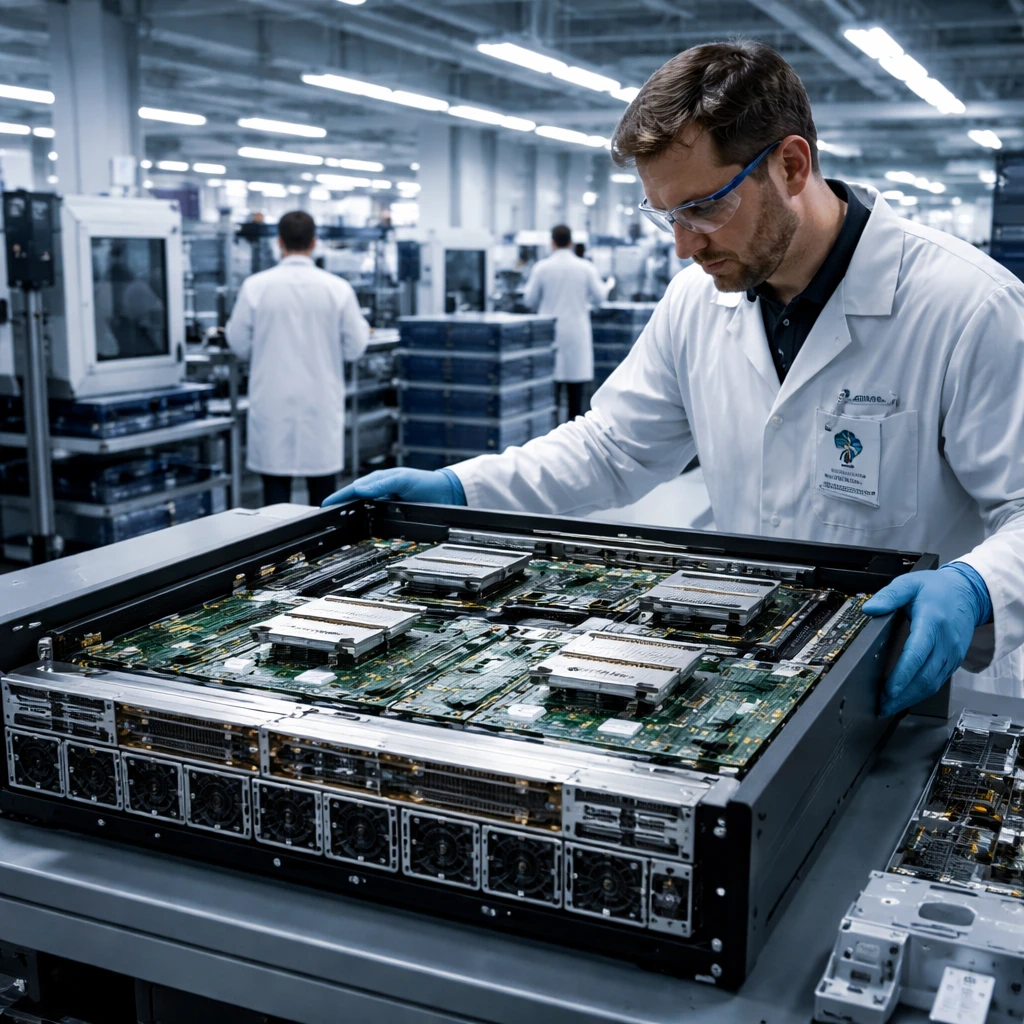
The reason investors should care now is structural: AI workloads are shifting some bottlenecks away from pure GPU supply to system-level integration, networking, thermal/mechanical design and partnership manufacturing. Companies that can deliver at rack-scale to Open Compute Project standards become strategic partners to cloud providers and large enterprises. The AMD - Celestica collaboration to manufacture Helios networking switches is a concrete example. If Celestica secures volume production slots on Helios, recurring revenue and higher-margin system-integration work follow.
Key fundamentals supporting the thesis
- Market cap and EV: The company’s snapshot market capitalization is roughly $34.1B with an enterprise value around $33.17B. That places it squarely in the large-cap systems-integration category.
- Profitability and cash generation: EPS stands at $7.24 and free cash flow was $458.3M most recently — not trivial for a contract manufacturer and supportive of reinvestment and balance-sheet flexibility.
- Margins and returns: Return on equity is strong at ~37.6%, signaling the company earns high returns on invested capital when volumes are favorable.
- Balance sheet: debt-to-equity sits at ~0.35, current ratio ~1.44 and quick ratio ~0.88 — manageable leverage for capital-intensive manufacturing while preserving flexibility for customer-driven capex.
- Share metrics: float ~113.7M shares, shares outstanding ~115.0M — not an ultra-barren float, but concentrated enough that incremental demand tied to program wins can move the tape.
Valuation framing
At $296.19 the stock trades at a trailing P/E around 40x (reported P/E ~39.6-40.1 depending on the snapshot), price-to-sales ~2.66 and price-to-book near 14.9. Those multiples are rich versus typical EMS peers but reflect two things: (1) a pivot to systems/integration that carries higher margins than pure board assembly; and (2) market expectations for continued AI-driven revenue mix shift.
Enterprise value-to-EBITDA sits near ~26.6x. That multiple implies the market is already pricing in significant growth and margin expansion. The trade is therefore not a deep-value call; it’s a catalyst-driven re-rating idea. The path to justify $360 is clearer revenue recognition from Helios / large AI server builds and continued free cash flow strength, plus sentiment improvement as large OEMs publicly lean on Celestica for scale manufacturing.
Catalysts
- AMD partnership progress - 03/16/2026 announcement: hardware validation milestones or production ramp communications would be direct upside triggers.
- Customer wins / order disclosures: any publicized multi-hundred-million-dollar OEM contract (cloud provider or telecom) would re-rate the stock.
- Quarterly results showing sequential revenue and margin uplift driven by server/network product mix; guidance raise would be a strong catalyst.
- AI capex cycle acceleration: if data center deployments accelerate and Helios becomes strategic, Celestica benefits structurally.
Trade plan
Position: Long Celestica (CLS).
Entry price: $296.19
Target price: $360.00
Stop loss: $270.00
Horizon: mid term (45 trading days). The reasoning: manufacturing ramps and program milestones that materially affect guidance typically crystallize over several weeks to a few months. A 45-trading-day window balances giving the ramp time to show up in order flow or commentary while still keeping the trade tactical against macro and sentiment swings.
Risk management: Risk per share at the entry ($296.19) down to the stop ($270.00) is $26.19. Size positions such that a full-stop loss represents a manageable portfolio hit (e.g., 1-2% of portfolio). Use trailing stops on partial positions if the stock reaches $330 to lock in gains; add only on confirmed volume-backed breakouts and positive operational commentary.
Technical context
Technically, the stock shows bullish momentum: 10-day and 20-day SMAs sit below current price, the MACD histogram is positive, and RSI is neutral-to-favorable at ~56.7. Short interest has been modest with days-to-cover around 2.07 as of 02/27/2026 — not an overhang that would instantly pressure the stock, but short-volume spikes in intraday sessions show active trading interest on pullbacks.
Risks and counterarguments
- Customer concentration / program risk: Loss or downsizing of a major customer program (e.g., a cloud provider moving assembly elsewhere) would hit revenue and margin quickly. Pomerantz filed an investigation into potential shifts away from Celestica tied to Google on 02/17/2026 — that headline underscores this risk and explains why the stock can be volatile on project rumors.
- Execution and ramp timing: Manufacturing complex rack-scale systems is non-trivial. Delays in yield, supply of critical components (HBM, ASICs) or factory scale-up could push revenue recognition beyond the trade horizon.
- Valuation sensitivity: The stock trades at elevated multiples (P/E ~40, EV/EBITDA ~26.6x). If growth disappoints, multiples can compress rapidly and erase gains.
- Macroeconomic and capex risks: A pause or slowdown in hyperscaler capex would disproportionately affect companies exposed to server and networking builds, pushing longer lead times and cancellations.
- Regulatory or legal risk: The investor investigation highlights potential litigation over revenue disclosures or customer relationships; legal outcomes are uncertain and could weigh on sentiment and valuation.
Counterargument to my thesis
One solid counterpoint is valuation. With P/E near 40 and EV/EBITDA in the mid-20s, the market may already price in significant share wins and margin expansion. If Celestica only captures a modest slice of Helios production or if Helios itself faces adoption headwinds versus incumbent architectures, the multiple could derate quickly. In that scenario the upside to $360 becomes dependent on multiple expansion rather than purely on incremental earnings.
What would change my mind
I would revise to a neutral or bearish view if any of the following occur: (1) a major OEM discloses it is moving primary manufacturing away from Celestica; (2) quarterly free cash flow falls materially below the $458M recent level and margin compression appears sticky; (3) AMD public updates show Helios delays or architectural changes that reduce Celestica’s role; or (4) the company issues guidance that significantly undercuts current market expectations. Conversely, sustained announcements of production milestones, multi-quarter margin improvement, or multiple new OEM programs would push me to be more aggressively long and extend the target beyond $360.
Conclusion
Celestica is a pragmatic way to express a thematic bet on AI infrastructure moving from chip-level scarcity to system-level integration and manufacturing capacity. The AMD Helios partnership is a tangible catalyst that could shift revenue mix higher and justify a re-rating. That said, valuation is full enough that this is a catalyst-led tactical trade, not a deep-value buy-and-hold. If Helios production ramps as hoped and Celestica’s free cash flow remains robust, $360 within ~45 trading days is a realistic target. Keep risk tight with the $270 stop and position size to limit downside from program or macro disappointments.
| Trade item | Value |
|---|---|
| Entry | $296.19 |
| Target | $360.00 |
| Stop | $270.00 |
| Horizon | Mid term (45 trading days) |
Trade smart: the thesis works if Celestica translates strategic partnerships into repeatable production wins. Discipline around stops and sizing is the difference between a calculated trade and a high-volatility gamble.