
Hook & thesis
CAVA is at a classic scaling inflection: management is moving fast to convert its momentum into footprint and CPG reach. The market has priced that story aggressively — price-to-sales and price-to-earnings multiples are high — but the company is delivering concrete expansion metrics and improving profitability that can justify the premium if execution continues.
We like CAVA from here as a directional, growth-weighted long. This is not a deep value play; it's a trade that banks on unit economics, continued restaurant openings, and ancillary CPG growth to supply both top-line expansion and margin lift over the next several quarters. Entry at $75.00, a stop at $68.00 and a target at $95.00 gives a favorable risk-reward while respecting the company's elevated valuation.
What the company does and why the market should care
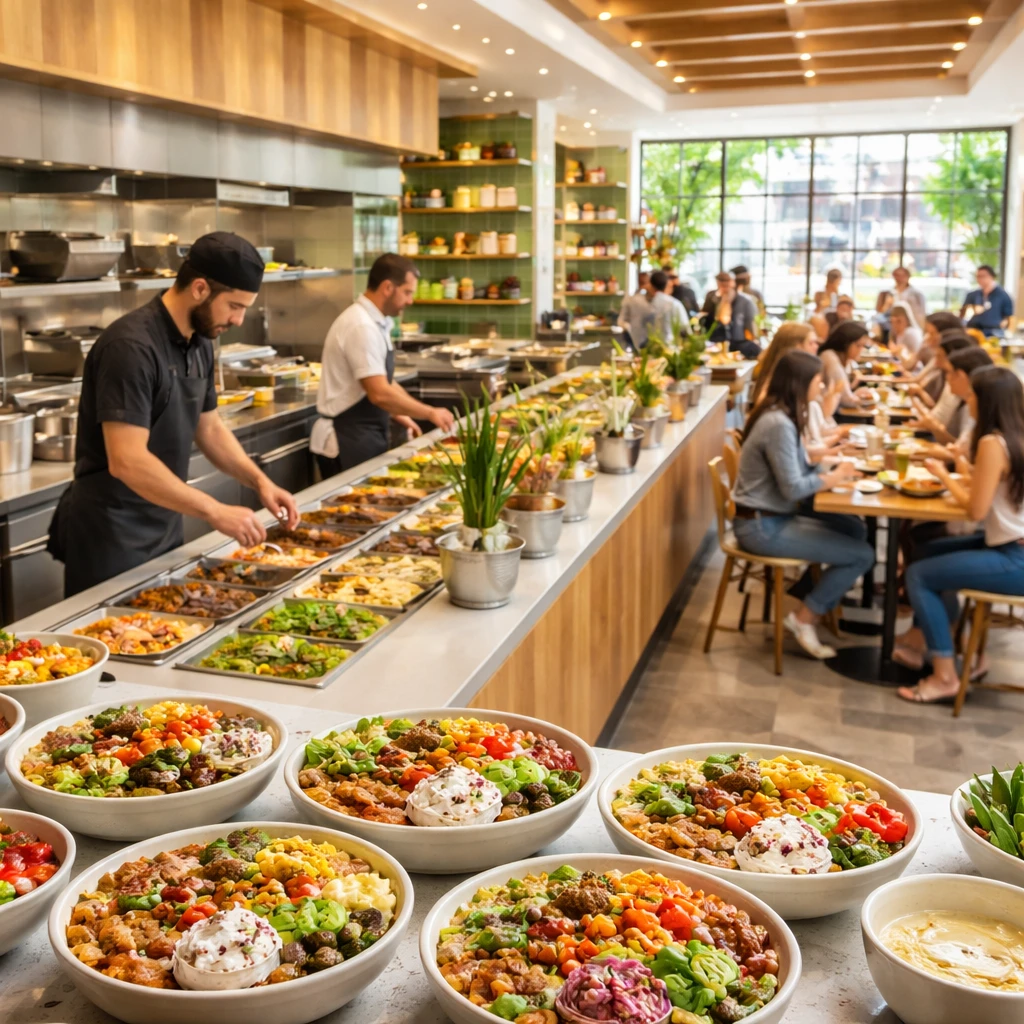
CAVA Group, Inc. operates a category-defining Mediterranean fast-casual restaurant brand and a related consumer-packaged goods business under CAVA Foods. The dual model matters: restaurants drive recurring unit economics and recurring brand exposure, while the CPG business offers an outsized margin opportunity and distribution leverage if retail penetration scales.
Why investors care now: management is accelerating openings (439 restaurants after adding 24 in Q4), guiding to 74-76 net new restaurants in 2026 and targeting 1,000 locations by 2032. That scale, if achieved, compresses corporate overhead per unit, increases purchasing power, and creates a large addressable market for CAVA Foods products into supermarkets and foodservice channels.
Concrete numbers that support the thesis
- Market capitalization: roughly $8.78 billion.
- Recent revenue momentum: Q4 revenue was reported at $272.8 million, up 21% year-over-year (earnings release on 02/28/2026).
- Profitability snapshot: trailing earnings per share is $0.55; the stock trades at a P/E around 138x (ratios show a P/E ~137.7).
- Valuation on sales and cash flow: price-to-sales ~7.44, EV/Sales ~7.2, EV/EBITDA ~63.45. Free cash flow in the latest reported period is ~$26.14 million.
- Balance sheet and leverage: debt-to-equity is reported as 0; cash on the balance sheet is $1.74 (reported), and current/quick ratios are comfortably above 2.5, suggesting liquidity to fund aggressive unit growth.
- Unit economics & footprint: the company had 439 restaurants after Q4; management's planning cadence calls for mid-70s openings in 2026 toward a 1,000-store target by 2032.
Valuation framing
On headline multiples CAVA is richly valued: P/S of 7.44 and a P/E near 138x imply strong forward growth expectations. A better way to think about valuation is market-cap-per-unit. Using the reported market cap of roughly $8.78 billion and 439 restaurants gives about $20.0 million of market value per restaurant. That is meaningfully higher than legacy fast-casual peers at similar stages of scale (for context, public peers that became dominant faster were valued much lower per unit earlier in their growth curves). The premium reflects two things: expected comp growth and the optionality of the CPG business.
That premium is defendable if CAVA delivers steady comp growth and demonstrates margin expansion from operating leverage plus higher-margin CPG sales. If comps stall and unit-level margins fail to improve, the market will re-price the stock sharply given the earnings multiple sensitivity.
Catalysts to drive the next leg higher
- Unit growth execution: hitting the 74-76 restaurant openings guide for 2026 and keeping opening costs in line with historical averages will validate the roll-out thesis.
- Same-store sales acceleration: management projected 3-5% comparable-restaurant sales growth for 2026 (02/28/2026 commentary). If comps reach the high end of that outlook, the narrative shifts from pure growth to sustainable growth-plus-mix.
- CPG penetration and distribution gains: larger retail and foodservice placements for dips and spreads increase high-margin revenue streams and reduce dependence on just unit growth to justify multiples.
- Margin leverage and FCF profile: improvements in operating margins and quarterly free cash flow above current levels (~$26.1M reported) can re-rate multiples toward growth peers that show margin expansion.
Trade plan (actionable)
Direction: Long
| Entry | Stop | Target | Horizon |
|---|---|---|---|
| $75.00 | $68.00 | $95.00 | Long term (180 trading days) |
Why this sizing and horizon: the long-term horizon (180 trading days) gives time for the company to report at least two meaningful operational updates (quarterly results and progress on the 2026 openings cadence) and shows whether comp trends and the CPG business are improving. The stop at $68.00 sits below recent 50-day technical support ($73.62 SMA) and provides a buffer for short-term noise while limiting downside if unit-growth economics deteriorate. The $95.00 target is a reasonable stretch toward the prior 52-week high area ($101.50) that assumes further momentum and execution; it captures favorable risk-reward (~2.9:1). Adjust position size so the loss to the stop represents a tolerable portion of portfolio risk.
Technical and sentiment considerations
Technicals are mixed: price recently pulled back from the mid $80s and sits around $75.42, with a 50-day SMA of $73.62 and 20/10-day SMAs higher (short-term momentum cooled). RSI is roughly 44, and MACD indicates bearish momentum, so this entry bets on a stabilization of momentum and a re-acceleration tied to execution cues. Short interest has been material recently — about 16.13 million shares as of 03/13/2026 with days-to-cover near 5.3 — which can amplify moves in both directions.
Risks and counterarguments
- Valuation sensitivity: the stock trades at very high multiples (P/E ~138x, P/S ~7.44). Any sign that growth or margin expansion slows would likely trigger a rapid re-rating and a large drawdown.
- Comp store performance stagnation: reported same-store sales were weak in earlier commentary (some articles highlighted low single-digit comps). If comps remain flat or decline, new stores will need to carry the growth burden and incremental returns could be lower than management's plan.
- Execution risk on openings: aggressive unit buildouts require consistent site selection, supply chain scale-up, and reliable unit economics. Missteps would pressure both sales and margins.
- CPG growth uncertainty: the CPG opportunity is a big part of the valuation story, but retail distribution is competitive and expensive. If CPG growth underperforms expectations, the premium multiple is hard to justify.
- Short-squeeze volatility and sentiment swings: elevated short interest and high short-volume days can create whipsaw price action that makes precise stop placement tricky.
Counterargument: One could argue this is a classic 'priced-for-perfection' growth stock. With a forward P/E in triple digits and P/S multiples far above category norms, patient investors should wait for a material pullback or evidence of sustained comp acceleration before buying. That's a defensible stance — our trade chooses to buy a disciplined, sized position to participate if execution meets the optimistic case, while limiting downside with a strict stop.
What would change my view
I would increase conviction if CAVA reports two consecutive quarters of comps above 3-5%, demonstrates consistent per-unit margin improvement, and shows tangible retail CPG distribution gains (meaningful shelf space increases with incremental sales growth). Conversely, I would cut exposure if same-store sales slip, unit-level margins worsen, or the company signals higher-than-expected opening costs or supply constraints that push out the path to positive operating leverage.
Conclusion
CAVA is a growth story that merits a premium but remains execution-dependent. The expansion plan and CPG optionality provide a strong fundamental rationale; the balance sheet and free cash flow give management the runway to execute. For traders and growth-oriented investors willing to accept valuation risk, a disciplined long with an entry at $75.00, stop at $68.00 and target at $95.00 across a 180-trading-day horizon is a pragmatic way to participate without overexposing to a high multiple. Monitor comps, openings cadence and CPG distribution closely — those will be the deciding factors for whether the premium is validated.