
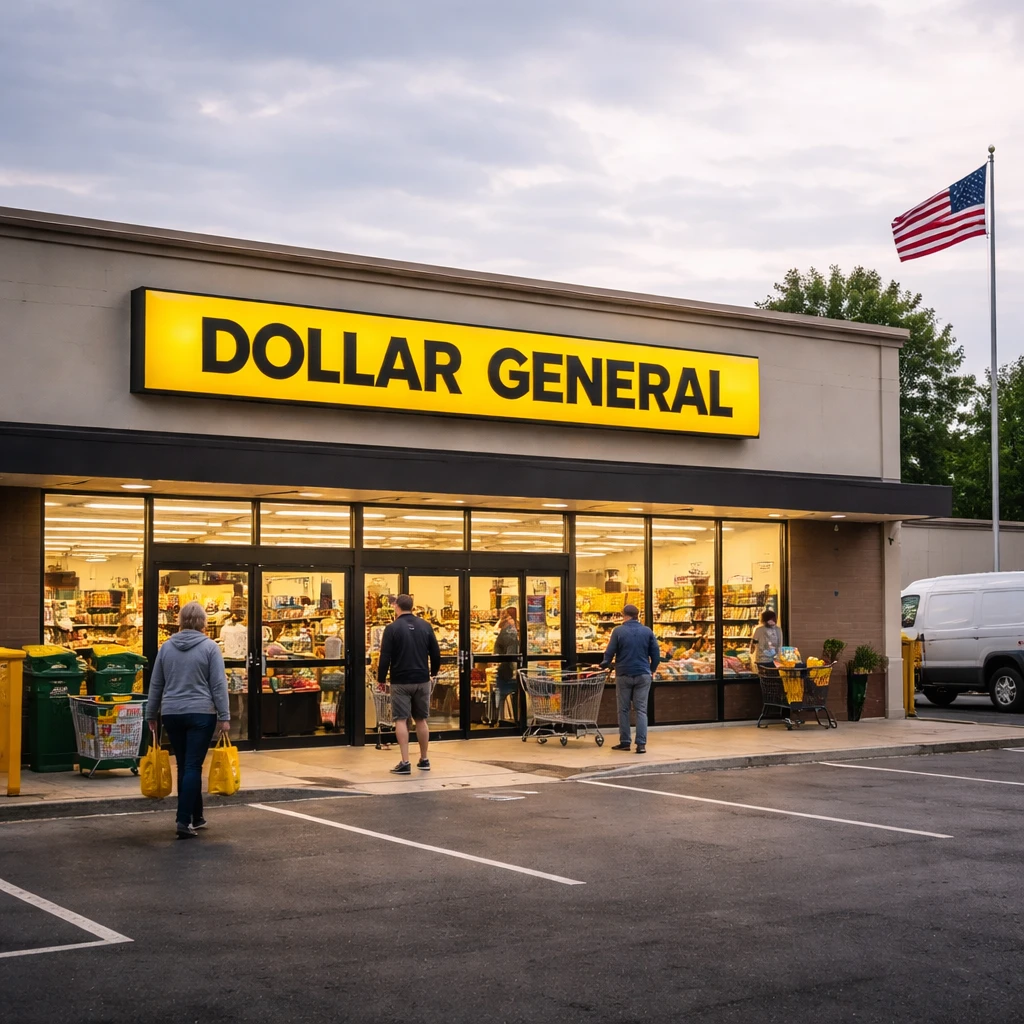
Hook / Thesis
Dollar General (DG) sold off after management flagged slower growth for fiscal 2026, but the move overshoots the facts: the company still reported a sales beat for Q4 ($10.91B vs $10.82B consensus) and earnings strength ($1.93 per share in the quarter). The pullback creates a tactical buying opportunity for disciplined traders who want exposure to a low-priced retail model that typically outperforms when consumers feel the squeeze.
At $137.87, DG is trading well below its short-term moving averages, with an RSI near 32 and clear bearish momentum. That technical oversold condition, coupled with robust free cash flow ($2.34B) and a manageable balance sheet (debt-to-equity ~0.63), argues for a mid-term swing trade to capture mean reversion and the ongoing structural tailwind of consumers shifting toward value retailers.
What Dollar General Does and Why the Market Should Care
Dollar General operates a dense network of discount-format stores selling consumables—food, cleaning supplies, basic apparel, health and beauty, and seasonal items. These are low-ticket, high-frequency purchases that make the chain a natural beneficiary during periods of household budget stress. A recent consumer-trends report showed dollar stores climbing to become one of the most-visited retail channels as affordability pressures bite: when households cut back, they often trade down to discount formats.
The market cares because DG combines scale, a localized footprint and product mix that skews toward essential spending. That mix gives it defensive revenue characteristics versus discretionary retailers, and it explains why DG can still generate solid cash flow even with moderated top-line growth.
Hard Numbers That Support the Trade
- Q4 reported sales: $10.91 billion (beat $10.82B consensus).
- Q4 earnings: $1.93 per share.
- Trailing EPS (annualized): $5.80, implying a price-to-earnings around 25x
- Free cash flow (most recent): $2.339 billion, with price-to-free-cash-flow near 13.6x.
- Market capitalization (snapshot): about $30.3 billion; enterprise value roughly $35.78 billion and EV/EBITDA ~12.25x.
- Balance-sheet and returns: return on equity ~15.6%, debt-to-equity ~0.63, dividend yield ~1.63%.
- 52-week range: $74.67 - $158.23 - meaning the current price sits roughly mid-to-high in the one-year span after a big recovery from last year’s lows.
Valuation Framing
DG is not a deep-value bargain by headline P/E, but the business is cash-generative: price-to-sales ~0.76 and price-to-free-cash-flow ~13.6x. Those figures suggest the market is pricing moderate growth into the stock rather than expecting a significant re-acceleration. Given the company’s defensive revenue mix and high-frequency purchasing behavior, paying mid-20s P/E for stable, predictable cash flow is reasonable for traders seeking downside protection with upside optionality.
Compare this to cyclicals where the same multiple can signal rich expectations; for DG, the multiple reflects a slower-growth but higher-resilience earnings stream. The recent guidance cut (management now guiding fiscal 2026 net sales growth to ~3.7-4.2% and comp-store growth to ~2.2-2.7%) explains the re-rating, but those numbers still imply positive top-line growth and incremental FCF if operating leverage holds.
Catalysts (2-5)
- Persistent consumer affordability pressures that keep traffic flowing to dollar-store formats - continuing structural tailwind.
- Quarterly beats or upside to same-store sales that would force the market to reprice the slower guidance as conservative rather than structural deterioration.
- Margin improvement or cost saves announced on upcoming calls; FCF expansion is a quick way to shift investor sentiment.
- Technical mean reversion as RSI climbs out of oversold territory and price reclaims key moving averages (SMA 10 / SMA 20 near $148-$150 areas).
Trade Plan
This is a mid-term swing trade that targets mean reversion and fundamental stability rather than a multiyear buy-and-hold. The recommended parameters are conservative relative to today’s volatility.
| Item | Plan |
|---|---|
| Trade Direction | Long |
| Entry Price | $138.00 |
| Stop Loss | $126.00 |
| Target Price | $155.00 |
| Horizon | Mid term (45 trading days) - enough time for earnings follow-up, comps read, and technical mean reversion. |
| Risk Level | Medium - tactical trade size recommended and use of a firm stop. |
Why these levels? Entry near $138 captures the current post-earnings weakness while staying above the recent intraday lows. The stop at $126 sits under the $128.84 low printed intra-session and allows for some noise while protecting against a momentum breakdown. The $155 target is set below the 52-week high of $158.23, allowing room for a run without expecting a full reclaim of prior highs in the mid-term window.
Position Sizing & Risk Management
Risk no more than 1-2% of capital on this single trade. With the entry and stop above, calculate position size so that the dollar loss to stop equals your risk tolerance. Re-evaluate if DG prints persistent new lows or if company commentary shifts to materially worse sales trends or margin pressure.
Risks and Counterarguments
Below are the main risks to this trade and a direct counterargument a cautious investor could reasonably make.
- Slower secular growth: Management’s guidance for fiscal 2026 shows slower net sales and comps growth versus the prior year. If consumer demand weakens further, DG’s valuation and cash flow could compress more than expected.
- Competition and channel share shifts: Walmart, grocery chains and club stores are all fighting for value-conscious shoppers. If competitors maintain lower prices or expand local formats aggressively, DG could lose traffic and margin.
- Margin and cost pressures: Rising freight, labor, or product costs could erode operating margins even if sales hold. DG needs disciplined purchasing and merchandising to protect FCF.
- Macro shock or rapid disinflation: If inflation eases quickly, consumers may trade back up to full-price channels, reducing the structural tailwind for discount formats.
- Technical downside continuation: Momentum indicators are bearish and short interest, while improving, could be a headwind if selling pressure builds. A failure to regain key moving averages could attract more technical sellers and prolong the decline.
Counterargument: The market’s sell-off is justified. Guidance implies materially slower growth and the stock’s mid-20s P/E already prices in fair value for a lower-growth retail chain. Waiting for clearer evidence of stabilized comps (a positive guidance revision or consecutive beat-and-raises) before buying reduces the risk of catching a falling knife.
What Would Change My Mind
I would abandon this long trade plan if any of the following happen within the mid-term window: management materially downgrades guidance again, same-store sales turn negative sequentially, free cash flow contracts sharply, or DG’s price breaks below $120 on expanding volume. Conversely, stronger-than-forecast comps or margin expansion would make me extend the horizon and consider adding to a position.
Conclusion
Dollar General’s pullback after a cautious fiscal-2026 outlook is a tactical buying opportunity for traders who want defensive retail exposure with cash-flow resilience. The company still generates strong free cash flow, maintains reasonable leverage and benefits from a consumer environment that favors value formats. The proposed mid-term (45 trading days) swing trade uses a disciplined entry at $138, a protective stop at $126 and a realistic target of $155 to capture mean reversion while limiting downside.
This is not a “set-and-forget” long-term buy; it is a pragmatic trade that balances the company’s durable business model with the immediate reality of slightly slower growth and bearish technicals. Keep position sizes controlled and respect the stop.