
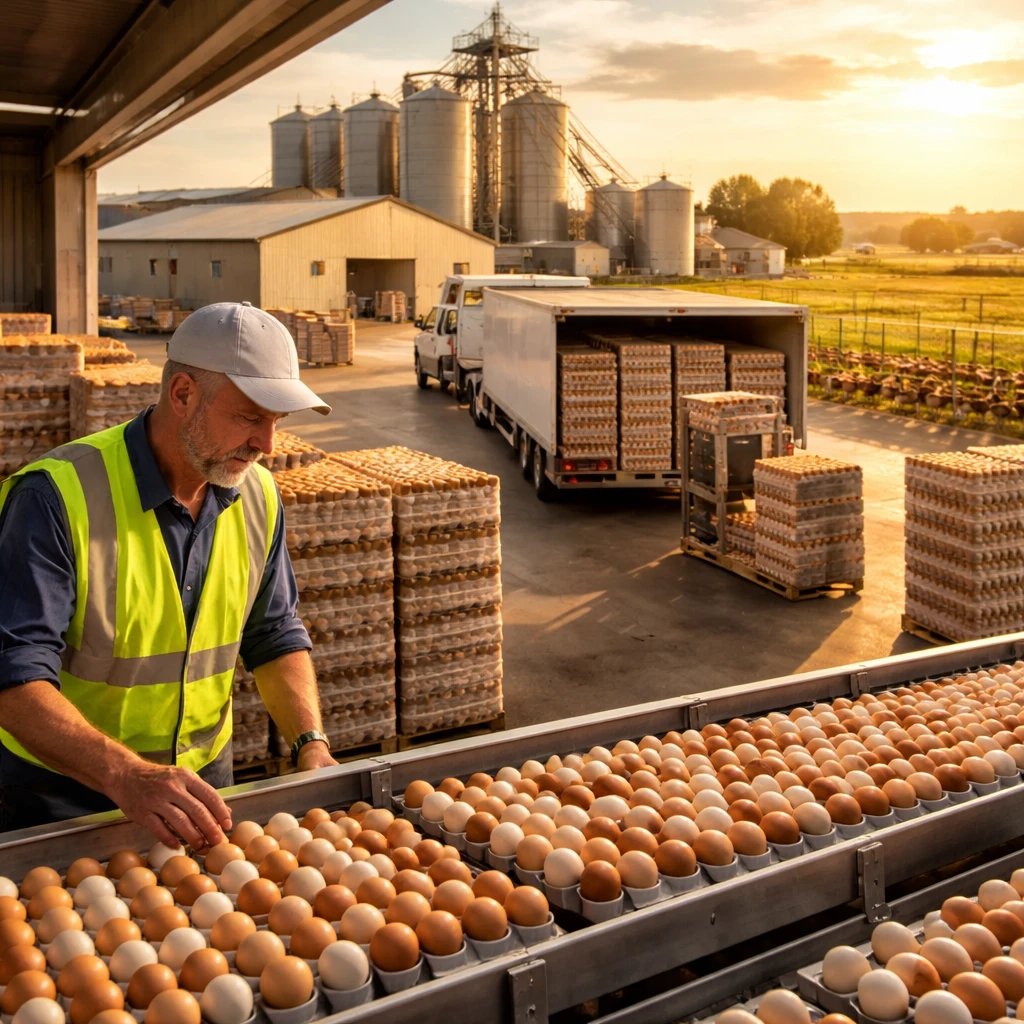
Hook & thesis
Cal‑Maine Foods (CALM) is the largest U.S. shell egg producer and it is standing on a remarkably simple setup: deep free cash flow, near-zero leverage, a cheaply valued equity, and an accretive $128.5 million acquisition that extends its Midwest footprint. The stock has pulled back into the low $70s–$80s after a summer high near $126; at $78.63 today the market is effectively paying less than 4x trailing earnings and under 1x sales for a business that generates meaningful free cash flow ($1.17 billion reported). That combination - rock‑solid cash flow and distressed multiples - is the basis for a tactical long ahead of near‑term catalysts.
My trade thesis: buy CALM now to capture a mid‑term re‑rating as the company reports results and begins integrating Creighton Brothers (announced 03/02/2026) while prepared‑foods capacity upgrades start to drive higher margin conversion of commodity eggs into value‑added product.
What the company does and why the market should care
Cal‑Maine produces, grades, packs, markets and distributes shell eggs and egg products to grocery chains, club stores, foodservice distributors and manufacturers. The business is vertically integrated: farms, hatcheries, feed mills and processing plants reduce supply risk and keep input costs and margins in management’s control. Investors should care because Cal‑Maine is not a high multiple growth story — it is a cash flow engine: trailing free cash flow in the dataset is $1,170,139,000, enterprise value is roughly $3.376 billion and the company reports no net debt on the balance metrics shown. That balance-sheet health plus a historically cyclical but essential product (eggs) makes CALM a defensive cyclical that can pay attractive returns to shareholders while funding selective capacity investments and M&A.
Important numbers that back the case
| Metric | Value |
|---|---|
| Current price | $78.63 |
| Market cap | $3.747 billion |
| Trailing EPS | $24.20 |
| Price / Earnings | ~3.25x |
| Price / Sales | ~0.89x |
| EV / EBITDA | ~2.22x |
| Free cash flow (trailing) | $1,170,139,000 |
| Dividend yield | ~11.3% |
| ROE / ROA | ~42.8% / 36.7% |
Put plainly: the stock is trading at a steep discount to both its cash generation and to ordinary mid‑cycle multiples for a branded, vertically integrated food company. That discount appears at least partly technical — momentum indicators show bearish pressure (RSI ~34.5, MACD histogram negative) — which creates a tactical entry opportunity if fundamental tailwinds reassert themselves.
Why now - catalysts that can move the needle
- Quarterly results (pre‑earnings trade): An upcoming release could show margin stabilization or narrowing of feed‑cost impacts; even a modest beat on operating margins or guidance could force a multiple expansion from the current ~3x earnings to something more normalized.
- Creighton acquisition (03/02/2026): The $128.5 million cash deal adds 3.2 million laying hens and an egg products facility in Indiana. That both diversifies regional production risk and supplies additional feedstock for prepared foods — improving margin mix over time.
- Prepared foods capacity upgrades: Management is investing in Echo Lake and related projects to add scrambled egg production and prepared foods capacity. Value‑added eggs sell at meaningful premiums to commodity shell eggs and can lift blended margins.
- Large dividend yield and buyback optionality: The company offers a high yield that can attract income buyers if payout stability is confirmed; management also has cash available for opportunistic buybacks or additional tuck‑ins.
Valuation framing
Valuation is the clearest argument for the bull case. At $78.63, market cap is roughly $3.7 billion while enterprise value is around $3.376 billion. With trailing EPS of $24.20, the P/E sits near 3.25x. EV/EBITDA of ~2.22x implies the market is pricing in a sustained period of very low margins or structural decline — a low‑probability scenario given Cal‑Maine’s integration and cash flow history.
Consider a conservative re‑rating: if the market reverts to a 6–8x P/E (still low for food processors but demonstrative of a modest multiple normalization) the implied price range would be $145–$193 based on trailing EPS. Even a small move to 4.5x P/E implies a price near $109. The trade target I set ($96.00) is deliberately conservative relative to those multiples and acknowledges cyclical risk while capturing meaningful upside from a modest re‑rating.
Technical background and positioning
Technically the stock has softened: the 10/20/50 day averages are above the current price and momentum indicators show bearish bias. Short interest has been elevated at times (recent settlements show several million shares short and days‑to‑cover in the 5–7 day range), which creates potential for a squeeze if earnings generate a positive surprise. RSI near 34 suggests the stock is not deeply oversold but is close to the level where value buyers often become active in cash cow names.
Trade plan (actionable)
- Position: Long CALM
- Entry price: 78.63
- Stop loss: 72.00
- Target price: 96.00
- Horizon: mid term (45 trading days) - I expect the trade to last through an earnings reaction and initial integration updates on the Creighton deal and prepared foods capacity schedule. That window gives time for the market to re‑price cash flows and for short covering to play out if results beat.
Rationale: entry near the current price captures the value multiple and dividend while the stop under $72 limits downside to a conviction level below the recent winter low ($71.92). The $96 target reflects a conservative re‑rating and partial realization of improved margin mix from prepared foods and acquisition synergies.
Risks and counterarguments
Any trade has risks; here are the material ones and a counterargument to the bullish thesis.
- Feed cost volatility: Feed is the largest input for egg producers. A sustained spike in grain prices would compress margins despite operational efficiency, and management may be forced to raise prices that could reduce demand in the short term.
- Avian flu / biological risk: Disease outbreaks can reduce laying hen populations quickly and force plant shutdowns or recalls. These are low‑probability but high‑impact events.
- Execution risk on integration: The Creighton acquisition (03/02/2026) was paid in cash. While the deal expands capacity, integration risk — from workforce, regional logistics, or plant conversion — could delay anticipated synergies.
- Dividend sustainability pressure: The company yields north of 10% today. If earnings swing materially lower, management may be pressured to cut dividends, which would likely lead to a retracement of the equity price.
- Market technicals and momentum: The stock carries bearish momentum indicators and above‑average short interest. A weak earnings result could trigger heavy selling and a deeper pullback that stops are intended to limit.
Counterargument: The primary bear case is that Cal‑Maine is a cyclical commodity producer facing structurally higher input costs and lower end‑market pricing; if the company is forced to cut output or prices to move inventory, margins and cash flow can suffer. Given the stock’s low multiple, the market may be pricing in the risk that margins remain compressed for multiple quarters, and a single weak print could reset expectations downward further.
How I would change my mind
I would abandon the long thesis and materially reduce risk exposure if any of the following happens:
- Guidance is cut materially and management no longer expects margin stabilization or an improvement in prepared‑foods conversion within the next two quarters.
- The company reports a significant avian influenza impact that materially reduces laying hens beyond management’s prior guidance.
- Dividend is cut unexpectedly without clear evidence that cash flow will recover within a reasonable timeline.
Conclusion
Cal‑Maine is a pragmatic value trade: strong free cash flow, near‑zero leverage, and an accretive acquisition create a favorable backdrop for a mid‑term long. The valuation is unusually cheap relative to cash flow and sales, which means upside from even modest margin recovery or multiple normalization is substantial. That said, the trade is not without real operational risks tied to feed costs and biological vulnerabilities. By taking a disciplined entry at $78.63, using a stop at $72.00 and targeting $96.00 over the next 45 trading days, you capture a favorable risk/reward while allowing earnings and integration progress to prove the story.
If the upcoming results show margin stabilization, better-than‑expected prepared‑foods volume, or clear integration wins from Creighton, I would add to the position and push the target higher. If one of the downside triggers above is realized, the stop should preserve capital and force a reassessment.
Trade idea summary: Long CALM at $78.63, stop $72.00, target $96.00, horizon mid term (45 trading days). Risk level: medium.