
Hook & thesis
Carnival Corporation (CCL) looks worth buying on a controlled dip. The shares pulled back amid sectorwide fear tied to renewed geopolitical tensions that briefly spooked leisure travel. That overreaction creates a tactical opportunity: Carnival is trading around $28.83 with a market cap near $39.4 billion, generates meaningful free cash flow, and is priced at single-digit EV/EBITDA and low-teens P/E multiples relative to recovery potential. We upgrade CCL to a cautious long here, but with a tight stop because two big risk vectors - oil/route disruption and elevated leverage - can still push the stock lower.
Summary trade: enter at $28.50, target $34.00, stop $24.50. Time horizon: mid term (45 trading days). Risk level: medium.
Business in a paragraph - and why the market should care
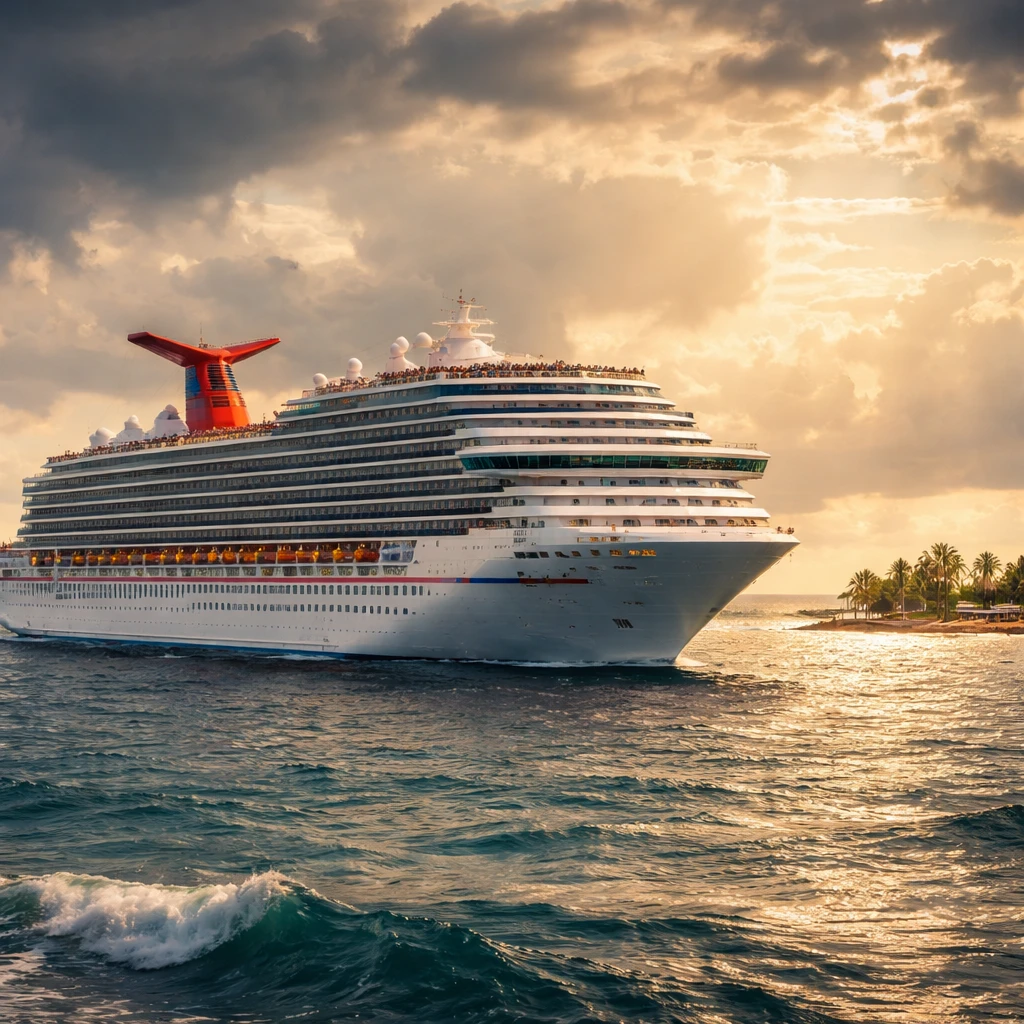
Carnival is the world's largest cruise operator, running major brands across North America and Europe (Carnival Cruise Line, Princess, Holland America, Costa, P&O and others) and also operating ports and private destinations. The business benefits from large-scale fixed assets (ships and islands), pricing power on peak itineraries, and attractive onboard revenue per passenger when demand is healthy. That makes Carnival highly cyclical: when demand is robust the company converts bookings into strong margin and free cash flow; when travel risk spikes, revenue and forward bookings reprice quickly and sentiment turns negative.
What the numbers say
Key data points that support a tactical long:
- Share price and liquidity: CCL is trading near $28.83 with average volume around 21.5 million shares (average_volume ~21,450,736), providing intraday liquidity for an active trade.
- Valuation: the stock trades at a P/E in the low-to-mid teens (EPS ~ $1.99 and P/E ~14-14.3), EV/EBITDA ~8.8 and price-to-sales ~1.48. Those multiples look reasonable for a business generating scale and improving margins compared with distressed pandemic levels.
- Cash flow: free cash flow on the last available data point is meaningful at ~$2.61 billion — a real buffer for capital spending and debt reduction.
- Capital structure: enterprise value sits around $64.23 billion while market cap is roughly $39.4 billion. Debt remains elevated (debt-to-equity ~2.17), a reminder that higher rates or slower recovery would pressure credit metrics.
- Technical context: short-term technical momentum is subdued - 9-day EMA ~$30.76 and 21-day EMA ~$31.17 with the 10- and 20-day SMAs above the current price, RSI ~39 and MACD showing bearish momentum. That technical setup explains why momentum traders may be stepping back and creates a lower-risk entry window for patient buyers.
Valuation framing
At a market cap of about $39.4 billion and EV of $64.23 billion, Carnival sits at attractive headline multiples given the company's improved cash generation. EV/EBITDA of ~8.8 and price-to-earnings around 14 imply the market is already discounting a degree of cyclical risk, not a full structural impairment. Free cash flow of ~$2.61 billion gives the company flexibility to pay down debt or reinvest in the fleet; management has already taken steps to reduce leverage materially since the pandemic peak.
Put another way: Carnival is not cheap on a replacement-cost basis, but compared with other cyclical travel operators and its own pandemic-era valuations, the current multiple leaves upside if demand remains intact and the macro stabilizes. The immediate near-term valuation floor is supported by improving fundamentals (FCF and EPS), but the balance sheet is the wild card — higher rates or shallow demand would compress multiples quickly.
Catalysts (what could drive the stock to our target)
- Normalization of travel sentiment after the recent geopolitical scare. Headlines on 03/03/2026 tied to escalation in the Middle East pressured travel stocks; a cooling of tensions would likely see a rapid rebound in bookings and yields.
- Continued debt reduction and lower net interest expense. Management has been actively reducing leverage and expects further interest savings; reports noting a multi-billion reduction in debt and an expected $700 million reduction in net interest expense would materially improve net income and cash flow.
- Stronger seasonal bookings and higher onboard spend supporting margin expansion through peak spring/summer itineraries.
- Positive institutional flows and catalyst trades (notable hedge fund buys were reported recently) that can accelerate multiple expansion given the company's size and liquidity.
Trade plan and time horizon
This is a tactical swing trade aimed at a mid-term horizon: 45 trading days. The plan reflects the tendency of travel sentiment to mean-revert quickly once headlines stabilize and the typical calendar pattern of bookings improving into spring/summer. Specific execution:
- Entry: $28.50. Enter on a constructive pullback or limit order near this level to capture current weakness while leaving room to confirm stabilization.
- Target: $34.00. This sits near the recent 52-week high ($34.03) and represents a logical market-reversion target if demand and sentiment normalize.
- Stop: $24.50. A breach below $24.50 indicates a deeper unwind in bookings or a macro shock that argues against holding spot exposure; this keeps downside controlled for the trade.
- Position sizing: keep exposure to a level where the loss to stop would be tolerable in your portfolio — here the stop equates to roughly an 14% downside from entry, so size accordingly for a medium-risk allocation.
Why the stop is important
Carnival's leverage (debt-to-equity ~2.17) and sensitivity to oil/route disruptions mean negative shocks can compress multiples rapidly. A defined stop prevents being caught by a multi-week unwind should bookings deteriorate or fuel spikes persist.
Counterarguments
- Geopolitical risk is real: if tensions escalate and key shipping lanes are threatened, travel demand and itineraries could be disrupted for multiple quarters, not weeks.
- Higher rates could keep net interest expense elevated despite debt reduction; that would weigh on net income and free cash flow, invalidating the bull valuation case.
- Competition or operational issues (outages, health incidents) can depress onboard spend and forward bookings even without macro shocks.
Risks - what could go wrong (at least four)
- Geopolitical escalation or prolonged regional instability that meaningfully reduces bookings or forces itinerary cancellations.
- Rising fuel costs and a sustained oil spike that pushes operating costs higher and reduces margin if fares do not reprice quickly.
- Balance-sheet stress: although Carnival has reduced debt materially since the pandemic, debt-to-equity remains elevated; slower cash generation would hamper debt reduction and risk credit-tightening effects.
- Weakening consumer confidence or an economic slowdown that dents discretionary travel demand and extends the booking cycle.
- Idiosyncratic operational events - health incidents, ship detentions, or major accidents - that can create prolonged reputational and revenue damage.
What would change my mind
I will abandon this trade if any of the following occur: a) a persistent rise in net interest expense guidance or evidence that debt reduction has stalled; b) forward booking trends show consistent sequential deceleration for two booking cycles; c) the company issues materially negative guidance tied to itinerary disruptions or a durable decline in onboard spending. Conversely, stronger-than-expected bookings, a clear and sustained drop in leverage, or a clean macro cooling of geopolitical headlines would reinforce the bullish stance and push me to add to the position.
Conclusion
Carnival is a classic recovery-and-risk play: attractive cash flow, reasonable valuation (EV/EBITDA ~8.8; P/E ~14), and improved balance-sheet dynamics argue for selective buying when the market overreacts to headline risks. That said, the leverage profile and outsized sensitivity to geopolitical and fuel shocks require a disciplined entry and a firm stop. For traders comfortable with a medium-term 45-trading-day horizon and willing to watch headlines closely, entering at $28.50 with a $24.50 stop and a $34.00 target offers a balanced risk-reward.
Trade specifics again: Enter $28.50, Target $34.00, Stop $24.50. Mid term (45 trading days). Risk: medium.
Key data snapshot
| Metric | Value |
|---|---|
| Current price | $28.83 |
| Market cap | $39.4B |
| Enterprise value | $64.23B |
| Free cash flow | $2.61B |
| P/E | ~14 |
| EV/EBITDA | ~8.8 |
| Debt / Equity | ~2.17 |
| 52-week range | $15.07 - $34.03 |
Actionable idea: buy the dip at $28.50, size appropriately, use a $24.50 stop and plan for a mid-term play to $34.00. Keep an eye on headlines and booking cycles; the trade works if travel demand normalizes and Carnival continues to deleverage.