
Hook & thesis
Energy Fuels (UUUU) is already a market favorite in the uranium patch, but the stock today trades like a pure play on nuclear commodities rather than as a potential Western rare-earth processor. That gap is the trade: UUUU owns and operates the White Mesa Mill and other assets that give it an existing U.S. processing footprint. With the U.S. government moving decisively to underwrite domestic rare-earth and critical-mineral supply (see Project Vault and other DOE programs), Energy Fuels is one of the few U.S.-based names that can credibly scale into refinining and value-added processing. If management executes, the market could re-rate the company from a uranium miner to a strategic supplier commanding security premia.
I want to be clear: this is a directional, event-driven idea. The path to upside is policy-driven demand for secure Western supply chains plus concrete execution around processing/plant upgrades and offtake wins. The balance sheet, free cash flow and EPS history are imperfect today, so position sizing and an explicit stop are essential.
The business and why the market should care
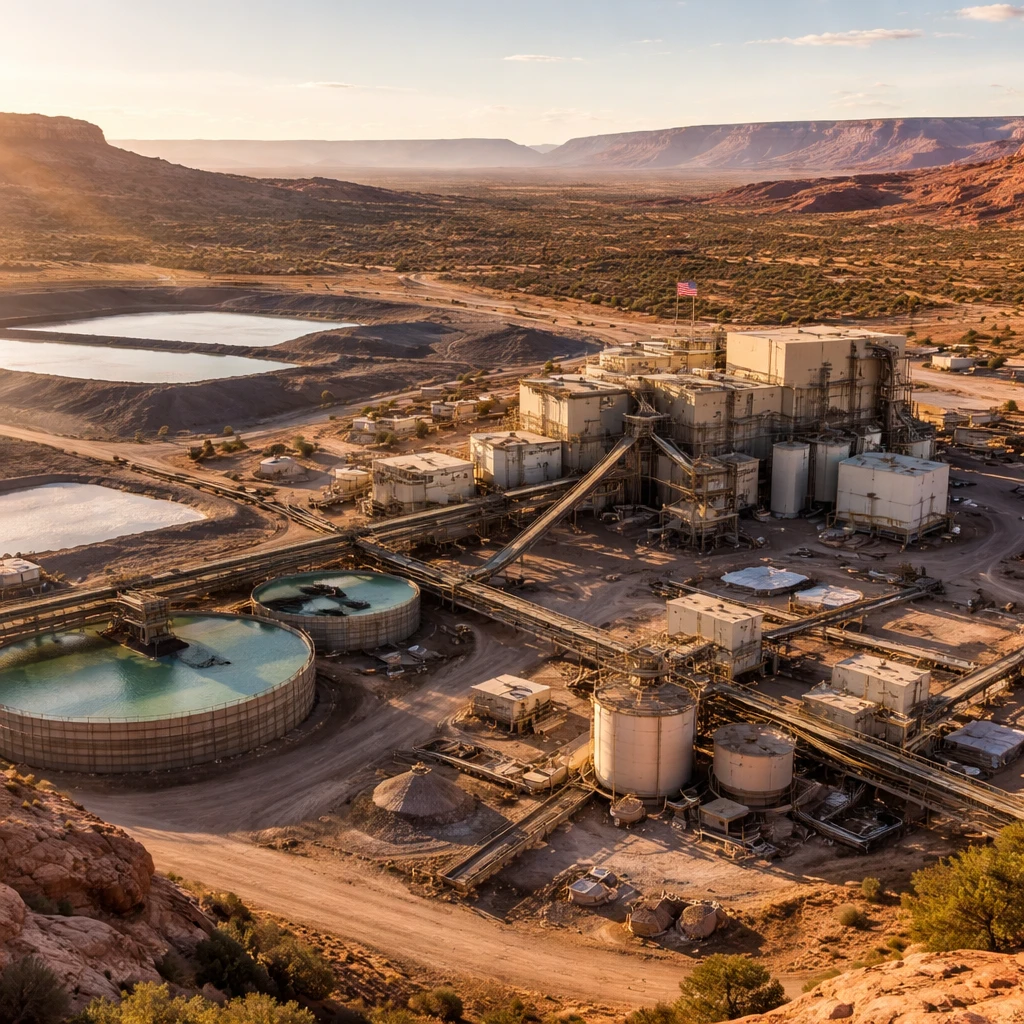
Energy Fuels describes itself as a mining development company focused on uranium and vanadium. It operates assets including Nichols Ranch and the White Mesa Mill. The White Mesa Mill is important in investor discussions because few U.S. facilities provide a domestic processing footprint. That existing infrastructure gives Energy Fuels optionality: it can scale uranium production, process other feedstocks, or be repurposed to take in rare-earth concentrates should management choose to pursue that path and secure capital and offtake commitments.
The macro driver is straightforward. The U.S. has begun to prioritize domestic critical mineral supply chains through large public-private programs. Project Vault (a $12 billion public-private partnership announced 02/03/2026) and other DOE injections (notable funding announcements in early January 2026) create both funding and political momentum for Western processing. Market participants are already valuing domestic security higher than commodity-only producers: analyst and market write-ups now assume domestic suppliers can command pricing premiums versus Chinese supply chains.
Supporting numbers
- Market capitalization sits around $5.1 billion (snapshot market cap roughly $5.07B; ratio-based market cap about $5.13B) while enterprise value is about $5.745B.
- Shares outstanding are ~237.3 million with a float reported at ~236.8 million.
- Recent price action: current trade near $21.35 with a 52-week high of $27.90 (01/28/2026) and a 52-week low of $3.20 (04/07/2025). The swing high indicates the market has already priced in some of the positive sector dynamics.
- Profitability and cash flow remain a concern: trailing EPS is negative at roughly -$0.36, and free cash flow is negative at about -$108.7 million. Cash on the balance sheet is reported at roughly $2.07 (units per statement), and the company has meaningful working-capital ratios (current ratio ~30.69; quick ratio ~28.34) that reflect a lumpy balance-sheet profile common to resource companies.
- Valuation multiples on current reported figures look stretched versus basic single-commodity peers: price-to-sales is very high (about 77.9x), and price-to-book is near 7.57x. These multiples reflect investor expectations for future earnings, non-operational asset value, or strategic optionality tied to domestic processing.
Valuation framing
At ~ $5.1B market cap, the stock clearly prices more than today’s uranium cashflows. That premium is justified only if the market expects either: 1) a sustained re-rating driven by robust near-term earnings, or 2) realization of strategic value in non-uranium processing (rare earths, critical minerals) and associated offtake/security premiums. Given trailing negative EPS and a negative free-cash-flow figure of roughly -$108.7M, the company is not cheap on existing commodity economics alone.
However, valuation should be viewed through two lenses. First, the 52-week high at $27.90 shows the market is willing to pay a premium when sector catalysts align. Second, Energy Fuels is uniquely U.S.-based with existing processing infrastructure; if management secures government programs, direct loans, or offtake that convert capacity into reliable revenue, the EV could expand materially because Western processors can command higher route-to-market margins than raw-commodity miners.
Key catalysts (what to watch)
- Policy & funding milestones: follow Project Vault implementation (02/03/2026 announcement) and DOE funding allocations (notable DOE announcements in early January 2026). Any direct loans, grants, or prioritization for domestic processing will be positive.
- Offtake / partnership announcements: a binding offtake agreement with U.S. OEMs, defense contractors, or a major chip/EV supply chain participant would materially derisk the rare-earth optionality.
- Permitting and technical updates for White Mesa Mill reconfiguration or capacity expansions: concrete timelines and capital estimates reduce execution risk.
- Quarterly results showing narrowed cash burn or positive free cash flow trends. The market reacted negatively to concerns about cash burn in late January 2026; normalization here is necessary for valuation support.
- Uranium and rare-earth commodity price movements: sustained higher uranium prices and any demonstrable premium for secure Western rare-earths would help margins and multiple expansion.
Trade plan - actionable entry, stop, target
Trade direction: long.
Entry price: $21.35 (current trade). Target price: $30.00. Stop loss: $17.00.
Horizon: long term (180 trading days). Why this horizon? Converting processing optionality into visible revenue or binding offtake agreements will take time - permitting, engineering, and commercial discussions move on multi-month timelines. Give the trade up to roughly six months to play out; you want to see either capital commitments (government or private) or material contract wins that justify a re-rate.
Sizing: treat this as a high-conviction but event-dependent trade. If you are risk-aware, size this position small (1-3% of portfolio) while the cash-burn and execution risks remain. If the company confirms funding or offtake, consider adding on strength.
Technical context
Price sits near shorter-term averages: 10-day SMA ~ $21.65, 20-day SMA ~ $21.77, and 50-day SMA ~ $20.07. RSI is roughly 49 (neutral), MACD shows slightly bearish momentum but not extreme. Short-interest appears meaningful but not overwhelming (recent days-to-cover ~2.53 as of 02/13/2026), so the stock can move quickly on news in either direction.
Risks and counterarguments
- Execution risk on conversion to rare-earth processing. Having a U.S. mill is an advantage, but converting it to a profitable rare-earth processor requires capital, permits and confirmed feedstock. Delays or cost overruns would hurt the re-rate thesis.
- Cash burn and funding risk. Free cash flow is negative (about -$108.7M). Market reactions earlier in 2026 highlighted investor worry about cash burn; absent new capital or material EBITDA improvement, dilution is possible.
- Commodity-price dependence. A significant portion of the near-term revenue case still ties to uranium and vanadium markets. A reversal in uranium fundamentals would hurt the base case while the rare-earth optionality remains unproven.
- Valuation is already premium. Price-to-sales and price-to-book multiples are elevated. If the market decides only a fraction of the processing optionality is realistic, the stock could revert sharply.
- Political & permitting risk. Government programs can change with administrations and budget cycles; project approvals and environmental permitting often take longer than expected.
Counterargument: A prudent skeptic will note that the market is already trading Energy Fuels at a premium that assumes successful strategic pivoting. If the company fails to secure offtake or demonstrate scalable throughput at White Mesa, the valuation could collapse back toward commodity-cycle multiples. In that scenario, the safer call is to own older, cash-generative miners with established production rather than optionality plays.
Conclusion and what would change my mind
My stance: constructive and long-term bullish while the company demonstrates clear steps to capture the rare-earth/critical-mineral upside. Entry at $21.35 with a $17 stop and a $30 target gives an attractive risk/reward given the policy backdrop and the unique processing asset base. This trade is priced for event-driven progress - funding confirmations, offtake deals, or credible technical timelines for processing conversion will validate the thesis.
I will change my view if any of the following happen: 1) management fails to secure funding or pivots away from processing optionality; 2) quarterly reports show accelerating cash burn without a plan for near-term funding; 3) permit or technical reports make conversion uneconomic. Conversely, binding offtake agreements or a confirmed government loan/grant would make me materially more bullish and increase position sizing in a portfolio context.
| Metric | Value |
|---|---|
| Current price | $21.35 |
| Market cap | ~$5.1B |
| Enterprise value | ~$5.74B |
| Trailing EPS | ~ -$0.36 |
| Free cash flow (trailing) | ~ -$108.7M |
| 52-week range | $3.20 - $27.90 |
Key points (short list)
- Unique U.S. processing footprint with White Mesa Mill gives real optionality to enter rare-earth processing.
- Federal programs (Project Vault - announced 02/03/2026 - and DOE funding) materially de-risk financing for domestic processors and can create pricing premia for secure suppliers.
- Valuation already implies optionality; the trade hinges on visible execution (offtake, funding, permit/tech progress).
- Trade plan: long at $21.35, stop $17.00, target $30.00, horizon long term (180 trading days).
If you buy this idea, treat it as an event-driven, execution-dependent position. Watch newsflow closely and tighten stops or trim into strength when concrete evidence of funding or offtake shows up.