
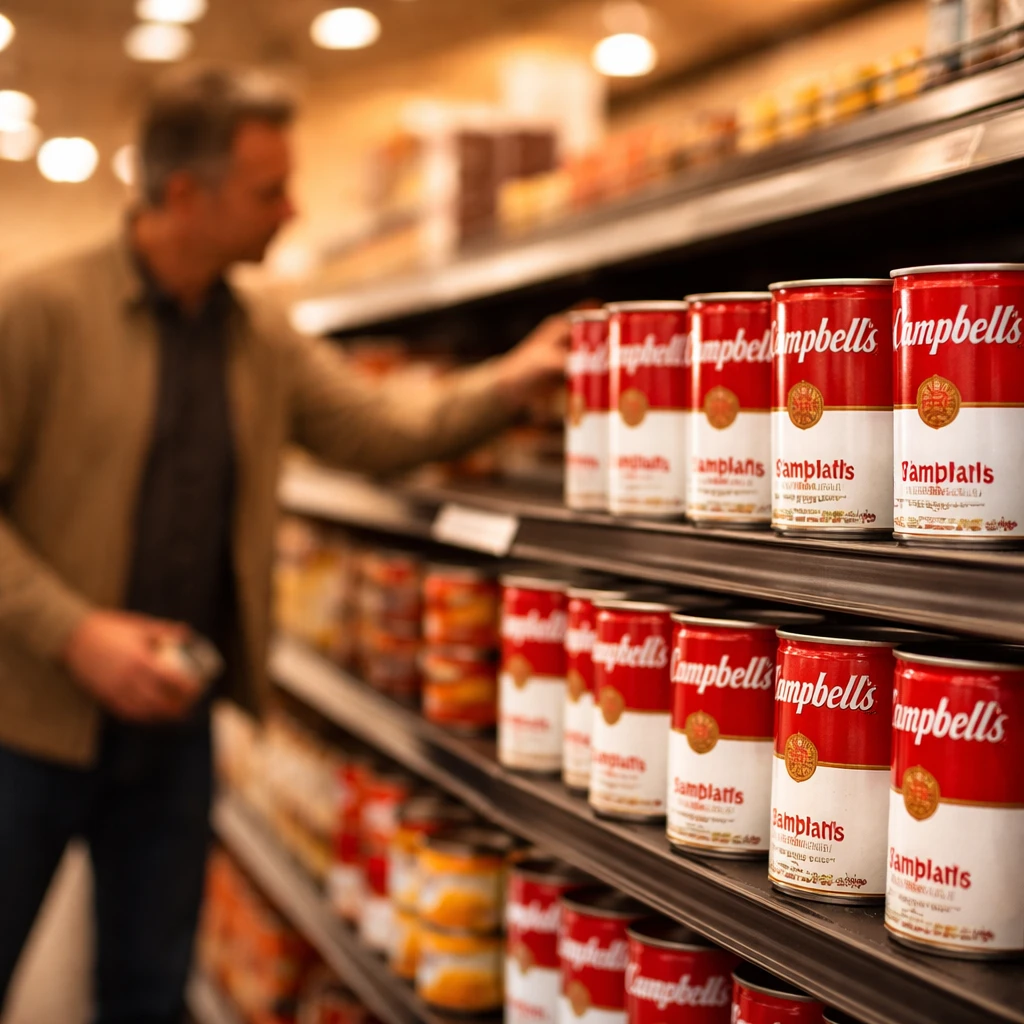
Hook & thesis
Campbell's (CPB) is serving up a classic value-with-income trade right now. The stock sits around $26.95, close to its 52-week low of $25.62, while yielding roughly 5.8% and trading at a P/E near 13.8. For investors willing to accept headline-level margin and balance-sheet risk, that combination - defensible brands, steady free cash flow, and an attractive yield - offers a concrete risk-reward if you enter with a defined stop and targets.
My trade thesis is straightforward: buy CPB around $26.95 with a stop at $25.00 and a primary target of $33.00. That setup captures a potential rebound toward the mid-30s while collecting a meaningful dividend and keeping downside limited. I characterize this as a position trade - plan to hold and reassess across ~180 trading days if catalysts play out; shorter holds are available depending on price action.
What Campbell's does and why the market should care
Campbell's manufactures and markets food and beverage products across two main segments: Meals and Beverages, and Snacks. The portfolio includes soup, meals, beverages, cookies, crackers, and frozen items. These are largely defensive, consumer-staples categories that do well in economic uncertainty and provide recurring cash flows from predictable retail demand.
The market should care because Campbell's combines cash generation with an above-average dividend yield and a valuation that looks cheap on several metrics. The company reported free cash flow of $687M and an enterprise value of roughly $14.81B, implying it produces meaningful cash versus its EV. That cash profile supports a 5.79% dividend yield and gives management optionality to invest in product innovation or buybacks if margins stabilize.
Key fundamentals and recent picture
- Current price: $26.95 (latest) with the 52-week high at $43.85 and low at $25.62 - trading nearer the bottom of that range.
- Market cap: ~$8.03B; enterprise value: ~$14.81B.
- P/E: ~13.85; P/B: ~2.02; EV/EBITDA: ~8.89.
- Free cash flow: $687M, which helps support the dividend and provides buffer for operational fixes.
- Dividend yield: ~5.79%; ex-dividend date: 04/02/2026; payable date: 05/04/2026.
- Balance sheet and liquidity: debt-to-equity is about 1.76, current ratio ~0.82, quick ratio ~0.34. Cash metric in the snapshot reads 0.05 (low), highlighting limited near-term cash cushion relative to liabilities.
Valuation framing
At roughly $26.95 the stock trades at a P/E under 14 and EV/EBITDA below 9. Those multiples are compelling for a company with strong brand equity and nearly three-quarters of a billion dollars in free cash flow. Market cap near $8.03B versus enterprise value near $14.81B reflects the leverage on the balance sheet; adjusting for that debt explains why equity looks cheaper on a P/E basis but carries added balance-sheet risk.
Compare price action to the 52-week band: the $26.95 quote is materially below the $43.85 52-week high. That gap is partly the market pricing in ongoing margin headwinds and shifting consumer preferences toward healthier snacks and fresher alternatives. Still, the low multiple plus cash generation argues CPB is priced for near-term weakness rather than a longer-term collapse.
Technicals and sentiment color
On the technical side, short-term moving averages sit above the current price - 10-, 20-, and 50-day SMAs are $27.33, $27.90, and $27.53 respectively - indicating recent downward pressure. The RSI around 44 suggests the stock is not oversold to extreme levels but has room for a bounce. MACD shows bearish momentum, and short interest is meaningful: recent settlement data shows ~34.9M shares short with days-to-cover in the 4.5-6 range historically. Active short volume in recent trading sessions suggests investors are positioned for weakness but also creates the possibility of rapid squeezes if sentiment shifts.
Catalysts that can re-rate the stock
- Dividend window - ex-dividend date of 04/02/2026 and payment on 05/04/2026. Income buyers might step in ahead of ex-date, providing near-term support.
- Margin stabilization - any reported signs of improved gross or operating margins (cost-savings realization, lower commodity costs) would directly boost free cash flow and valuation multiple.
- Positive consumer trends - better-than-expected seasonal demand (e.g., soup/meal seasons or snacks) or successful product reformulations toward health-conscious variants could accelerate sales recovery.
- Macro tailwinds - if the Fed shifts expectations toward rate cuts and consumer confidence steadies, staples with yields and improving cash flow often re-rate. Jim Cramer and other macro commentators have signaled such possible tailwinds in recent months.
- Analyst revisions - upgrades or better-than-feared guidance could prompt a quick re-rate given current short interest levels.
Trade plan - entry, stop, targets, timeframe
Trade direction: Long. Entry: $26.95. Stop loss: $25.00. Primary target: $33.00. Secondary target (aggressive): $38.50 if the company shows substantive margin improvement and the broader sector rallies.
Horizon: This is recommended as a position trade - plan to hold for long term (180 trading days) while monitoring quarterly updates and dividend safety. A shorter path is available: if price action reaches $31 quickly, consider taking partial profits for a mid-term outcome - mid term (45 trading days). For traders booked into near-term dividend capture, a short hold into the ex-dividend date - short term (10 trading days) - could be considered, but that is a different playbook than the core position discussed here.
Why these levels? The $25 stop limits downside below the recent low of $25.62 and respects the company's balance-sheet risks. The $33 target sits below the mid-30s where multiples would reflect normalized margins and a modest multiple expansion from current EV/EBITDA and P/E; reaching $33 implies both a margin improvement narrative and partial de-leveraging of sentiment.
Risk and counterarguments
There are several concrete risks to owning CPB here:
- Margin erosion - The company has faced pressure from input costs and changing consumer preferences. If margins continue to compress, earnings and cash flow could fall short of expectations and the multiple could compress further.
- Leverage and liquidity - Debt-to-equity at ~1.76 and a current ratio near 0.82 (quick ratio ~0.34) show limited short-term liquidity. An operational misstep could force tough choices on capital allocation, including potential pressure on the dividend policy.
- Consumer trends - Structural shifts toward fresh, healthier, or private-label alternatives could slow revenue growth in core categories and make market share gains difficult without increased investment in R&D and marketing.
- Short interest and volatility - Elevated short interest makes the stock vulnerable to volatile moves in either direction; that can accelerate losses if negative news comes or produce sharp squeezes if bullish news arrives.
- Macro sensitivity - Extended weakness in consumer spending could hit discretionary snack categories and reduce pricing power.
Counterargument to the setup: It's plausible the market is appropriately punishing the stock for structural demand shifts and persistent margin headwinds, meaning the multiple will remain depressed and the dividend could become unsustainable. If that narrative plays out, the stock could revisit the low $20s or below and keep investors waiting for an indefinite turnaround.
Why I'm willing to look past that: the company still generates substantial free cash flow ($687M), trades at reasonable multiples (P/E ~13.85, EV/EBITDA ~8.89), and sits near its 52-week low. That combination implies the market is pricing in a sizable probability of downside. With a strict stop and clear catalysts (dividend window, margin fixes, macro support), the asymmetric payoff - income collection plus potential capital appreciation to the mid-30s - is attractive to disciplined buyers.
What would change my mind
I would reduce or abandon this long stance if any of the following occur:
- Management signals dividend cuts or significant debt-fueled acquisitions that materially increase leverage without clear synergies.
- Quarterly results show continuing free cash flow erosion - at the same time as rising leverage - rather than temporary margin pressure.
- Consumer demand deteriorates further with visible market-share loss to fresh or private-label competitors and no credible turnaround plan.
- Technical breakdown below $25 on high volume that signals capitulation rather than a short-term oversold condition.
Conclusion - stance and sizing guidance
I recommend a tactical long in Campbell's at $26.95 with a stop at $25.00 and a primary target of $33.00. Risk is medium - the business is cash-generative and undervalued on headline multiples, but leverage and margin headwinds require discipline. For a typical retail-size account, consider sizing this as a modest percentage of risk capital (single-digit percent of equity allocation) and use the stop to control maximum downside. If CPB moves toward $31, trim some exposure and let the rest run to the primary/secondary targets while re-evaluating on quarterly results.
This trade is not a blind yield capture. It is a defined risk-reward position that banks income while giving the company time to show operational stabilization. If margins start to normalize and the macro backdrop improves, CPB should re-rate from its current low multiple. If not, the stop keeps the downside acceptable.
Trade details recap:
- Entry: $26.95
- Stop loss: $25.00
- Primary target: $33.00
- Secondary target: $38.50
- Horizon: long term (180 trading days) with optional mid-term (45 trading days) partial profit-taking.