
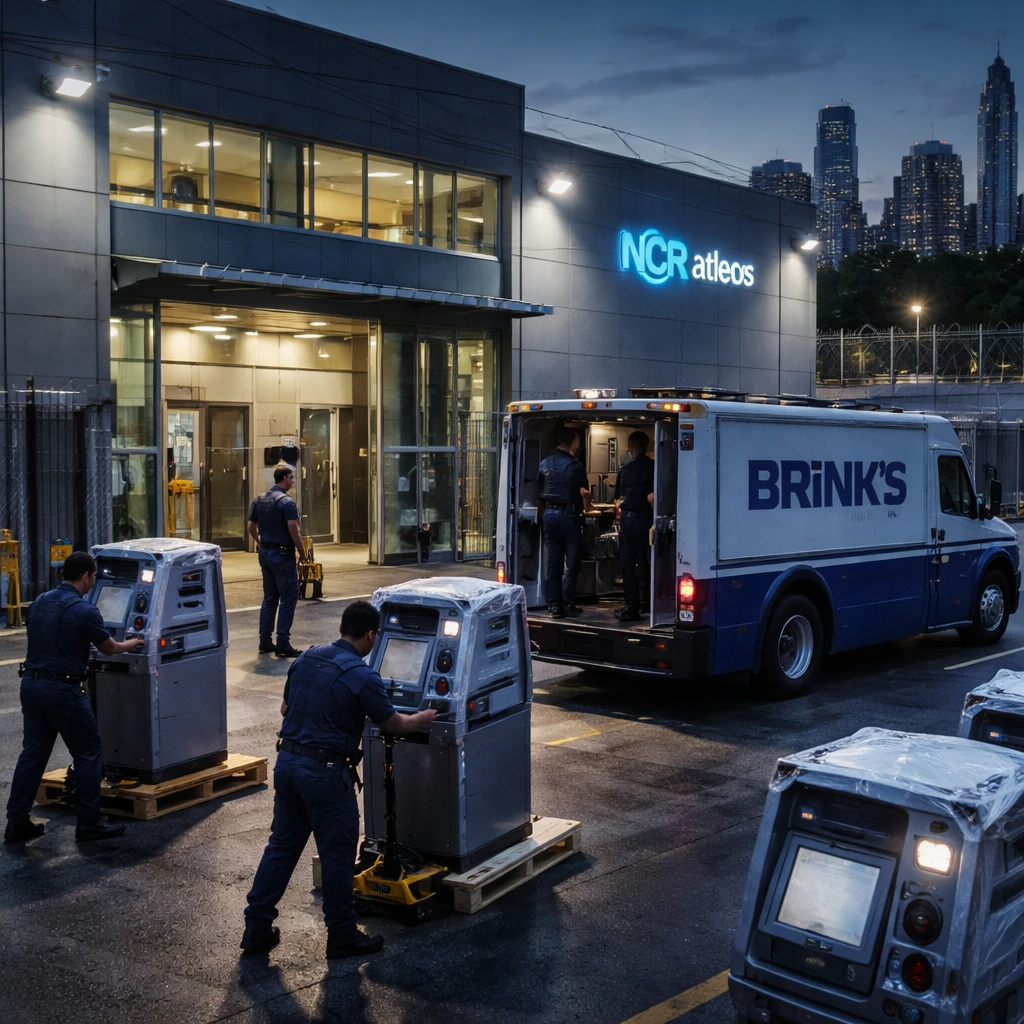
Hook & thesis
On 02/26/2026 Brink's announced an agreement to acquire NCR Atleos for roughly $6.6 billion in cash and stock, a transaction management projects will close in Q1 2027 and deliver at least 35% EPS accretion plus $200 million in run-rate cost synergies. For traders, this creates a defined, event-driven path to re-rating: accretion + meaningful buyback capacity and strong free cash flow can compress multiples even if revenue growth is modest.
My tactical view: a controlled long exposure to BCO at or near $126 is justified with a target of $150 over a longer holding period (about 180 trading days), while keeping a hard stop at $115 to protect against integration failure or broader market rotations. The trade balances attractive FCF yield and accretion against integration and financing risks.
Why the market should care
Brink's is a global cash and valuables logistics business with services that increasingly bridge physical cash logistics and digital retail solutions. The acquisition brings NCR Atleos' ATM management footprint - notably 78,000 owned-and-operated ATMs - into Brink's platform and boosts scale in a market that still depends on cash in many regions. Management projects $200M in annual cost synergies and a substantial EPS accretion of at least 35% once the deal is fully integrated.
The numbers that matter
| Metric | Value |
|---|---|
| Deal size (announced) | $6.6 billion |
| Market cap (snapshot) | $5.18 billion |
| Enterprise value | $7.34 billion |
| EV / EBITDA | 8.48x |
| P / E | ~26.8x |
| Free cash flow (last) | $436.4 million |
| Quarterly dividend | $0.255 (payable 03/02/2026) |
| Buyback program | $750 million (announced) |
| Projected synergies | $200 million annually |
Put simply: management is deploying capital aggressively (a $750M buyback and a $6.6B acquisition) while the company generates solid free cash flow ($436M). That combination is the primary fundament of the bullish case — accretion on top of buybacks can lift EPS and enable multiple expansion if integration goes smoothly.
Valuation framing
The headline multiples are not nosebleed for an industrial services operator: EV/EBITDA of 8.5x and an implied free cash flow yield in the high-single digits (FCF $436M vs market cap ~$5.18B gives roughly an 8%-9% FCF yield). The market is paying about 26.8x reported earnings, which already incorporates some growth and margin premium. The buyback program equals a material portion of market cap (~$750M is roughly 15% of current market cap), which could materially reduce share count and lift EPS if executed.
That said, the company shows a PB ratio above 17 in the snapshot and what looks like elevated leverage metrics (debt-to-equity appears elevated in public ratios), which argues that the market is valuing this as a stable, cash-generative infrastructure business rather than a growth story.
Catalysts
- Deal close and regulatory sign-off (expected Q1 2027) - a binary re-rating point if the acquisition completes without major concessions.
- Execution or announcement of the $200M annual synergy plan - tangible synergy milestones or early run-rate captures can trigger revaluation.
- Buyback execution - read-throughs from management on how the $750M authorization will be deployed (accelerated repurchases would support the stock).
- Quarterly operating beats and cash flow prints - any upside to FCF or margin progression supports the accretion thesis.
- Macro or sector-specific data showing ongoing reliance on cash/ATMs in key markets (driving recurring revenue for ATM management).
Trade plan
Entry: Buy BCO at $126.00.
Stop: $115.00.
Target: $150.00.
Horizon guidance
- Short term (10 trading days): This is an event window to capture the market digesting the announcement and any near-term commentary. Expect volatility; partial profit-taking around $132 can be prudent if the market moves quickly.
- Mid term (45 trading days): Watch for incremental disclosure on financing, integration teams and early synergy targets. $140 is a reasonable intermediate objective if integration messaging is positive.
- Long term (180 trading days): Target $150 — this horizon assumes deal progress, synergy realization or buyback execution that meaningfully improves EPS and compresses multiples. Hold or re-evaluate after Q1 2027 close and the first synergy cadence report.
Why these levels? The $150 target reflects a combination of: (a) modest multiple expansion on stronger EPS after accretion and buybacks, and (b) the market’s willingness to pay for scale in cash logistics and ATM services. The $115 stop respects that a failed integration or large financing surprise would materially change the investment case.
Risks and counterarguments
- Integration risk: Combining two complex operations (logistics, ATM management, technology platforms) is operationally heavy. If synergies prove elusive, the accretion thesis evaporates and the stock could re-rate lower.
- Financing and dilution: The deal is cash and stock. If Brink's issues material equity to finance the purchase or takes on outsized debt, EPS could be diluted and leverage burdensome.
- Regulatory hurdles: Large M&A in cash logistics and ATM networks can attract antitrust scrutiny in key jurisdictions, delaying or conditioning the deal.
- Secular decline in cash: Over the long run, reduced cash usage is a structural risk for cash logistics and ATM servicing. The acquisition stakes Brink's on continued relevance of physical cash in many markets; if adoption of cashless payments accelerates, both revenue and the ATM asset base could erode.
- Market sentiment and macro risk: The stock could react to broad market rotations or to negative tech-lending/credit conditions that make financing expensive and depress M&A multiples.
Counterargument: Critics will say Brink's is overpaying for a legacy ATM business at a time when payments are shifting digital, and that the 35% EPS accretion hinges on aggressive synergy assumptions. Short interest and elevated short-volume spikes suggest there is active skepticism in the market. These are valid concerns and the trade is predicated on execution rather than being a no-risk arbitrage.
What would change my mind
I would exit or flip to a bearish view if any of the following occur: clear evidence that the $200M synergy target is unrealistic (management downgrades), the financing package materially dilutes shareholders or burdens the balance sheet, antitrust regulators force divestitures that remove core assets, or free cash flow trends deteriorate meaningfully. Conversely, accelerated buyback execution, outsized synergy captures, or stronger-than-expected cash flow would make me materially more bullish.
Final take
This is an event-driven, fundamentally supported trade. Brink's has the cash flow to support a meaningful buyback and the acquisition can be accretive on paper — that combination gives the stock an asymmetric upside profile into deal closure and early integration signals. That said, execution and financing are the primary risks, and a disciplined stop at $115 protects capital against those outcomes. For traders comfortable with M&A execution risk, a controlled long here offers a clear risk-reward tied to discrete catalysts.
Key Dates to watch
- 02/26/2026 - Acquisition announcement and deal terms.
- 03/02/2026 - Quarterly dividend payable (reminder of cash generation).
- Q1 2027 - Expected close window for the transaction (big re-rating event).