
Hook and thesis
Black Rock Coffee Bar (BRCB) is the rare small-cap coffee chain that combines a mostly company-owned rollup with a management team pursuing aggressive unit growth. With more than 170 drive-thru coffee bars across seven states and a public target to approach 1,000 locations over the next decade, the company is in scale-up mode. That ramp should produce visible margin expansion at the corporate level as new store openings dilute fixed costs and purchasing scale improves gross margins.
I see a pragmatic, actionable midpoint trade to own BRCB now as daily volume and momentum line up behind the story. Enter on strength or a shallow pullback, size modestly, and manage risk tightly: the market has already priced meaningful growth expectations into the share price (price-to-book is elevated), but the next 45 trading days should deliver fresh proof points - new store openings, regional rollout beats and incremental same-store sales - that could re-rate the stock higher.
What the company does and why it matters
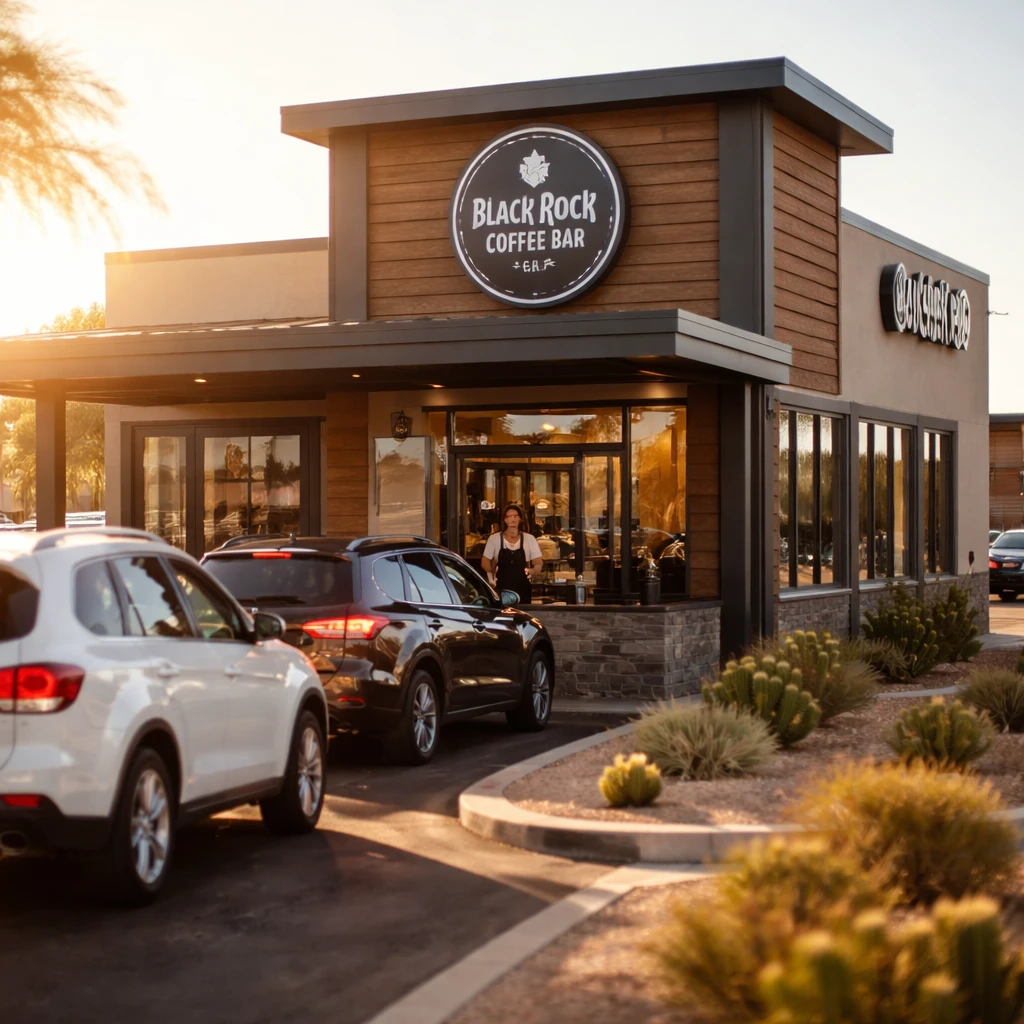
Black Rock Coffee Bar is a company-owned drive-thru coffee retailer that sells roasted coffees, teas, smoothies and the company’s Fuel energy drinks. Management emphasizes high-frequency drive-thru locations and a company-owned model - a contrast with franchise-heavy peers - which preserves control over unit economics and brand execution. The market should care because that model allows the company to capture store-level operating leverage and corporate margin expansion as unit count grows - if management can maintain disciplined site economics.
Key fundamentals and data points
- Current price: $15.88 (intraday high today $16.75, low $15.04).
- Market capitalization: $794,886,205.
- Shares outstanding: 50,055,806; public float: 15,844,899.
- 52-week range: $11.51 - $30.40.
- Valuation note: price-to-book ratio ~ 17.2, indicating the market currently prices substantial growth and profitability improvements into the shares.
- Recent footprint: management reports over 170 drive-thru locations across seven states and continues to add stores (Austin opening 02/17/2026; new Colorado Springs and Phoenix locations in late 2025 and early 2026).
- Technical backdrop: 10-day SMA ~ $13.31, 50-day SMA ~ $17.65, RSI ~ 55, MACD histogram positive (bullish momentum).
- Short interest is meaningful but not extreme: latest reported short interest ~ 2.6M shares (settlement 02/13/2026) with days-to-cover near 4.5 on average volume, and a high short volume fraction on several recent sessions - this creates episodic upside gamma risk if volume spikes.
Why the market should care now
Two dynamics make the stock actionable in the coming weeks. First, the company is executing a visible store rollout with new markets and cluster expansions - recent openings in Austin (02/17/2026), multiple Phoenix locations and Colorado Springs stores indicate management is accelerating unit growth. Incremental units should begin to flow through same-store sales and corporate margin metrics in the quarterly results and near-term commentary.
Second, the company's mostly company-owned model means corporate margins will be more sensitive to scale benefits than a franchise model. If store-level economics are comparable to peers like Dutch Bros (as some coverage has noted), incremental stores will translate faster into corporate-level EBITDA expansion. For investors who want growth + improving margins, that combination is compelling.
Valuation framing
At a market cap near $795M and a price close to $15.88, BRCB pricing reflects both aggressive growth expectations and a still-small free float (roughly 15.8M shares), contributing to outsized moves on volume. The price-to-book at ~17x is elevated and not comparable to mature restaurant peers, but the proper frame is growth-adjusted - investors are effectively paying for a multi-year rollup and better store-level margins. There's no widely available consensus multiple for the company's future EBITDA in the dataset, so think of valuation qualitatively: if management can sustain mid-teens percentage same-store sales growth and add units profitably, the present valuation could be justified; if the rollout stalls, the stock will re-rate lower quickly.
Catalysts (next 45-180 trading days)
- Quarterly results and FY2026 outlook call on 03/03/2026 - look for management commentary on unit economics, same-store sales trends, and planned openings.
- Cluster openings in key MSAs (Austin, Phoenix, Colorado) that will prove unit-level economics at scale.
- Any disclosure of incremental margin gains at the corporate level or guidance tightening for unit growth/margins.
- Higher-than-usual short-covering days given a concentrated float and elevated short-volume on recent sessions; a volume squeeze could spike shares higher in the short term.
Trade plan
Trade direction: long. Time horizon: mid term (45 trading days) - this should be enough time to capture directional re-rating from the company’s quarterly commentary and early post-quarter unit openings while limiting exposure to longer-term execution risk.
| Entry | Target | Stop | Time Horizon |
|---|---|---|---|
| $15.50 | $21.00 | $13.50 | mid term (45 trading days) |
Rationale: enter at $15.50 to capture a shallow pullback from today’s intraday strength while keeping the entry below immediate resistance near $16.75. Target $21.00 is modest relative to the 52-week high of $30.40 but represents a ~32% upside from the entry and a realistic re-rate if the company prints improving margins and stronger-than-expected unit economics. Stop at $13.50 limits capital exposure and respects the recent 52-week low area; a break below $13.50 would suggest momentum and sentiment have turned negative.
Risks and counterarguments
Below are the primary risks that could derail this trade.
- Execution risk on unit economics - rapid expansion only works if new sites meet company-expected throughput and operating margins. Poor site selection or higher build costs would compress margins and force a valuation reset.
- Valuation is already rich - the price-to-book near 17x embeds significant future profits; any slip in same-store sales or margin guidance will quickly trigger a multiple contraction.
- Concentrated float and short activity - while short interest is not extreme, short-volume spikes have been material. That can create whipsaw trading - fast upside squeezes and equally fast sell-offs.
- Macroeconomic pressure - consumer discretionary spend on specialty beverages is cyclical; rising unemployment or weaker consumer spending could reduce ticket frequency.
- Execution of company-owned model - the company-owned strategy gives control but requires more capital and management bandwidth than franchising; capital allocation missteps or slower cash flow conversion could stress the balance sheet as the roll-out continues.
Counterargument
One persuasive counterargument is that the market is already pricing all of the good news into the stock. With an elevated price-to-book and a previous peak near $30, the upside for a mid-term re-rate may be limited unless the company posts materially better-than-expected same-store sales and margin improvements. In other words, the stock can stay expensive while execution risk lingers.
What would change my mind
I will reduce conviction if any of the following occurs: (1) management signals a meaningful slowdown in planned openings or pushes out the 1,000-store ambition, (2) quarter-to-quarter same-store sales trend turns negative or materially below management guidance, or (3) the company reports unexpected cost pressures that materially compress gross margins on a corporate basis. Conversely, I would add to the position if the company provides concrete unit-level profitability metrics showing rising contribution margins and upgrades guidance for fiscal 2026 store openings or profitability.
Conclusion
Black Rock Coffee Bar sits at an interesting crossroads: an aggressive growth road map and a company-owned operating model that can magnify margin gains as the chain scales. The stock is not without risks - valuation is rich and execution must be clean - but the next 45 trading days offer binary catalysts (earnings call, and a string of new store openings) that can provide clarity on whether management can convert growth into higher corporate earnings. For traders willing to manage position size and use a disciplined stop, the long trade outlined above offers an attractive risk/reward to capture a potential re-rating as unit economics prove out.