
Hook & thesis
Astronics (ATRO) is not a story stock — it is a mid-cap aerospace supplier that has navigated lumpy demand and integration noise and now presents a tactical buying opportunity. The company carries some legacy leverage and a stretched multiple, but recent strategic moves — including the Bfchler Motor Aviation acquisition — add near-term revenue and breadth to product suites that matter to both OEMs and the after-market. For investors willing to accept operational variability, there is a well-defined trade: buy into stabilization and target the pre-winter highs while protecting capital with a tight stop.
My view: Astronics can manage through the turbulence. The market cares because the aircraft lighting and electrical systems end-markets are expanding — and Astronics already participates in both. If order cadence and margins re-accelerate, the stock can move toward its $83.96 52-week high. If execution falters, the position is protected by a stop below recent technical support.
What Astronics does and why it matters
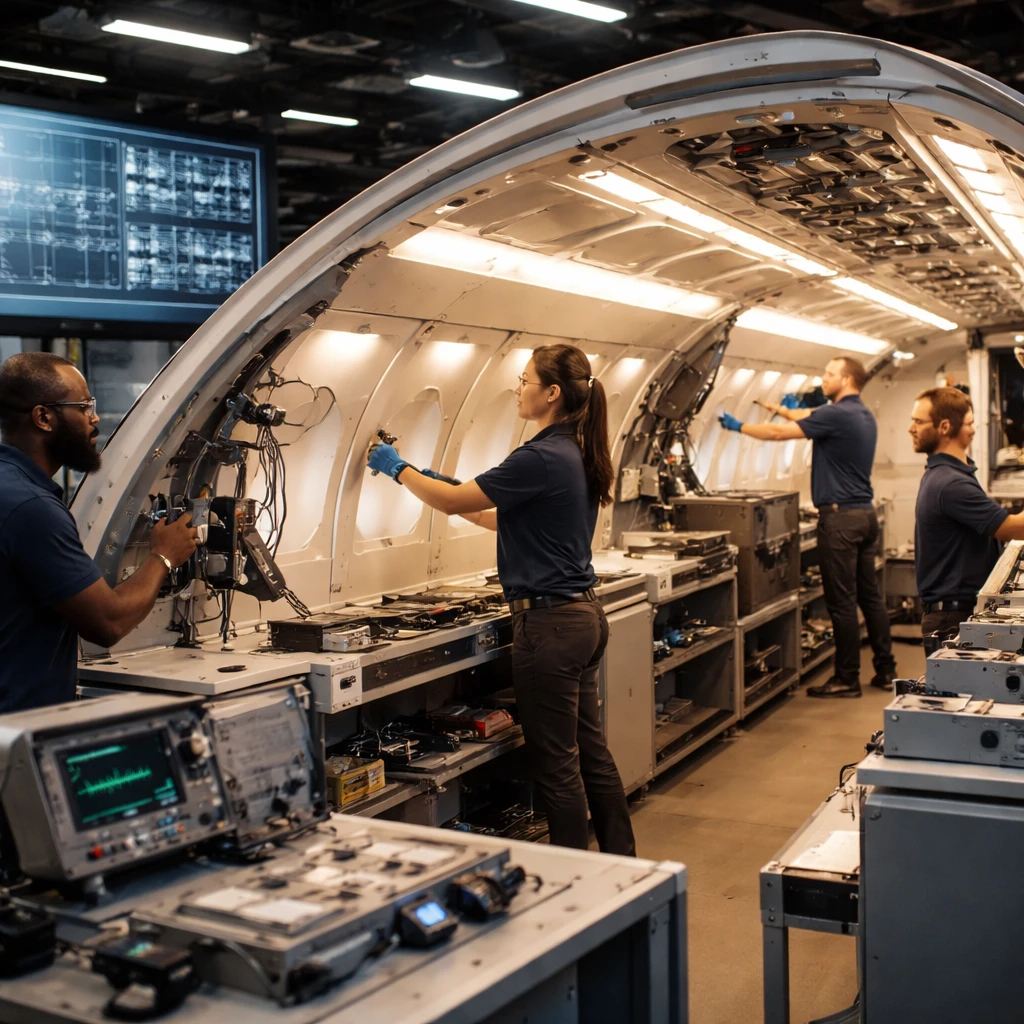
Astronics designs and manufactures electrical power generation and distribution systems, motion and seating actuation, lighting and safety systems, avionics, and test systems for aerospace and defense. The business splits across Aerospace and Test Systems, supplying OEMs and the MRO/aftermarket. That mix gives the company exposure to both new aircraft build cycles and recurring aftermarket demand — a structural advantage when OEM deliveries swing.
The market structural drivers are straightforward: aircraft production and retrofit cycles are rising, LED and smart-cabin lighting adoption is accelerating, and airlines continue to spend on passenger experience upgrades. Independent market reports referenced industry growth in aircraft lighting and electrical systems, with the aircraft lighting market expanding and forecasts calling for mid-single-digit CAGRs through the next decade. That industry growth translates into a steady addressable market for Astronics' cabin lighting, in-flight connectivity hardware and electrical power systems.
Fundamentals and recent financial picture
Quick facts to frame the trade:
- Market cap: about $2.48 billion.
- Trailing price/earnings: roughly 82-84x depending on the snapshot.
- Price-to-sales: ~2.8x, which implies the market is paying for growth but expects execution to remain strong.
- Free cash flow: $43.1 million, showing the business generates positive cash despite a heavy cap/working capital footprint.
- Return on equity: ~21%, which is attractive and indicates solid profitability when margins cooperate.
- Debt-to-equity: 2.39, a material leverage load that requires monitoring.
The company has a volatile trading history — 52-week low of $19.89 to a 52-week high of $83.96. That range reflects a recovery from severe weakness into a period of re-rating. The recent bolt-on purchase of Bfchler Motor Aviation, expected to contribute roughly $22 million in annual revenue by 2026 (announced 10/13/2025), is a concrete example of management adding accretive, product-level revenue that supports margin improvement in motion-control systems and interiors.
Valuation framing
On headline multiples Astronics looks expensive: forward-looking P/E in the 80s is high compared with broad industrial peers. But the valuation is rooted in several offsets: the company is growing revenues via M&A and product content gains, free cash flow is positive at $43.1M, and ROE is high. The elevated P/E partly reflects a compact share count (shares outstanding ~35.7 million) and an equity base that magnifies EPS. Enterprise value sits near $2.74 billion which, when combined with an EV/sales of ~3.2x and EV/EBITDA near ~28x, suggests the market is paying for high-quality growth and margin expansion rather than current cyclical earnings alone.
In short: valuation is demanding, so this is not a deep-value play. The trade assumes re-rating is possible if revenue contributions from recent deals and improving aftermarket demand translate to visible margin gains and stronger cash conversion.
Technical & market flow context
Technically, the stock is trading around $69.87, just above a 10-day SMA near $67.58 and below the 50-day SMA which sits in the low $70s. Momentum indicators are mixed: RSI is around 47 signaling neutral momentum, while MACD shows a modest bearish tilt. Short interest has been meaningful but not extreme — recent days-to-cover is roughly 4.4, and short volume in recent sessions has been sizable. That creates two-way risk: a squeeze can amplify moves higher, but persistent negative headlines or earnings misses could accentuate selling.
Catalysts to watch (2-5)
- Order flow and backlog updates - signs of more OEM wins or expanding retrofit programs would re-rate sentiment.
- Margin improvement from integration and cost synergies, particularly from the Bfchler Motor Aviation deal.
- Upcoming quarterly results that show free cash flow growth or working-capital improvement.
- Industry data prints showing continued growth in aircraft lighting and electrical systems (positive macro prints could lift all suppliers).
- Options/short-covering events that compress supply and accelerate a move toward prior highs.
Trade plan (actionable)
Thesis: Buy into stability and execution visibility — the stock should benefit if revenue contributions from recent M&A and steady aftermarket demand translate to better margins. I recommend a tactical long for a mid-term recovery.
| Action | Price |
|---|---|
| Entry | $69.87 |
| Stop loss | $63.00 |
| Target | $82.00 |
Horizon: mid term (45 trading days). This horizon is meant to allow time for an earnings or business update to confirm stabilization and for sentiment to normalize toward prior highs near $83.96. If momentum is strong, consider trimming toward the target. If the stock stalls but fundamentals are intact, reassess position sizing and potential extension toward a longer time frame.
Risk management: keep position size limited to a level where a stop at $63 would represent a manageable loss. Trailing the stop above breakeven if price moves favorably protects gains against reversal given the company's leverage and cyclical end markets.
Risks and counterarguments
Below are the primary risks to the trade and a counterargument to the bullish thesis.
- Execution risk - Aerospace OEM programs and integrations are notoriously lumpy. Missed synergies or higher integration costs from recent acquisitions could compress margins and slow free cash flow conversion.
- Leverage and balance sheet pressure - Debt-to-equity of ~2.39 is high for a supplier exposed to cyclical OEM demand. If volumes weaken, liquidity strain could be meaningful.
- Valuation sensitivity - With P/E in the 80s and EV/EBITDA elevated, any earnings disappointment is likely to trigger outsized multiple contraction.
- Order-book concentration and commercial sensitivity - Large OEM customers and program timing can cause big swings in revenue recognition and working capital.
- Macro / air travel slowdown - A slower recovery in passenger traffic or OEM order cuts would reduce both new-build and retrofit spending, hitting Astronics' top line.
Counterargument: One could argue the market is already pricing in recovery and growth — valuations reflect optimistic future margins and revenue, and the stock's run from the 52-week low has left little margin for error. In that view, buying here is buying optimism rather than concrete improvement.
What would change my mind
I will reduce conviction or exit the trade if any of the following happen:
- A quarterly report shows deteriorating free cash flow or a material increase in working-capital use despite stated cost-saving plans.
- Management guides to lower revenue or delays integration synergies for acquired assets beyond prior expectations.
- Balance sheet stress emerges, such as covenant pressure or a material refinance need at higher rates that meaningfully dilutes equity value.
Conclusion
Astronics offers a pragmatic, tactical long for traders willing to stomach operational variability. The company participates in growing end markets with concrete revenue add-ons (like the Bfchler purchase) and positive free cash flow, but it carries leverage and a valuation that demands visible execution. The trade proposed is mid-term (45 trading days) with an entry at $69.87, a stop at $63.00 and a target near $82.00 — a plan designed to capture a recovery toward the stock's recent highs while limiting downside if execution slips.
Monitor order flow, margin commentary and cash conversion closely. If Astronics delivers improved margins and cleaner cash flow, the market should reward the stock; if not, the stop protects capital and preserves optionality.