
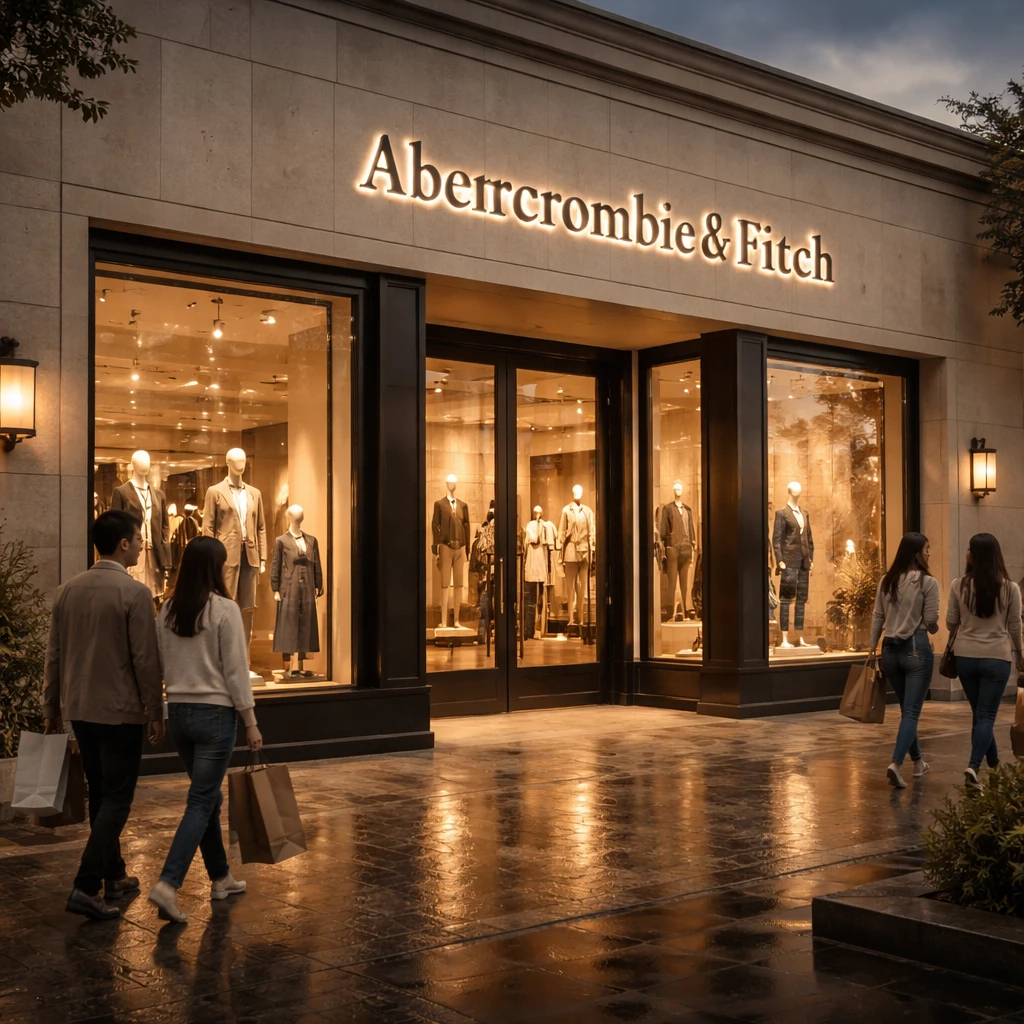
Hook & Thesis
Abercrombie & Fitch (ANF) is a classic example of a beaten-down growth-style retail story that has turned into a cash-generating, shareholder-friendly value play. The company is producing strong free cash flow ($384.5M most recently), carries essentially no net leverage relative to its enterprise value, and management has pivoted to aggressive buybacks that materially shrink share count and amplify per-share metrics. At current levels around $87, the stock trades at single-digit multiples when adjusted for cash flow and EBITDA - a profile deserving of an upgrade from Buy to Strong Buy.
The combination of a fortress balance sheet, double-digit repurchases, and continued retail momentum in core brands suggests downside is limited and upside is meaningful. This is an actionable long with a clearly defined entry, stop and target for a 180-trading-day hold.
What the company does and why investors should care
Abercrombie & Fitch is a consumer apparel retailer operating through three segments: Americas, EMEA and APAC. The firm's offering spans Abercrombie, Hollister and related brands; it participates in the mid-premium casual apparel market and benefits from brand recognition, recurring seasonal demand and an omnichannel footprint.
Investors should care because ANF has converted retail sales into robust cash generation. Management has leaned into returning that cash via buybacks while maintaining a conservative capital structure, which accelerates EPS and free cash flow per share even if top-line growth is moderate. In a retail environment where many peers are still burdened by bloated inventories or capital constraints, ANF’s financial shape is a differentiator.
Evidence and fundamentals
- Free cash flow: $384,545,000. That’s not a one-off number; it’s consistent with the company’s recent ability to convert sales to cash.
- Enterprise value: ~$3.35B versus a market cap near $3.996B - the EV/EBITDA sits at ~3.8, implying the market is not paying up for ANF’s earnings base.
- Profitability: Reported trailing earnings-per-share is roughly $11.38 (TTM), and P/E sits well below 10 depending on the price reference; the firm is delivering meaningful ROE (near 40%).
- Recent quarter: On 11/25/2025 the firm reported a strong Q3 with $2.36 adjusted EPS and $1.29B in sales and raised full-year guidance — that confirms the business can still produce healthy margins in a volatile retail backdrop.
- Shareholder returns: Management has deployed a large, double-digit buyback program (public commentary and industry coverage highlight this shift), which is accelerating EPS and cash-return to owners.
Valuation framing
Relative to the company’s cash generation, ANF trades cheaply. EV/EBITDA of ~3.8 and price-to-free-cash-flow around ~10 (depending on the precise share price reference) are low for a profitable, consumer-facing retailer with no significant leverage. The market cap is roughly $3.996B while enterprise value is about $3.35B, leaving a spread that underscores the cash-generative profile.
Put simply: you are paying mid-single-digit multiples for a business that is generating hundreds of millions annually in free cash flow and returning capital through buybacks. That combination can rapidly compress shares outstanding and lift per-share metrics even absent step-change sales growth.
Technical and market context
ANF is trading below its 10-, 20- and 50-day moving averages; the short-term RSI (~37) signals the stock is not overbought and could be set up for a mean-reversion move as buybacks and fundamental news arrive. Short interest has declined from multi-million-share peaks, and days-to-cover sits near ~2, which reduces the risk of sustained short squeezes but also shows shorts have been stepping back.
Catalysts (2-5)
- Continued aggressive buybacks - buyback announcements or active repurchases will be a direct upside driver to EPS and valuation.
- Better-than-feared guidance or margin commentary in upcoming quarterly reports — management has previously raised full-year guidance after strong quarters.
- New store openings and lease activity (the company signed a lease for a Town Center of Virginia Beach location announced 03/03/2026) that indicate real estate demand and retail footprint expansion.
- Retail macro improvement (consumer confidence, easing tariffs) that helps sustain same-store sales and margin expansion.
Trade plan (actionable)
Thesis: Buy ANF for a long trade to capture upside from buyback-driven EPS leverage and mean reversion in valuation multiples. The company’s cash flows and low EV multiples create a favorable asymmetric trade.
| Plan element | Detail |
|---|---|
| Entry Price | $87.00 |
| Target Price | $125.00 |
| Stop Loss | $74.00 |
| Time Horizon | Long term (180 trading days) - enough time for buybacks to materially reduce share count and for at least two quarterly results to reset investor expectations. |
| Risk Level | Medium - Strategy relies on continued cash generation and buyback execution, but downside is cushioned by conservative capital structure and strong FCF. |
Why these levels? Entry at $87 sits near the current trading price and provides immediate exposure to the company’s cash flow story. The $125 target is a realistic re-rating toward a mid-teens EV/EBITDA multiple or a partial return toward the company’s 52-week highs, reflecting the combination of continued FCF, aggressive repurchases and multiple expansion. The $74 stop is below recent trading ranges and allows modest volatility while capping downside to a level that would likely reflect a material deterioration in the thesis.
Risks and counterarguments
Every trade has risks. Below are the principal ones I see for ANF:
- Cyclical consumer risk - Apparel is discretionary. An unexpected consumer slowdown would pressure same-store sales, margins and cash flow.
- Buyback execution risk - If management shifts capital away from buybacks or the pace slows materially, the expected per-share lift will be reduced.
- Margin compression from input costs and tariffs - Management has cited higher capex and tariff headwinds previously; persistent cost pressure could squeeze margins even with decent sales.
- Inventory / fashion risk - A merchandising miss or inventory markdown cycle could require heavy promotion and hurt profitability.
- Valuation/perception risk - Despite low multiples, ANF has a P/B around 3; some investors may view the brand as riskier than the numbers imply and demand a larger valuation haircut.
Counterargument to our thesis - One could argue management’s buybacks are a cover for weak organic growth: re-rating via buybacks can mask a secular slowdown in relevance among younger consumers. If margins depend on continued brand strength and traffic, returning cash instead of reinvesting in product and marketing could be short-sighted. That’s a plausible path and would argue for caution until buyback cadence and same-store-sales trends are clearly sustainable.
What would change my mind
I would downgrade the conviction if any of the following materialize:
- Management suspends or sharply reduces buybacks in favor of large, unrelated investments that do not improve core margins.
- Two consecutive quarters of negative comp growth and margin contraction that materially reduce free cash flow guidance.
- Management takes on meaningful net debt to fund operations or M&A, altering the conservative capital structure that currently cushions downside.
Conclusion
Abercrombie & Fitch today looks like a rare combination in retail: strong free cash flow, conservative capital structure and an active buyback program at a valuation that does not fully credit those strengths. That creates a favorable asymmetric opportunity for a long-term trade. The plan above outlines a clear entry, stop and target for a 180-trading-day position designed to capture buyback-driven EPS accretion and multiple normalization. I’m upgrading ANF to Strong Buy and will watch incoming quarterly results, buyback disclosures and same-store-sales trends as the key monitoring points.
Trade details recap: Long ANF at $87.00, stop $74.00, target $125.00, horizon: long term (180 trading days).