
On a notably cold Friday with temperatures plunging below freezing in Minneapolis, a significant number of Minnesota businesses chose to close for the day as part of a coordinated protest against the increased presence of immigration enforcement agents in the city. Orchestrated by religious leaders and labor unions, this collective action was dubbed a general strike, aimed at voicing opposition to President Donald Trump's deployment of thousands of U.S. Immigration and Customs Enforcement (ICE) officers onto the streets of Minneapolis.
Businesses across the state displayed "ICE OUT!" flyers on their doors, directly addressing the agency at the center of the unrest. Reports indicate that more than 300 establishments, including bars, restaurants, museums, and shops, shuttered operations for the duration of the day, as documented by the Minnesota Star Tribune. Although no official school districts closed, educational institutions in Minneapolis and St. Paul offered remote learning options to accommodate the protest environment.
An afternoon march was scheduled in downtown Minneapolis, anticipated by organizers to be the most substantial public demonstration yet against the federal enforcement escalation. Locally, figures such as Mayor Jacob Frey and other Democratic leaders have characterized the deployment as akin to an invasion. President Trump initiated this Minnesota-specific crackdown following allegations of fraud involving members of the state's sizable Somali American community. The President's rhetoric has included derogatory descriptions of Somali immigrants, labeling them "garbage" and emphasizing his administration's goal to remove a record number of immigrants, spanning asylum seekers to long-standing lawful residents.
Community response has manifested in persistent street-level activism, marked by continuous noise through whistles and musical instruments day and night. Tensions between immigration officers and protesters have intensified, with exchanges involving obscenities and the use of tear gas and flash-bang grenades by agents to disperse crowds. The Trump administration has contended that some protesters obstruct enforcement activities and have verbally harassed agents.
Regarding the private sector, major corporations headquartered in Minnesota, most based in the Minneapolis area and many part of the Fortune 500, have largely remained silent publicly about the immigration raids. Target Corporation, a Minneapolis-based retailer previously criticized for retreating from its diversity commitments, has drawn additional scrutiny for its lack of commentary on ICE activity connected to its stores. State legislators have actively sought clarity on the company's policies guiding employee actions during potential ICE encounters, but Target has declined to comment. Attempts to obtain statements from other notable Minnesota companies, including UnitedHealth, Medtronic, Abbott Laboratories, Best Buy, Hormel, General Mills, 3M, and Fastenal, have not yielded immediate responses.
This protest and the surrounding events highlight significant local resistance to federal immigration enforcement strategies, generating economic and social reverberations within Minnesota's communities and corporate sectors.
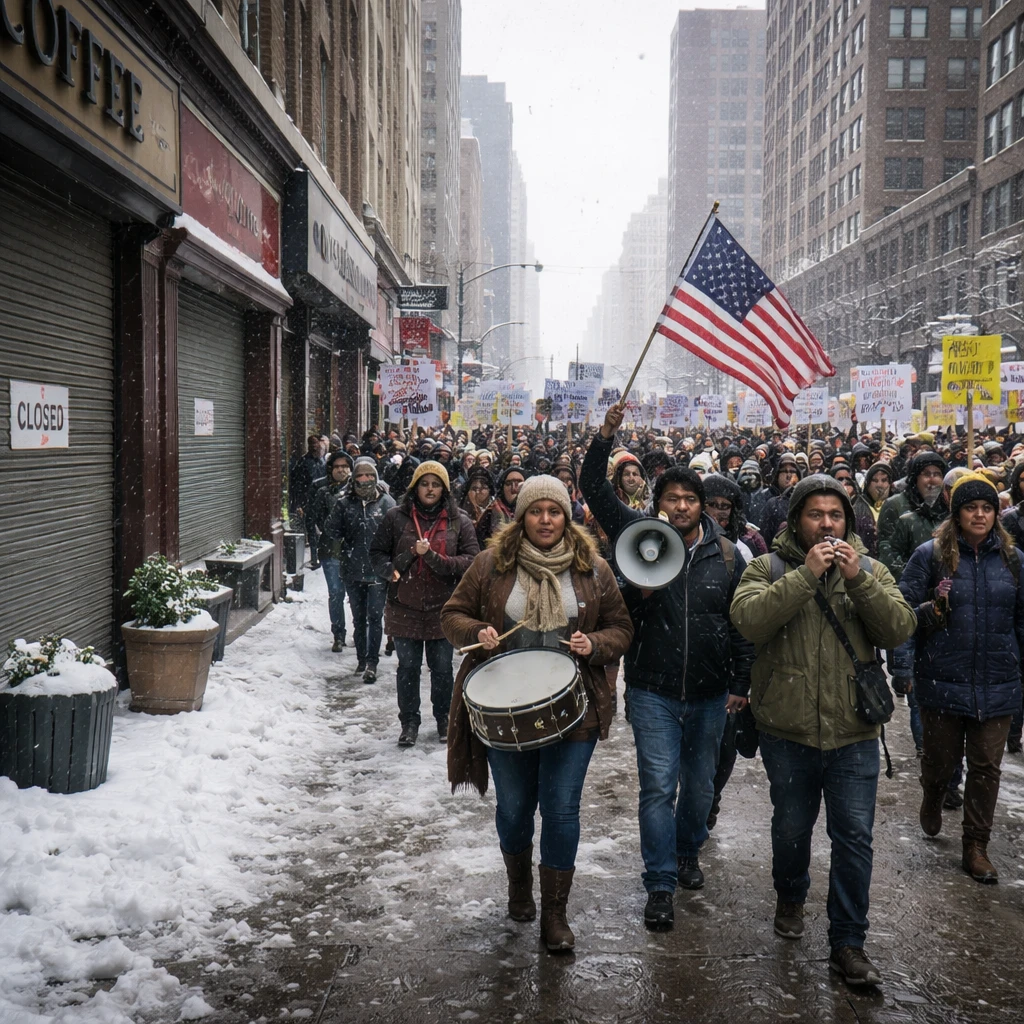
In response to a federal surge of immigration enforcement officers in Minneapolis, numerous local businesses across Minnesota closed their doors on a cold winter Friday. Religious groups and labor unions led this coordinated action, underscoring deep community opposition. Downtown Minneapolis hosted a large planned protest march, drawing attention to contentious immigration enforcement tactics and heated local reactions.
Key Points
- More than 300 Minnesota businesses, including restaurants, bars, and shops, participated in a one-day closure protesting the increased ICE presence in Minneapolis.
- An afternoon march in downtown Minneapolis was planned to be the largest demonstration against the federal immigration enforcement surge, reflecting widespread local opposition.
- Major Minnesota-based corporations, including Target and other Fortune 500 companies, have refrained from publicly addressing the ongoing immigration raids despite community and legislative pressure.
Risks
- Escalating tensions between immigration enforcement agents and protestors may lead to disruptions impacting local businesses and public safety.
- Potential reputational risks for Minnesota corporations, especially those headquartered in Minneapolis, stemming from their silence or response to the ICE operations.
- Ongoing federal immigration enforcement actions could stimulate further social unrest, affecting Minnesota's economic activities and community relations.