
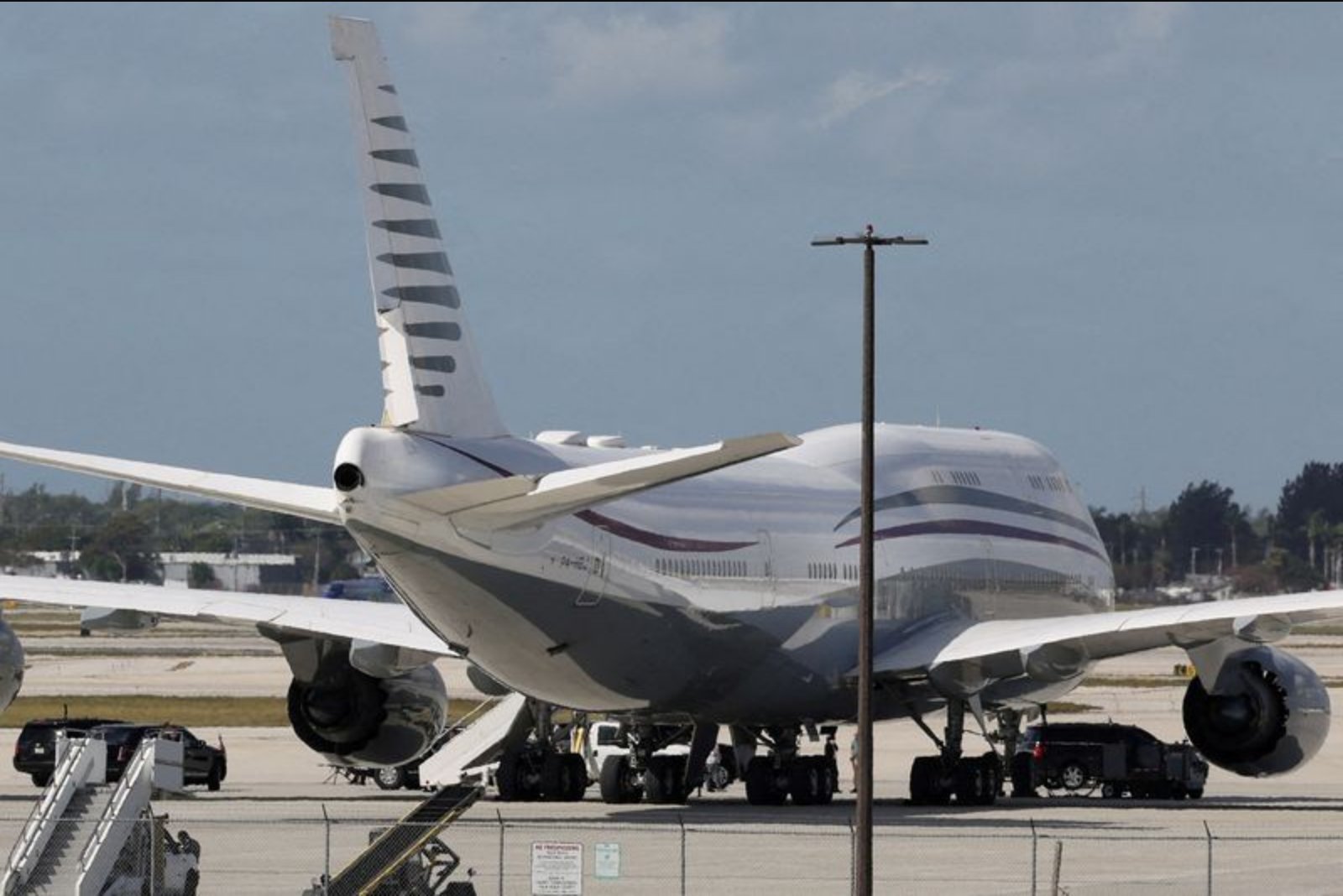
The U.S. Air Force has set a target delivery date of July 4 for a Boeing 747 that Qatar gifted to the United States, with officials and program insiders saying the aim is to have the aircraft enter service in time for the nation’s 250th anniversary. The White House accepted the luxury jet in 2025 and tasked the Air Force with an accelerated conversion to presidential configuration, assigning L3Harris as the contractor to perform the work.
According to a person familiar with the program, there were also efforts to move the delivery even earlier, with planners considering a date roughly three weeks before July 4 to coincide with President Donald Trump’s birthday on June 14. If the schedule holds, the president would have the Qatar-donated airplane available for the July celebrations.
The Doha gift has prompted criticism from Democrats and government watchdog groups, who argued the donation could present a conflict of interest or otherwise influence presidential decisions. President Trump has pushed back on those concerns, calling it “stupid” to refuse the offer of the 13-year-old plane, which carries a $400 million list price.
At present, the specialized presidential airlift roster includes two heavily modified 747-200B aircraft. By convention, any Air Force plane carrying the U.S. president at a given time is referred to as Air Force One.
Retrofitting the Qatar-donated 747 to meet presidential requirements has included a range of technical and defensive upgrades. Experts involved in or familiar with the work have said the modifications must address security needs, enhance communications systems to block eavesdropping, and install protections intended to defeat potential missile threats.
An Air Force spokesperson commented on the program’s timing, saying, "The aircraft is on schedule to deliver this summer." The Air Force also said on Friday that the aircraft has finished modification and flight testing and is currently in the painting stage.
Boeing’s official replacement program behind schedule and over budget
Separately, the formal Air Force One replacement program, which involves Boeing converting two 747-8 airframes into next-generation presidential jets, is running about four years late. Deliveries under that program are not expected until mid-2028, creating the possibility that President Trump could conclude his term in January 2029 without the officially contracted new aircraft in service.
The Boeing effort originated with a fixed-price, $3.9 billion contract awarded in 2018. Since then, program costs have risen to more than $5 billion, and Boeing has recorded approximately $2.4 billion in charges against earnings related to the project. In 2025 the company appointed Steve Sullivan, a former Northrop Grumman executive who worked on the B-21 bomber program, to take charge of the effort in an attempt to stabilize progress.
The Air Force has also announced a refreshed exterior design for its executive airlift fleet. The new livery uses red, white, dark blue and gold and replaces an earlier plan that was abandoned in 2022. This updated scheme will be applied to the VC-25B designation for the Boeing 747-8, supplanting the white-and-two-tone-blue appearance that has been maintained since the Kennedy era. Four Boeing 757-200 aircraft used by the vice president, cabinet members and other senior officials will receive the new paint as well.
Last December, the Air Force purchased two former Lufthansa 747-8i aircraft for $400 million. One of those airframes is intended as a dedicated trainer for aircrew and maintenance personnel, while the other will serve as a source of spare parts as the service prepares to retire the current presidential fleet, which has been in service since 1990.
Program context and operational considerations
The accelerated conversion of the Qatar-donated 747 represents a near-term workaround for presidential airlift capability while the official Boeing replacements remain delayed. The donated plane’s retrofit timeline, the completion of modification and flight testing, and the painting phase are the most recent status markers provided by Air Force officials. How the donated aircraft will fit into the broader fleet plan, including the use of the newly purchased 747-8i airframes, will be determined as the modernization and retirement schedules progress.