
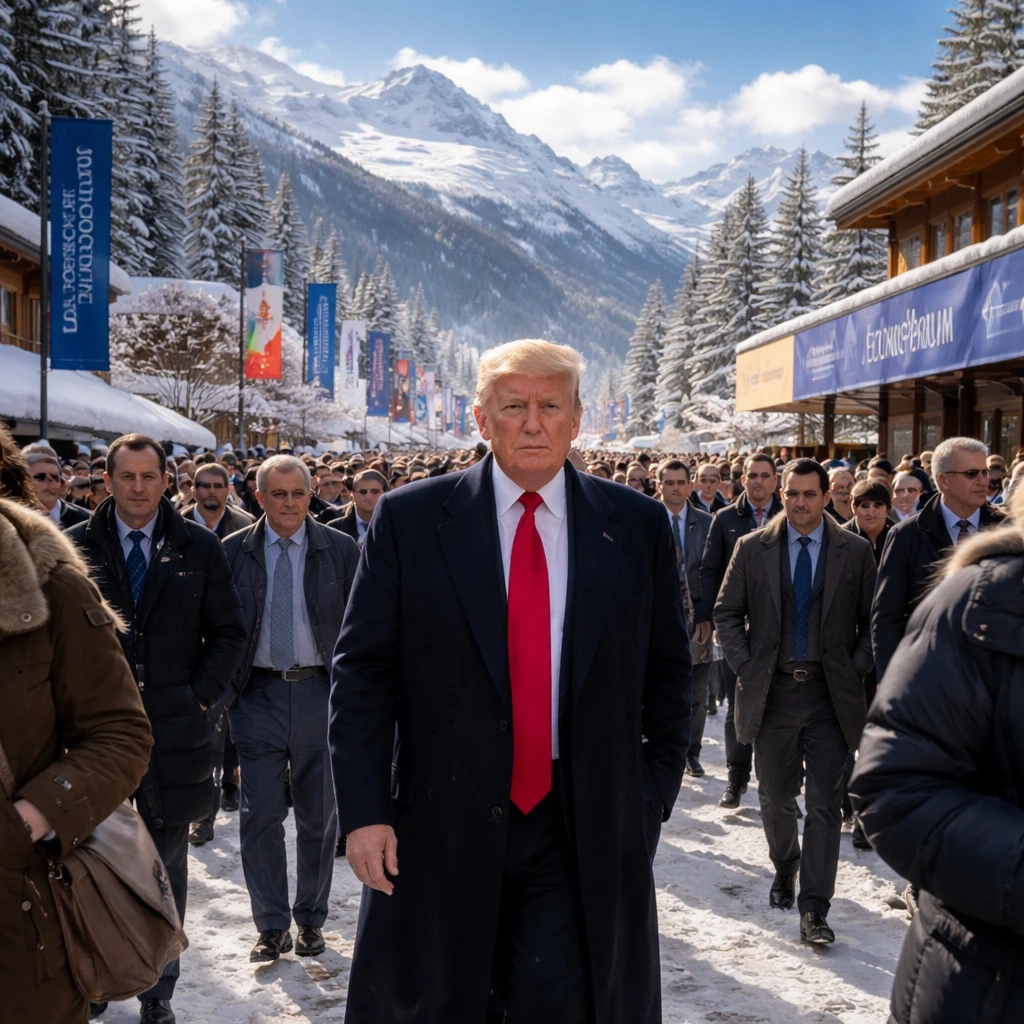
At this year’s World Economic Forum (WEF) in Davos, the atmosphere was charged as President Donald Trump and prominent U.S. officials made their presence felt amid the wintry Swiss setting. Their participation brought a complex blend of fear, disapproval, and resigned acceptance to the event, reflecting a broader reaction to the administration's approach to global affairs.
Many participants acknowledged certain elements of Trump’s agenda, such as his demands for Europe to increase its defense spending, as having some validity. Yet, the manner in which these positions were articulated by the president and his team generated discomfort and, at times, offence.
Conradin Cramer, who heads the cantonal government of Basel, expressed his apprehension following Trump’s Wednesday address to the Forum, describing it as overwhelming and indicative of “the full Trump show.” He highlighted Trump’s outspoken criticisms of Europe and its values as ‘‘frightening.’’
Within the business community, unease was palpable. Two bankers based in the United States confided they were concerned about the possibility of an escalated trade conflict that could weigh heavily on business confidence and the broader economic climate.
A Forum Marked by Significant Events
Observers at the WEF reflected that this iteration might rank among the most eventful in the 50-year history of the gathering, despite its tagline, “A Spirit of Dialogue.”
Significant diplomatic activity occurred on the margins, including a deal on Greenland negotiated between Trump and NATO Secretary General Mark Rutte, as well as the unveiling of a new Board of Peace by Trump that attracted global leadership attention. The U.S. delegation also indicated progress towards a peace resolution in Ukraine, which was underscored by the appearance of President Volodymyr Zelenskiy on the Forum’s Thursday agenda.
Another noteworthy development was the attendance of Kirill Dmitriev, an envoy of Vladimir Putin, marking the first Russian official visit to Davos since the 2022 invasion of Ukraine. These interactions underscored the forum’s diplomatic significance amid geopolitical tensions.
This year’s meeting was also the first following the departure of Klaus Schwab, the WEF’s founding figure, with some attributing considerable influence to BlackRock CEO Larry Fink, who, as WEF co-chair, leveraged his position to draw major participants like billionaire Elon Musk, making his Davos debut.
Trump himself praised Fink, crediting him with a Midas touch on ventures. However, several sessions appeared to avoid challenging scrutiny of Trump administration policies, a dynamic reflected in the program’s reduction in climate change topics — four sessions this year compared with sixteen in 2022.
During his extended speaking slot, Trump spoke for over an hour, surpassing his scheduled time, yet some attendees began departing during the follow-up moderated session, hinting at mixed engagement levels.
Negotiations Amidst Discomfort
Despite Trump's dominating presence, business was conducted amid the Forum’s many conversations. Executives engaged in discussions spanning geopolitics, trade, stablecoins, and developments in artificial intelligence. Francesco Ceccato, CEO of Barclays Europe, noted that the geopolitical context was inescapable yet acknowledged meaningful dialogue on AI investment and associated energy concerns.
The Trump administration’s influence permeated the proceedings. A notable moment occurred when U.S. Commerce Secretary Howard Lutnick critiqued Europe during a dinner hosted by Larry Fink, prompting European Central Bank President Christine Lagarde to leave the event. Lutnick also participated in gatherings with key financial leaders, including Bank of America’s CEO Brian Moynihan, with social activities such as chess played by British Finance Minister Rachel Reeves and a live performance by Marcus Mumford enriching the networking ambiance.
Alongside the formal meetings, attendees exchanged rumors and gossip typical of Davos, though some circulating early in the week caused concern — including a false report that mobile and internet networks would be shut down during Trump’s visit. In reality, communications remained operational throughout his stay.