
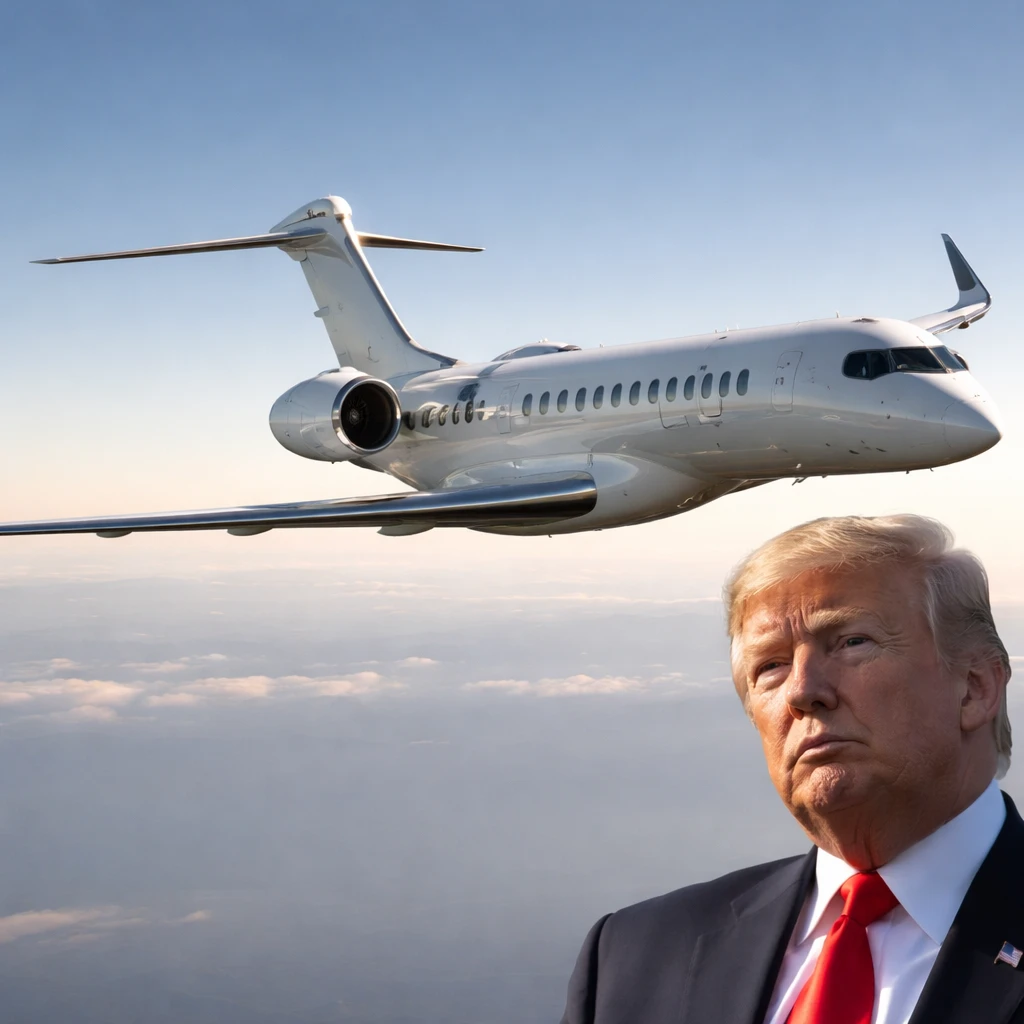
Bombardier Inc. (TSX:BBDb) saw its stock price drop sharply in morning trading after a late-evening social media statement from the U.S. President threatened to decertify Canadian-built aircraft and levy a 50% tariff on future exports to the United States. The company’s shares fell 7.2% on the reaction.
The White House action was framed as a countermeasure to what officials describe as a regulatory blockade by Ottawa. In his statement the President said: "Based on the fact that Canada has wrongfully, illegally, and steadfastly refused to certify the Gulfstream 500, 600, 700, and 800 Jets, one of the greatest, most technologically advanced airplanes ever made, we are hereby decertifying their Bombardier Global Expresses, and all Aircraft made in Canada."
Market analysts at Desjardins, led by Benoit Poirier, responded to the move by labeling the threat "empty and unlikely to be enforceable." The firm pointed out that, contrary to the broad language of the presidential statement, only two Gulfstream models remain pending approval with Transport Canada, the sovereign authority charged with safety reviews.
Poirier emphasized logistical and practical obstacles to implementing a decertification. Roughly 2,000 Bombardier jets are already operating in the United States, the analyst noted, and removing or re-certifying that fleet would present a substantial undertaking. Many of those aircraft are owned by Fortune 500 companies and high-net-worth individuals who rely on the jets for cross-continental travel.
The analysts also highlighted the deep integration of the North American aerospace supply chain as a complicating factor. Bombardier’s Global 7500, for instance, derives more than half of its value from American-made components, including systems supplied by GE Aerospace (NYSE:GE) and Honeywell International Inc (NASDAQ:HON). That cross-border industrial interdependence would add layers of complexity to any effort to isolate Canadian-built aircraft from the U.S. market.
The presidential statement also placed pressure on Canadian authorities to accelerate outstanding certification reviews for General Dynamics’ (NYSE:GD) Gulfstream G700 and G800. The President warned that "if, for any reason, this situation is not immediately corrected, I am going to charge Canada a 50% Tariff on any and all Aircraft sold into the United States of America."
The recent selloff contrasts with a multiyear ascent in Bombardier’s share price. Over the past five years the company’s stock has risen more than 1,400%, including a roughly 160% gain last year. That rally has been supported by a record $16.6 billion order backlog and the market introduction of the Global 8000, described in company materials as the world’s fastest business jet.
Summary - A presidential social media directive threatening decertification and a 50% tariff triggered a 7.2% drop in Bombardier shares, while Desjardins analysts called the move unlikely to be enforceable given limited outstanding approvals and the complexity of decertifying in-service aircraft.