
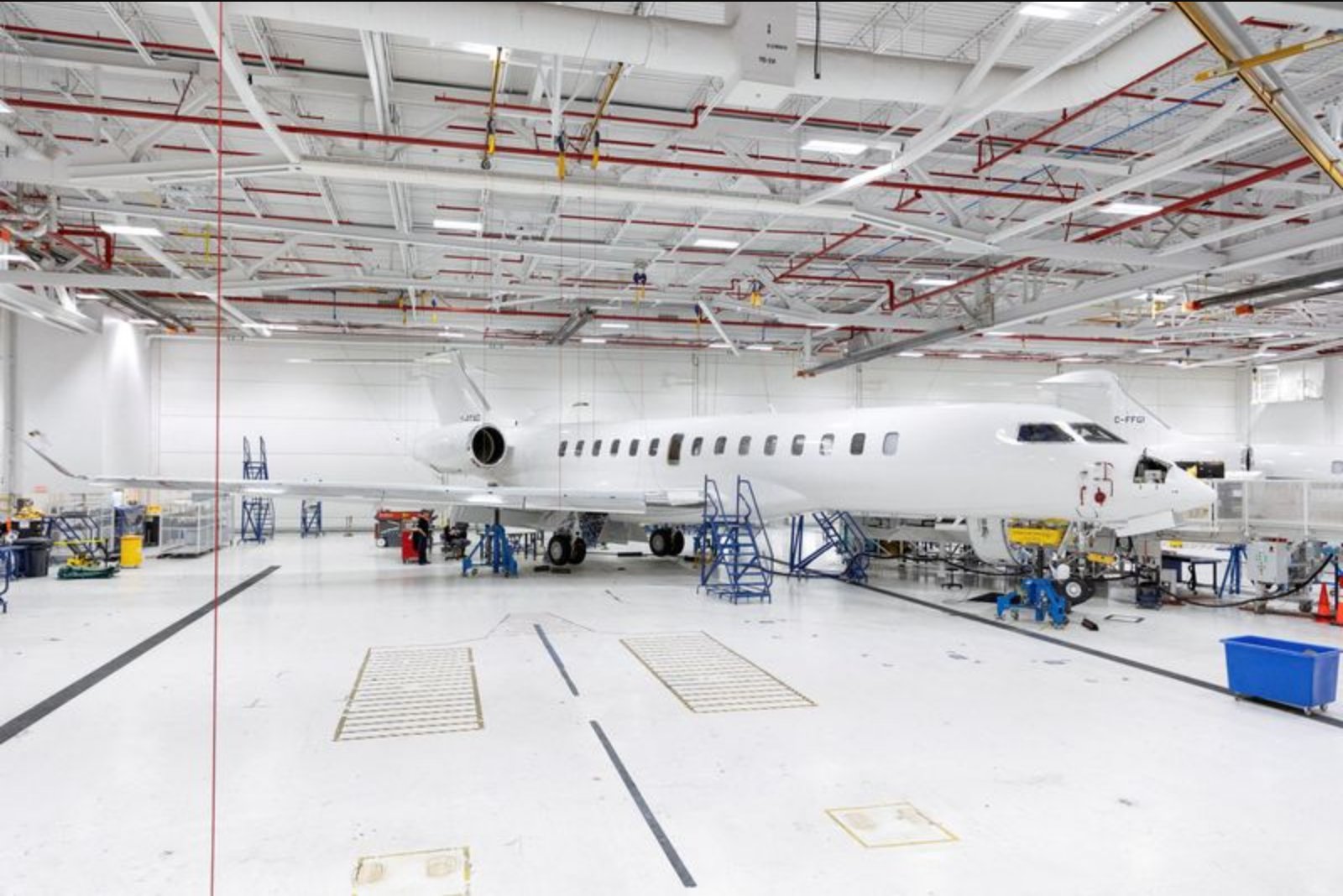
President Donald Trump said on Thursday that the United States would decertify Bombardier's Global Express business jets and threatened to impose a 50% tariff on aircraft made in Canada unless Canada certified several Gulfstream models produced by the U.S. manufacturer.
In a post on Truth Social, the president accused Canada of effectively preventing the sale of Gulfstream products in Canada through its certification procedures and warned that, unless the situation was "immediately corrected," he would levy a 50% tariff on "any and all aircraft sold into the United States of America."
The president specifically claimed Canada had refused to certify Gulfstream 500, 600, 700, and 800 jets. In April, both the Federal Aviation Administration and the European Union Aviation Safety Agency certified the Gulfstream G800, the company said. Transport Canada, the body responsible for certification in Canada, did not immediately respond to a request for comment.
It was not clear from the president's announcement which additional Canadian-made aircraft would be subject to the proposed tariffs beyond Bombardier's Global Express family. That raises questions about whether commercial types assembled in Canada, such as the Airbus A220, could be affected.
FlightRadar24 reported on X that more than 400 Canadian-made planes were operating to and from U.S. airports as of about 0100 GMT on Friday. Cirium, a data provider, said there were 150 Global Express aircraft in service registered in the United States, operated by 115 operators.
Bombardier, General Dynamics-owned Gulfstream and the office of Canadian Prime Minister Mark Carney did not immediately respond when asked for comment.
Observers noted an immediate legal and procedural ambiguity: aircraft certification is the responsibility of the Federal Aviation Administration, not the White House. The mechanics of a presidential decertification were unclear from the statement, and the FAA did not provide an immediate comment.
Historically, the president has made broad declarations that were later implemented, modified or carried out with exemptions by the relevant agencies. It was similarly unclear whether the FAA could revoke certifications for aircraft for reasons tied to trade or economic policy rather than safety - and, if it could, what consequences that would entail for U.S.-registered owners and operators. The FAA does have the authority to revoke an aircraft's certification on safety grounds.
Under established international aviation rules, the country in which a plane is designed is responsible for primary certification, often called a type certificate. In Gulfstream's case that primary regulator is the United States. Other countries normally validate the primary authority's decision to allow an aircraft into their airspace, but they retain the right to refuse to validate or to request additional data on design and safety.
Regulators in other jurisdictions have in the past delayed endorsement of U.S. certification decisions. The article notes that following the Boeing 737 MAX crisis, some European authorities delayed endorsing U.S. certification decisions and pushed for further design changes, illustrating how validation can become contentious.
The diplomatic and trade context framed the dispute. As part of ongoing tensions between the two countries, the office of Canadian Prime Minister Mark Carney denied on Tuesday that he had retracted comments which had irritated the president, and Carney said "almost nothing was normal" in the United States. Citing U.S. trade policy, Carney last week urged nations to acknowledge what he described as the end of the rules-based global order that the United States had once championed.
The article also notes that U.S. tariffs on key Canadian imports have prompted Canada to diversify its trade away from the United States. The United States accounts for roughly 70% of all Canadian exports under the U.S.-Mexico-Canada free trade agreement, the piece states.
The Federal Aviation Administration certified Bombardier's Global 8000 business jet in December. Transport Canada had certified the Global 8000 on November 5. The Global 8000 is described as the world's fastest civilian plane since the Concorde, with a top speed of Mach 0.95, or about 729 mph (1,173 kph).
Separately, an analytical product mentioned in the original reporting evaluates General Dynamics, the parent company of Gulfstream. That product, ProPicks AI, is described as assessing GD against thousands of companies using more than 100 financial metrics to identify potential stock ideas based on fundamentals, momentum and valuation. The product notes notable past winners it identified, including Super Micro Computer (+185%) and AppLovin (+157%), and offers to show whether GD appears in any current strategies or if there are alternative opportunities in the same sector.
The president's public statement raises immediate questions about trade law, the interplay between political directives and agency authority, and practical effects on operators of affected aircraft. Multiple agencies and private companies named in the announcement did not immediately provide comment.