
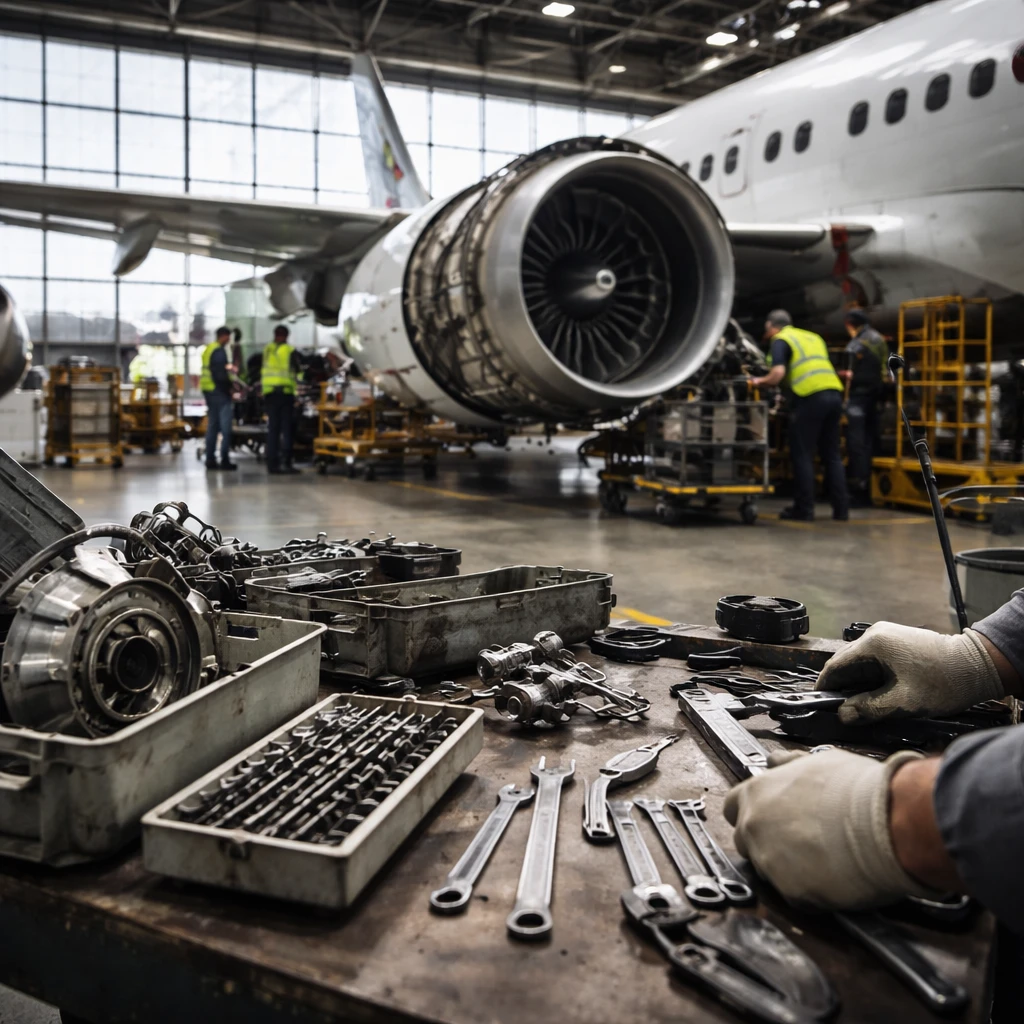
Truist has flagged a potential headwind for commercial aerospace aftermarket stocks as Brent crude broke above $100 per barrel in March 2026 amid geopolitical tensions in the Middle East. The research firm cautioned that higher fuel costs could lead airlines to pare back flights and curtail nonessential expenditures, which would lower demand for parts, repairs and other aftermarket services.
The firm noted that a decline in flight activity would reduce the volume of replacement parts and maintenance work even though aftermarket capacity remains tight. In this environment, Truist said, investor sentiment toward aerospace aftermarket providers could sour and push valuation multiples lower.
Despite the cautionary outlook, Truist left its ratings intact. The firm continues to carry Buy recommendations for AAR Corp (AIR), Astronics Corporation (ATRO), HEICO Corporation (HEI), Moog Inc. (MOG.A), StandardAero, Inc. (SARO), TAT Technologies Ltd. (TATT), TransDigm Group Incorporated (TDG), VSE Corporation (VSEC), and Woodward, Inc. (WWD). It retains a Hold rating on AerSale Corporation (ASLE).
Several major carriers have already signaled operating adjustments or notable fuel impacts. United Airlines announced it will reduce planned capacity by 5% to eliminate marginal flying and has conducted internal stress tests. Delta Air Lines reported a roughly $400 million fuel-related headwind in March alone but reaffirmed its first-quarter 2026 guidance, citing resilient demand. American Airlines disclosed a more than $400 million effect on first-quarter 2026 expenses tied to fuel costs and volatility.
Other airlines have adopted different hedging or revenue responses. Southwest Airlines kept its first-quarter 2026 earnings-per-share guidance intact, noting new revenue measures, including an expected $1 billion in annual bag fees and assigned seating, which it views as natural offsets to fuel swings. Lufthansa said it is closely tracking the Middle East conflict and sees potential demand offsets in regions such as Asia and Africa, along with rising cargo freight rates.
Compounding the pressure from higher fuel is limited progress on fleet modernization. Truist pointed to ongoing supply chain constraints and quality issues among original equipment manufacturers that continue to impede carriers' ability to renew fleets. One recent example cited is scratched wiring insulation in 737 MAX jets, a quality issue that has further slowed Boeing's delivery cadence and exacerbated industry capacity constraints.
In sum, Truist expects the combination of elevated fuel prices, potential flight reductions and persistent supply-side bottlenecks to weigh on demand for aftermarket services and to place downward pressure on multiples for companies serving the commercial aerospace aftermarket.