
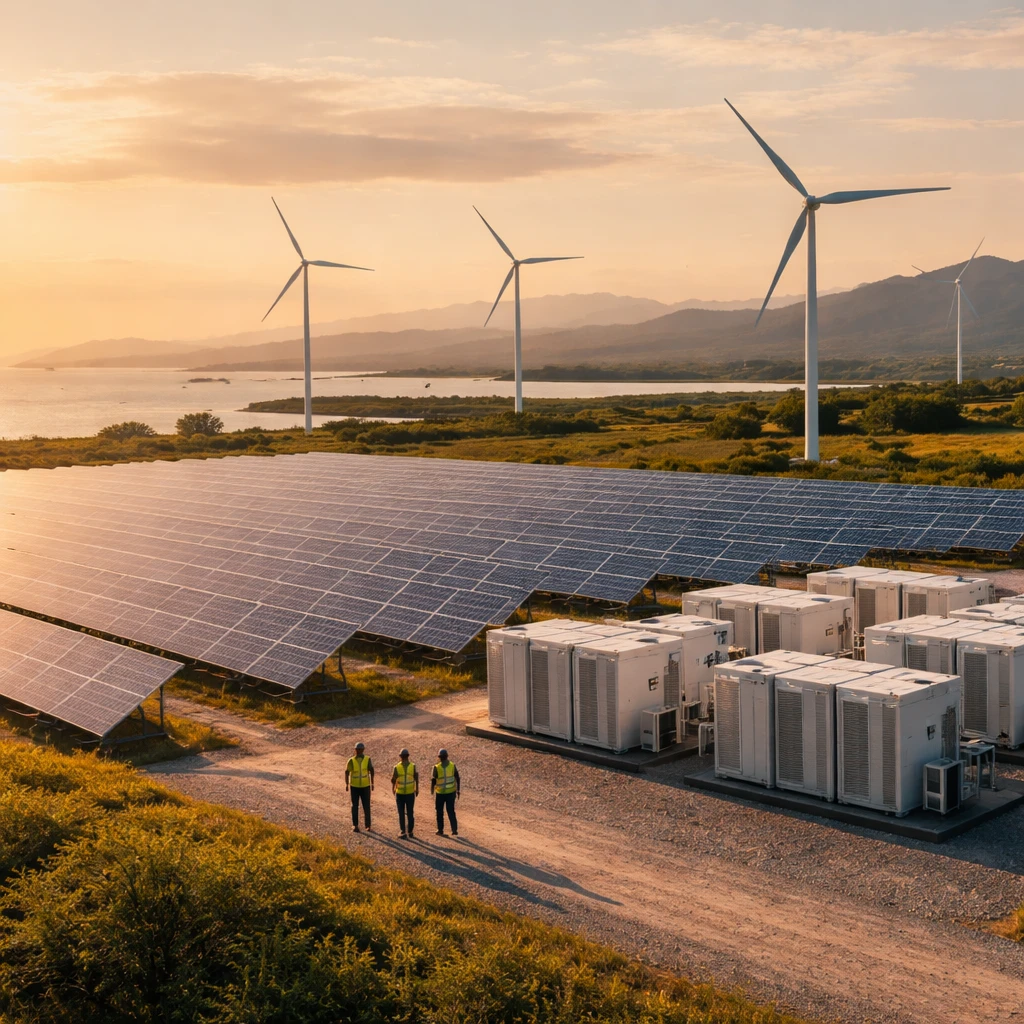
TotalEnergies and Abu Dhabi Future Energy Co., known as Masdar, announced the creation of a $2.2 billion joint venture that combines their onshore renewable operations across nine countries in Asia.
The Abu Dhabi-based company will serve as the exclusive platform through which both partners develop and operate onshore solar, wind and battery storage projects in selected markets, which explicitly include Azerbaijan, South Korea, Indonesia and Japan.
Each partner will hold an equal 50% stake in the joint venture. The two organizations said the new entity will bring together approximately 200 staff members from both companies. Specific management appointments for the venture will be announced at a later time.
The partnership’s initial portfolio comprises about 3 gigawatts of operational assets. In addition to those assets, the companies expect another 6 gigawatts to be operational by 2030, bringing the venture’s total expected capacity to roughly 9 gigawatts in the coming years. Both TotalEnergies and Masdar will contribute assets to the joint venture, and they stated that those contributions will be of comparable value.
Summary
The joint venture represents a pooling of onshore renewable assets and development capabilities between two equal partners, forming a dedicated vehicle focused on solar, wind and battery storage across multiple Asian markets. It is based in Abu Dhabi, will be staffed by around 200 employees transferred from the two firms, and has an operational base of 3 GW plus an expected 6 GW more by 2030.
Key points
- The joint venture is capitalized at $2.2 billion and will be headquartered in Abu Dhabi.
- It will be the exclusive platform for onshore solar, wind and battery storage projects across nine Asian countries, including Azerbaijan, South Korea, Indonesia and Japan.
- The portfolio includes 3 GW currently operational, with an additional 6 GW targeted to be online by 2030.
Risks and uncertainties
- Management leadership for the venture has not yet been named, leaving near-term governance and execution responsibilities to be clarified - this could affect operational momentum.
- Timelines for bringing an additional 6 GW online by 2030 are targets rather than guarantees; delivery depends on development and execution in multiple jurisdictions.
- Integration of approximately 200 staff members from two organizations poses operational and cultural integration challenges that could affect early-stage coordination.
Further details on management structure and the precise composition of contributed assets will be released by the partners at a later date. Until then, the venture stands as a 50-50 partnership between TotalEnergies and Masdar focused on scaling onshore renewable capacity across several Asian markets.