
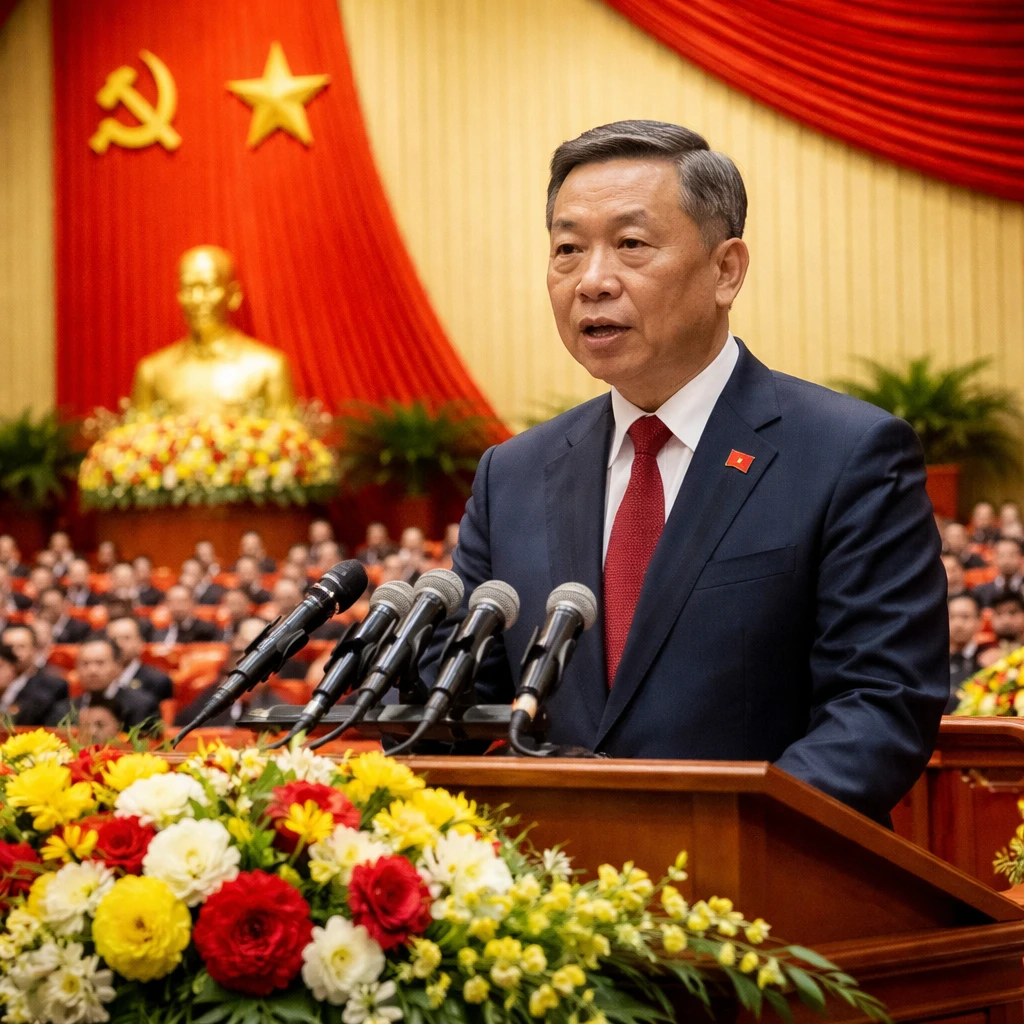
Vietnam's foremost political figure, To Lam, secured a unanimous vote from the newly established central committee to continue leading the ruling Communist Party for an additional five years. This decision took place at the conclusion of the party's quinquennial congress, an event where essential objectives and leadership appointments are determined. The vote, involving all 180 committee members, underscored broad internal support for Lam, who has positioned himself as a progressive reformer intent on propelling the export-driven economy forward.
Prior to his reappointment, Lam unequivocally pledged to deliver double-digit economic growth, signaling a sharp departure towards more ambitious national objectives. Addressing party delegates, Lam stressed the need for a governance framework rooted in "integrity, talent, courage, and competence," where officials’ performance is measured against concrete outcomes.
Since mid-2024, during his initial term in the country's top party position, Lam has overseen a period of rapid economic expansion driven by comprehensive reforms. These actions have elicited mixed reactions; while applauded for enhancing decision-making efficiency and reducing bureaucratic delays, the reforms have also led to significant civil service layoffs, sparking some backlash among affected groups.
Anticipating these tensions, Lam took proactive steps to consolidate backing from various influential factions within the party, including the powerful military segment. This strategic alliance-building was crucial, particularly given concerns regarding his approach to strengthening private conglomerates potentially at the expense of state-owned enterprises (SOEs). In response, Lam reaffirmed the prominent role of SOEs ahead of the congress, highlighting entities like Viettel, a major telecommunications and defense corporation under military control.
Experts note Lam’s methodical preparation for his leadership maneuvers. As the former Minister of Public Security, he adeptly navigated the political landscape to ascend to the party's pinnacle in 2024, especially during a period marked by health challenges faced by his predecessor, Nguyen Phu Trong.
In his recent address, Lam, now 68, committed to preserving party unity and indicated intentions to assume the national presidency, a decision expected imminently. His continued leadership is perceived as reassuring stability for foreign investors who prioritize predictable governance environments. However, some analysts caution that consolidating the top two positions may introduce risks to Vietnam’s traditionally collective leadership model, which has relied on internal checks and balances.
During the congress, Lam outlined an ambitious economic target: sustaining annual growth exceeding 10 percent throughout the coming decade. This goal notably surpasses the World Bank's forecast of approximately 6.5 percent growth for the current and following years. To achieve this, Lam envisions a fundamental shift from Vietnam's longstanding growth paradigm—based predominantly on low-cost labor and exports—to a model emphasizing innovation, efficiency, and higher value-added industries, setting the nation on a trajectory to reach high-middle-income status by 2030.
Alongside economic ambitions, Lam initiated the most significant overhaul of Vietnam’s public administration and government in decades, aiming to deepen the reform agenda despite concerns mounting about financial risks, contentious infrastructure projects, and potential favoritism within the system.